
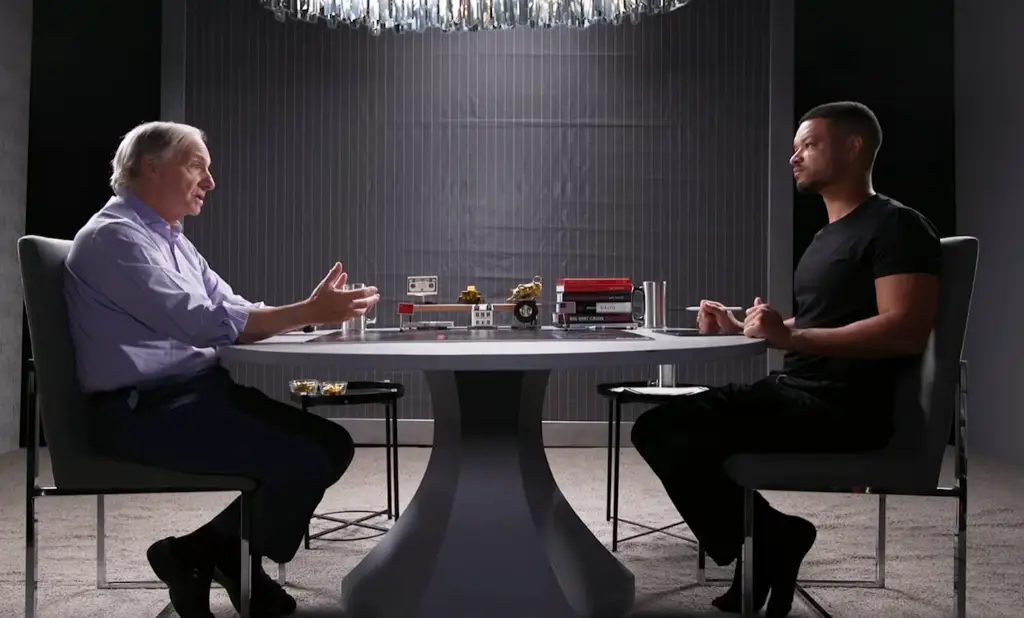
Bridgewater founder Ray Dalio said the current AI boom is showing classic signs of a bubble, arguing that the setup resembles past episodes in which revolutionary technology, leverage and rising valuations fed a broader economic downturn once the cycle turned.
According to a summary of his appearance on The Diary Of A CEO, Dalio said AI could deliver transformative change by replacing human physical labor and part of human reasoning. But he placed that excitement inside a wider macro picture that also includes geopolitical change, government funding strain and intensifying internal conflict. He said China has replaced the US as the largest trading partner for most countries, and warned that economic contraction tends to sharpen social confrontation.
Dalio says AI mania fits a familiar historical pattern
Asked directly whether the world is in an AI bubble that could contribute to economic collapse, Dalio said yes. He also agreed with investor Jeremy Grantham’s warning, comparing the current environment with 1929 and the 2000 dot-com bubble.
Dalio said bubbles form when investors treat a new technology as a miracle, borrow against rising asset values and stop paying attention to price. In his telling, paper wealth is not the same as money. Investors only get spendable cash when they sell. Once taxes change, interest rates rise or debt payments come due, the need for liquidity can puncture the boom.
He described the chain reaction in straightforward terms: prices fall, investors lose money, forced selling picks up, demand weakens, consumption slows, and the economy can slide into recession or even depression.
The host used a simple example. An investor buys $100 of an AI stock, then borrows $50 from a bank against that paper equity. If a shock such as war pushes the stock down to $25 while the debt remains $50, the investor has to sell quickly. Asset prices then fall across the board, consumers stop spending, and the bubble breaks. Dalio responded that the example was completely right.
He added that AI companies also face a supply-and-demand problem in equity markets and a deep uncertainty over future profits. A company may spend only $50 million and still carry a $1 billion valuation, creating billionaires on paper. But that valuation is still an accounting number. If market excess starts feeding inflation, central banks raise rates. That increases pressure on debtors to find cash. At the same time, strong demand for shares can lead to waves of new stock issuance. When debt costs exceed returns on equity, share supply rises and investors need liquidity, the bubble can break.
An 80-year “big cycle” of debt, politics and geopolitics
Dalio said the bubble discussion cannot be separated from what he calls a “big cycle,” which he described as lasting about 80 years on average. He placed the start of the last new cycle in 1945.
In his framework, several forces are moving at once: widening wealth inequality that fuels domestic political conflict, including left-right confrontation; large government fiscal deficits that leave states without enough money to pay their bills; and geopolitical change that raises the risk of conflict between countries.
Without that longer historical lens, he said, people see only daily headlines and miss the link between isolated events.
His advice to ordinary investors: diversify rather than hide in cash
When asked how a typical person should prepare for a possible economic downturn, including someone aged 30 with only $100 a month in disposable income, Dalio said the most important principle is diversification.
He argued that many people think cash is the safest place to be, but over the long run it can be one of the worst investments because inflation steadily erodes purchasing power. Even if a saver earns a short-term rate, he said the return still looks poor once annual inflation of 3.5% to 4% and taxes on that income are taken into account.
Dalio said a diversified portfolio should include stocks, gold, bonds and real estate. In his view, assets such as gold often perform well when stocks or bonds are under pressure, which helps lower risk without necessarily lowering returns.
For younger people with no financial assets, he said their main asset is themselves. The practical task is to build skills that can command better income, align work with personal passion where possible, and still keep the money question in view.
About 1% in Bitcoin, but physical gold remains his preference
On Bitcoin, Dalio said about 1% of his portfolio is allocated to the asset. He described Bitcoin as a hard currency that cannot be printed at will.
Even so, he said he personally prefers physical gold. He argued that gold cannot be cracked through technology, is the only financial asset that is not someone else’s liability, and remains the second-largest reserve currency held by central banks.
By contrast, he said digital currencies such as Bitcoin could face threats from quantum computing and from government monitoring and taxation. If governments do not want it, he said, they have the power to act. He also argued that central banks will not hold large amounts of Bitcoin because of concerns tied to transactional privacy and control.
AI, labor and the widening split between capital and workers
Dalio was also asked whether AI will create new jobs in the way past industrial shifts did. He said Silicon Valley tends to hold that view because it produces the technology and has made a lot of money from it.
He framed the process as another stage of evolution. The industrial revolution replaced human muscle with machines. AI, he said, is replacing human thought and reasoning at a higher level. The biggest beneficiaries in that transition are the capital owners with ideas who can use capital to replace labor.
According to Dalio, the share of corporate income going to workers is falling while the share going to owners is rising, which will widen wealth inequality even more. He said that once both the body and the mind can be replaced, the question becomes what humans still have left to sell. For the foreseeable future, he said, the people best positioned will be those who can bring exceptional human intelligence to their jobs and work in partnership with AI.
Wealth tax, Britain and the risk of capital flight
On the debate over taxing the rich through a wealth tax in places such as the UK and parts of the US, including New York and Los Angeles, Dalio said the idea is very difficult in practice.
His argument was that wealthy people would need to sell assets to raise cash for taxes, and that process itself could become one of the triggers that punctures a bubble. He also said a wealth tax could reduce investment, since wealth is often deployed as capital expenditure that creates productivity.
If wealth is merely transferred for consumption rather than used to raise overall productivity, he said society will run into trouble. Governments that try to force the issue may face capital flight. To stop that, they may change laws for retroactive taxation or impose severe capital controls.
Dalio described the UK as a classic negative example, saying it is caught in a cycle of excessive debt, low productivity and constant internal political conflict. The way out, he said, requires a strong political center, bipartisan cooperation, shared sacrifice and difficult reforms aimed at raising productivity for most people.
Changing world order, regional blocs and US weakness
Dalio also returned to his long-running theme of changing world order. He said this pattern has repeated over the past 500 years. Before World War I and World War II tied the globe into what he called “one world,” power was divided among regions and their dominant states. In a one-world system, major disagreements are usually settled through some form of conflict, cold or hot, and the final outcome is determined by power rather than by a so-called rules-based order.
Looking ahead, he said the most likely and beneficial result would be a more regionalized world. He said China, shaped deeply by Confucian thought, seeks competitiveness without being cut off from the world rather than occupation and control of other countries. If both China and the US remain strong and avoid a large destructive war, he said the world could evolve into separate blocs, including the Americas and a China-and-Asia-Pacific sphere.
Asked about the US and Iran, Dalio said the situation exposes American weakness. He said there is an international view, especially in Asia, that the US does not actually want war because the public worries about higher oil prices and casualties and wants quick outcomes. But a war that requires long-term occupation and control cannot be won that way.
He said Asian countries are starting to recognize that the US may retreat, which can turn American military bases in the region into liabilities. Dalio compared that shift to the decline of the British Empire, citing the Suez crisis as an example of power transition. In his view, the US no longer has the same economic and military weight it once had when a signal alone could compel other countries to comply. He said involvement in the Iran conflict was a huge mistake because it exposed that vulnerability to the world.