
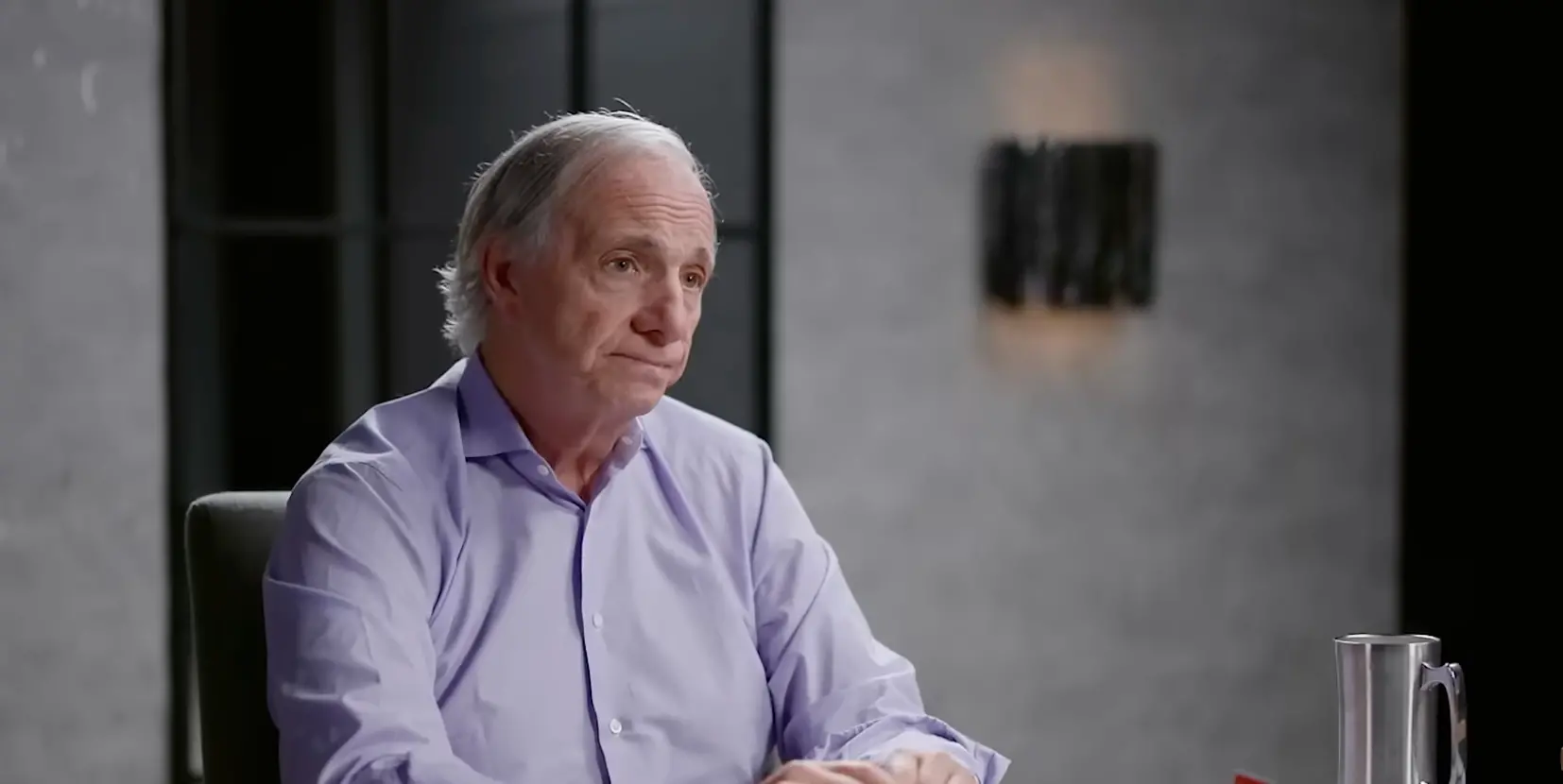
Bridgewater Associates founder Ray Dalio said in a recent appearance on The Diary Of A CEO that the AI trade is showing the same underlying pattern seen in earlier bubbles, while reiterating that gold, not Bitcoin, remains his preferred form of hard money.
In the interview, Dalio laid out his views on how speculative manias form, what tends to break them, how investors should position around them, and who is likely to benefit most as AI reshapes the economy. He also revisited his long-running view that major shifts in world order tend to unfold in cycles of roughly 80 years.
Dalio says AI enthusiasm is following a familiar bubble pattern
Dalio described a bubble as a period in which prices surge, companies appear to be thriving, and the eventual reversal spills over into the broader economy and financial markets. He cited the 1929 bubble and the dot-com boom in 2000 as historical examples.
His basic argument was that this tends to happen when a genuinely revolutionary technology arrives. During the internet boom, he said, the technology was real and exciting, so investors rushed in, often borrowing money to increase their exposure. What many failed to pay attention to was price. Valuations kept climbing, and the bubble was created in the process.
He said AI is now producing the same dynamic. Investors are right to be excited because AI is bringing real change, in his telling, but the recurring mistake is that people still ignore price while trying to gain exposure. For Dalio, that is the repeating mechanism that shows up across market cycles.
He added that in an economic bubble, people often take on large amounts of debt to invest. Wealth appears to expand quickly, but paper wealth is not the same thing as money that can be readily spent. Once holders need to sell assets to raise cash, those asset values come under pressure. If taxes change, interest rates rise, or debts have to be repaid, the process can start to unwind and the market can fall.
Dalio also said the wealth-building dynamic reverses once a bubble bursts. In the upswing, investors can borrow against assets whose values have risen, which reinforces the cycle. When prices turn lower, that same process works in reverse.
That is often when recession shows up as well. As investors deleverage, repay debt, and liquidate assets, consumption weakens and spending falls.
To illustrate the point, Dalio referenced the period before the Great Depression in the United States. In the late 1920s, new technologies and products were spreading into everyday life, including electrification, refrigerators, lighting, cars, airplanes and radios. People widely believed those innovations had enormous promise. At the same time, asset buying pushed stocks higher, leverage increased, and corporate profits eventually failed to justify the prices being paid. The chain reaction that followed led into the Depression.
He said the same uncertainty exists in major technological shifts today. Even people building in AI cannot map out future revenue with precision. Companies are left with two unattractive possibilities: invest too little and risk falling behind competitors, or invest aggressively without being able to control the returns and timing. That is where trouble begins.
Three signs Dalio says can puncture a bubble
Dalio said there is no single switch that ends a bubble, but he highlighted three broad warning signs.
The first is any shift that forces investors to sell assets in order to raise cash, with higher interest rates being the most common example. In the early stage of a downturn, he said, tighter financial conditions are often what pierce the bubble. A wealth tax could also have that effect, but his broader point was that liquidity starts to contract, often because central banks tighten policy in response to inflation. Once rates move higher, bond yields can become more attractive than returns on equities.
The second sign is a large increase in stock issuance. Dalio said markets are not only driven by demand. Supply matters too. Companies can issue shares to raise money, and in an exuberant market that can be one of the easiest ways to create paper wealth. A wave of new share supply and broader fundraising demand can help bring the bubble to an end.
The third signal is the nature of the investor base. Dalio said one common way to judge how stretched a market has become is to look at whether shares are held by committed investors or by weaker hands. He stressed that a bubble is not a black-and-white condition but a matter of degree.
In his description, weak hands usually mean a large influx of retail investors who lack deep expertise and are often using leverage. That can mean borrowing to buy stocks or buying leveraged financial products. He used leveraged ETFs tied to the stock market as an example and said participating in those products is, in essence, not far from rolling dice.
Those are the main conditions he said tend to show up before a bubble breaks. When the break finally comes, markets panic and large-scale liquidation follows. Seen from the other side, he said, that is also the moment when many assets become cheap enough for everyone to buy.
Still, Dalio warned that investors often rush to buy too early, trying to call the bottom before the dust settles, and that behavior can feed another bubble. His conclusion was that investors should not rely on market timing. Even experienced participants are not likely to identify the precise moment a bubble bursts. Diversification, in his view, is the better response.
Why Dalio favors diversification and starts with gold
Dalio said many ordinary investors treat cash deposits as the safest asset, but over long periods he sees cash as one of the worst investments because inflation erodes its value.
Beyond stocks, he said investors can choose from a much wider set of assets, including gold, bonds, real estate and Bitcoin. Each moves for different reasons, and those relationships often follow recognizable patterns. In his telling, gold often rises when bonds are falling and housing is losing value.
That is why he prefers a diversified portfolio. He argued that spreading exposure across multiple asset classes can cut risk without necessarily lowering returns. Diversification, he said, means owning a position in each type of asset and understanding how to balance them because volatility differs from one asset to another.
His advice was to begin with what he called real assets, and specifically with gold.
Dalio’s case for gold over Bitcoin
Gold, Dalio said, is interesting because it often performs well when other assets are doing poorly, which makes it an effective diversifier. He also described gold as an asset that cannot be technologically “cracked,” one that can be directly held and owned, and the only financial asset that is not someone else’s liability.
For that reason, he said most people who want some exposure to hard money should hold 5% to 15% of their portfolio in gold.
On Bitcoin, Dalio acknowledged that some investors see it as digital gold, but he said he still prefers actual gold bars. In his framing, Bitcoin is a gold-like asset and shares the characteristic of being a form of money that cannot simply be printed.
At the same time, he argued that technology could undermine it. He pointed to the possibility of quantum computing and said that if governments can monitor it, it could be taxed. He added that digital currencies more broadly face similar issues to some degree.
Dalio also said that when governments decide they do not need Bitcoin, they have the power to deal with it as they wish. He argued that central banks will not hold these kinds of assets in large amounts because they want privacy in their transactions and full control over how those transactions are handled. He referred to Russia’s situation as an illustration, saying other types of assets can be seized or frozen, while gold is much harder for outsiders to touch.
Who benefits most from the AI shift
Dalio’s view on the distributional effects of AI was blunt. He said only a very small share of people, less than 1% of the population, control frontier technology and can use it while helping accelerate its development.
For everyone else, especially people whose jobs depend on cognitive work, the risk of replacement is rising. In his words, the world is moving toward a stage in which almost everything can be automated.
He traced that process through a long arc of economic history. In the agricultural era, innovation was limited. Then machines arrived and replaced human physical labor. People once worked fields like oxen, he said, and were later replaced by tractors. After that came the industrial age. The printing press expanded access to knowledge, invention accelerated, the first industrial revolution took shape, and machines increasingly replaced physical work in factories.
For Dalio, AI is the next step in that progression. Machines first replaced the body, then moved up to parts of human thinking that can be computerized, and are now advancing toward higher-order reasoning. He described that as part of an ongoing evolutionary process.
The biggest winners, he said, will be capital owners — the people who can apply the idea of replacing workers with machines and turn it into business gains. Retail businesses may generate revenue from customers, but the share going to labor is falling while the share going to owners is rising. The result, in his view, is a period in which top-tier groups create enormous wealth while lower-tier groups face growing pressure.
That is one of the central challenges he sees today. He said the economy may look relatively healthy overall, but college graduates are finding it harder to get jobs. Entry-level roles used to require training, yet many of those tasks can now be completed more quickly through AI and computerized systems. As robotics improves, he expects that pressure to intensify.
Dalio also linked the speed of current disruption to the volume of capital flowing into frontier AI model companies such as Anthropic and OpenAI.
He said inequality is widening at the same time. Although he said he loves capitalism, he also argued that capitalism produces large differences in income and wealth. Once a worker’s mind and body are both replaceable, the question becomes what that person still has to sell.
He did not frame the outcome as entirely bleak. Humans still possess emotion and intuition, he said, and some services remain difficult for AI to provide. He floated the example of whether robots can deliver a good massage or spa service. For the foreseeable future, he said, people with exceptional human intelligence and the ability to work with others can still do very well.
Dalio says the next major point in the long cycle is near the present moment
Dalio also returned to his long-standing argument that shifts in world order tend to happen roughly every 80 years. He said that number should not be treated as a precise clock. It is more like an average range, just as human life expectancy varies from person to person.
Because of that, he said he does not focus too heavily on the exact duration of the cycle. What matters more is where the world is now in that process and, based on the symptoms and related indicators, where the next important turning point is likely to appear.
His answer was direct: that important point is near the time period the world is in right now.