
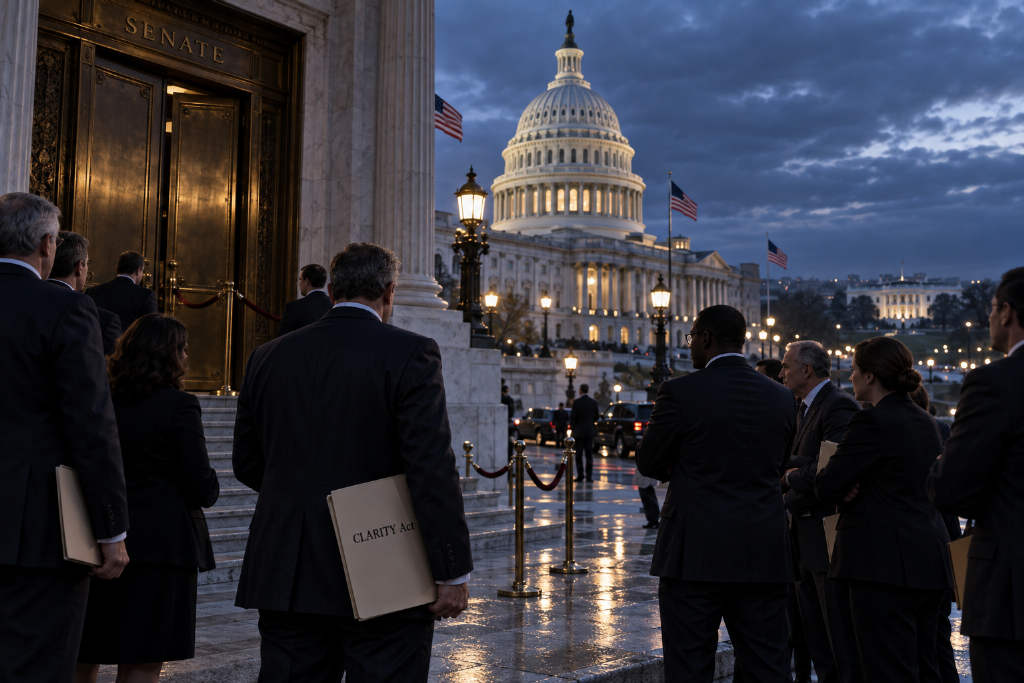
Republican senators say the Digital Asset Market Clarity Act is likely to run into trouble when the Senate returns next week, just days before a procedural vote that will help decide whether the crypto market structure bill gets any floor time this year.
Semafor reported Tuesday that Sen. Mike Rounds, R-S.D., said the bill "does not look good right now." The outlet also quoted Sen. Thom Tillis, R-N.C., as saying that if there is no interest from the White House in trying to bridge the gap on the ethics language, "it is going to fail."
Fight centers on conflict-of-interest language tied to Trump and his family
Democrats want the bill to include a conflict-of-interest provision covering President Donald Trump and his family. Two Democratic aides told Semafor that talks have barely moved.
Democrats have held that position for months. In the spring, Sen. Kirsten Gillibrand, D-N.Y., said there would be no votes without an ethics provision covering senior officials.
A White House spokesperson, quoted in the Semafor report, said Trump is unequivocal that Congress must pass the bill and said the administration has already agreed to "the most comprehensive and wide-ranging ethics provision in history."
Sept. 15 cloture vote is the next test
Majority Leader John Thune, R-S.D., filed cloture on the motion to proceed to H.R. 3633 on Aug. 8, before the chamber left for recess.
Under a unanimous consent order entered before the recess, that cloture motion ripens at 2:15 p.m. ET on Sept. 15. Invoking cloture requires 60 votes and would only open debate. It would not pass the bill.
Republicans cannot reach that threshold without Democratic support. If the vote fails, the bill would not be formally dead, but the Senate's 2026 calendar leaves very few session days between next week and the Nov. 3 midterms.
Lummis points to Democrats
Sen. Cynthia Lummis, R-Wyo., wrote on X on Tuesday that if the bill fails, "it won’t be because of ethics," but because Democrats did not join Republicans in backing what she described as a bipartisan bill that protected consumers, cemented America's leadership in digital assets, and empowered law enforcement to clamp down on illicit finance.
Lummis added that if those gaps can be bridged, she is confident Clarity can pass, but said that would require more compromise from Democrats, not the White House.
Bill cleared the House and Senate Banking Committee earlier this year
The House passed the bill 294-134 in July 2025. The Senate Banking Committee advanced it 15-9 in May.
The legislation then stalled over the summer as the banking lobby and crypto companies fought over stablecoin yield.
In July, Lummis released updated text that included an ethics section barring public officials and their spouses, including the president, from issuing or sponsoring digital assets for payment.
That ban would sunset in January 2029 and would be enforced by the attorney general.