
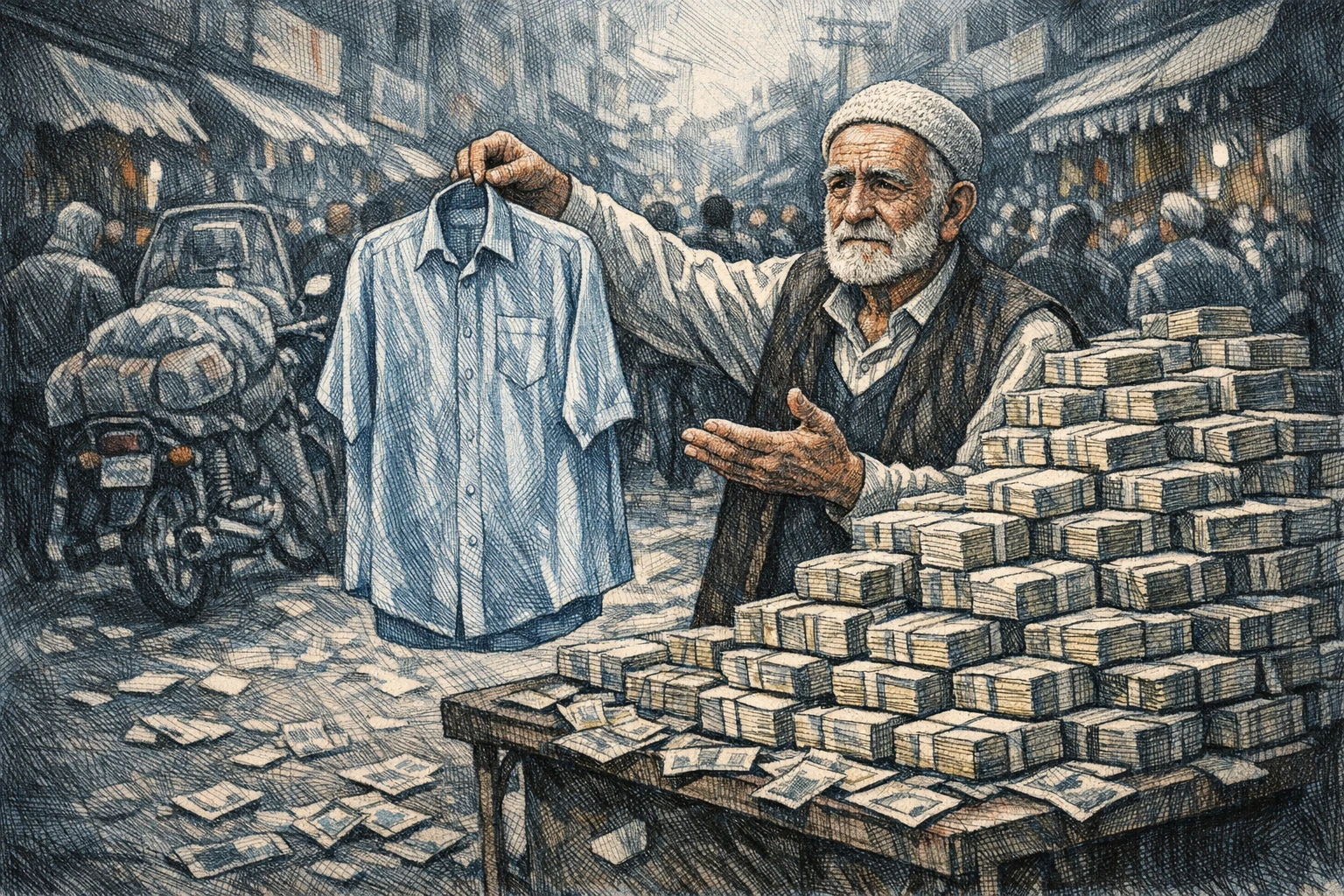
Iran’s currency breakdown is most visible in the exchange rate. According to the report, $200 could be exchanged for 160 million Iranian rials on the streets of Tehran, based on a black-market rate of roughly 800,000 rials per dollar. The official rate was still listed at 42,000 per dollar. That leaves a gap of nearly 20 times between the state rate and the market rate, making formal exchange channels largely detached from actual purchasing power.
The loss of value shows up in daily spending. The article describes 20 million rials buying only a basic short-sleeve shirt. Banknotes keep getting larger in denomination, while what they buy keeps shrinking. It also notes that on March 21, 2026, Iran’s central bank issued a new 10 million-rial note, worth about $5. Just one month earlier, a 5 million-rial note had been introduced. Within half a year, the highest denomination had doubled.
Mainstream payment rails are effectively cut off
The breakdown is not limited to inflation. The report says Iran’s domestic financial system does not connect with the international rails most travelers take for granted. Visa and Mastercard were unusable, while the global SWIFT network and Iran’s local Shetab system operated as separate worlds. No mobile connectivity. No easy cash withdrawal. A traveler could land and find basic payments impossible almost at once.
That isolation has created several informal layers of finance. The first is direct cash support through personal networks. In the account, two Chinese businesspeople handed over a combined 14.5 million rials in emergency cash, while repayment was made through Alipay and WeChat. A second layer came from Chinese-run restaurants, hotels, and convenience stores that served as small exchange hubs, offering about 700,000 rials per dollar. Outside that circle, the street market offered better pricing and deeper liquidity.
USDT appears in physical exchange shops
The most striking part of the report is the role of stablecoins in a sanctioned economy. The author describes seeing a large outdoor advertisement in Tehran for Nobitex, identified as an Iranian crypto exchange and presented as “Iran’s largest cryptocurrency platform.” In a country where international cards do not work and modern payment tools are restricted, local crypto infrastructure is visible in public view.
The report goes a step beyond advertising. It states that some exchange shops in Tehran were already willing to convert USDT into Iranian rials, charging a fee of about $30. These channels were described as limited rather than widespread, but they were functioning. For people trying to move or preserve value across borders, the appeal is obvious: stablecoins do not depend on SWIFT, and they do not require an offshore bank account. The transaction starts with a wallet address.
Cash, black markets, and crypto now coexist
The article also says that during visits to 11 countries in 2025, the author found that more than half showed some level of crypto support. In Iran, Georgia, Armenia, Egypt, and Dubai, Crypto ATMs or physical exchange stores were visible. Vietnam and Thailand were described as already supporting stablecoin payments by QR code or card. In the Iranian case, this places crypto less in a speculative frame and more inside an everyday payments and exchange reality.
From emergency cash between migrants, to ethnic business hubs, to street money changers, and then to USDT conversion, each layer serves the same purpose after formal finance stops working. The report’s central point is plain: when a country is shut out of international settlement systems, ordinary people do not stop transacting. They fall back on whatever network can still carry value.