
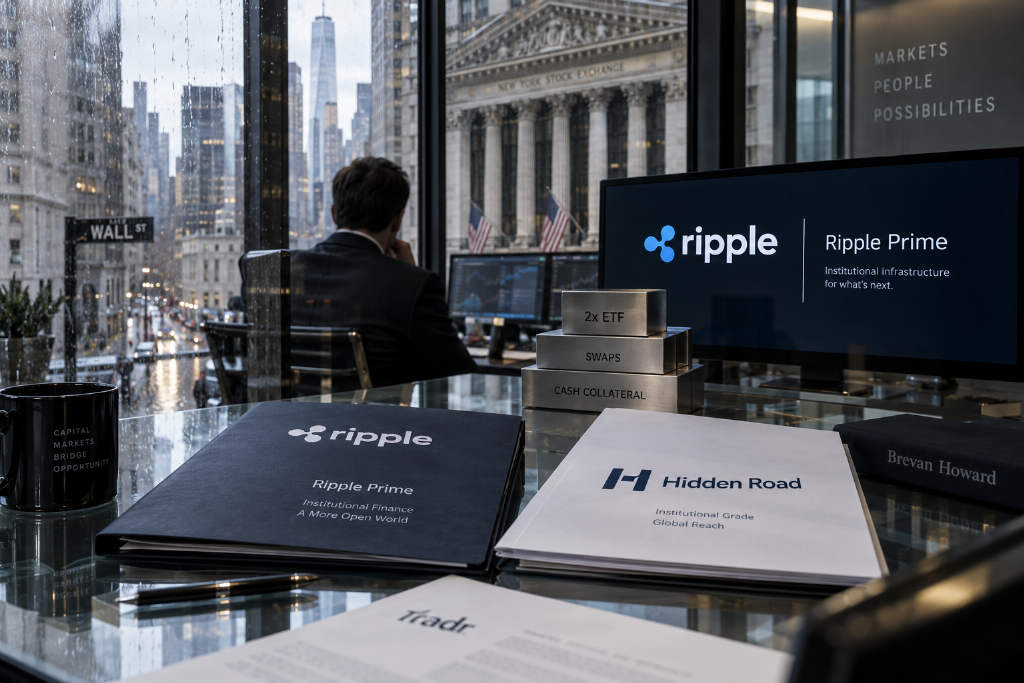
Ripple has pushed into a part of Wall Street that usually sits behind the scenes: financing leveraged stock ETFs. Investors may see the product on an exchange, but the leverage has to be funded somewhere, and Ripple is now stepping into that role.
CoinDesk, citing The Wall Street Journal, reported that Ripple Prime, Ripple’s institutional brokerage arm, has formally entered the leveraged equity ETF financing business. One example in the report was a Tradr 2x long SanDisk fund. That fund pays an overnight bank benchmark rate plus a 4 percentage point premium, which works out to roughly 8% annualized at current market levels.
In practice, retail traders pay for amplified exposure to a volatile stock, while the financing provider collects the spread in the background. That is the revenue stream Ripple is targeting.
Built on the Hidden Road acquisition
Ripple’s entry into the business comes through an acquired brokerage platform. In 2025, the company spent $1.25 billion to buy Hidden Road. After the transaction closed in October, it was renamed Ripple Prime. Through that business, funds can trade, clear and finance positions without lining up separate counterparties for each asset class.
The contracts behind these leveraged ETF structures are total return swaps. A broker provides the economic return tied to a stock’s price moves, the fund pays a financing fee, and the broker manages risk through positions such as holding the underlying shares. Retail traders buy the ETF. The broker sells the leverage.
The more money that flows into stock themes, the more financing those funds need, and the more room there is for Ripple Prime to charge for that service.
Ripple had already launched swaps tied to U.S. stocks, indexes and digital assets on Aug. 27 this year. On Oct. 6, hedge fund manager Brevan Howard expanded its relationship with Ripple and adopted its cross-asset brokerage, clearing and financing services. The latest report adds named clients and pricing details, showing that the licenses, team and institutional relationships acquired with Hidden Road are now producing business.
The income goes to Ripple Prime, not directly to XRP holders
XRP has not shown a strong market response to the development. At the time of publication on Oct. 8, XRP was around $1.41, down about 3.8% over 24 hours and about 6.5% over the past seven days. It closed near $1.49 on Sept. 30 and around $1.42 on Oct. 7. The report also did not appear to trigger a clear run-up beforehand.
Under the arrangements disclosed so far, the financing income is collected by Ripple Prime. Holding XRP does not entitle investors to any share of that interest income, and the business announcement did not outline any plan to use the proceeds for XRP buybacks. New clients first expand Ripple’s corporate business, not tokenholder cash flow.
When Ripple announced the Hidden Road acquisition, it also described how the brokerage could connect to its broader product stack. The plan included using the dollar stablecoin RLUSD as collateral and moving some post-trade processing onto the XRP Ledger. Funds could manage collateral with a stablecoin, while the broker could use the ledger to reduce settlement and operational costs.
For XRP itself, the more direct link is whether institutions actually hold and trade the token. Ripple Prime already offers OTC spot trading in XRP, and institutions can manage spot holdings alongside other digital asset positions for margin purposes. If new clients increase XRP allocations through those services, that would reach the token market more directly.
Ledger usage creates demand, but on a small scale
If clients only use the XRP Ledger, the resulting XRP demand is much smaller. The standard base fee for a regular transaction is 0.00001 XRP, and that amount is burned. A new account currently has to reserve 1 XRP. At the standard base fee, 1 million regular transactions would burn 10 XRP.
That low cost may help institutional adoption. It also shows why a large stock-financing business cannot be translated mechanically into large XRP consumption.
Ripple Prime also has its own funding costs
Even if Ripple Prime charges funds about 8% for financing, that does not mean the full amount drops to profit. Company disclosures show Ripple Prime has more than $1 billion in regulatory net capital. In August, it issued $275 million of senior unsecured notes, and it had previously secured $200 million in debt financing.
The fees paid by clients still have to cover funding costs, hedging costs and operating expenses. Only what remains after those items would count as profit, so the eventual earnings impact of the business shift is still unclear.
No change to XRP supply mechanics
The stock-financing business does not alter XRP’s supply structure. About 63.093 billion XRP are currently in circulation. A June 30 snapshot on Ripple’s website showed roughly 32.6 billion XRP still held in escrow. Those escrowed tokens are released monthly, and unused portions are placed back into later schedules.
No part of the newly disclosed financing business requires additional XRP to be locked.
Based on what has been disclosed, anyone buying XRP on this news is effectively betting that Ripple’s new institutional clients will eventually become XRP users as well. What they are not buying is a claim on the financing interest paid by leveraged U.S. equity funds such as the SanDisk product, and this is not a direct buyback model tied to Ripple’s new Wall Street revenue.