


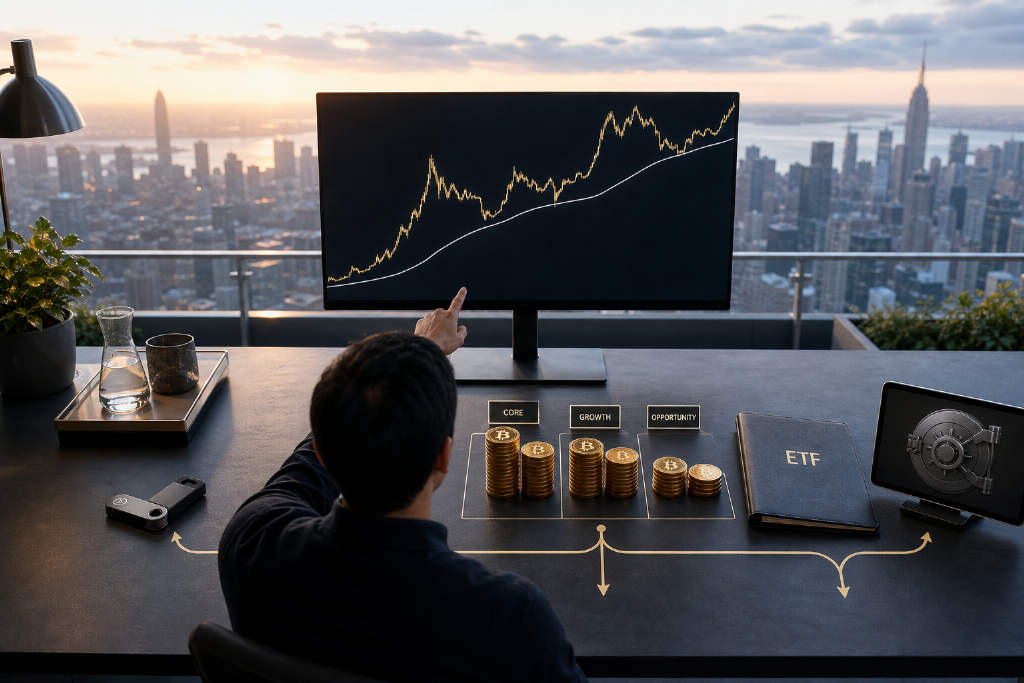
Crypto analyst Rob said Bitcoin’s move back above its 200-week moving average should be viewed less as a signal to chase an exact bottom and more as a solid area for dollar-cost averaging, according to a recent interview on The Milk Road Show that was later compiled by PANews.
Rob, who hosts the YouTube channel Digital Asset News and closely follows crypto, macro trends and market structure, used the interview to explain how he buys Bitcoin during deep drawdowns, how he scales out in bull markets, and why recent wallet incidents have made him more cautious about relying on any single custody method.
Rob says Bitcoin near the 200-week average still looks attractive for long-term accumulation
The interview opened with Bitcoin’s return above the 200-week moving average, a level often treated as a major bear-market floor. The host noted that past bear markets have sometimes spent a long time chopping around that line, and asked whether the market had already bottomed or whether more pain could still be ahead.
Rob said he actually hopes the market has not bottomed yet. In his view, the area around the 200-week moving average has repeatedly offered one of the best long-term entries in Bitcoin’s history.
He pointed back to 2015, when Bitcoin was still widely viewed as a fringe bet and briefly dipped below the 200-week line before recovering quickly. He then cited 2018, after the 2017 peak, when Bitcoin also broke below that level and sentiment turned deeply negative. Rather than treating that period as a reason to give up, he said the better response was to keep accumulating through dollar-cost averaging.
He described the 2020 COVID-driven panic as another case in which Bitcoin fell below the 200-week average and presented what he called a very cheap buying opportunity. In 2022, he added, Bitcoin did not stop at the 200-week line and fell through the 250-week and 300-week moving averages as well.
Now that Bitcoin is once again trading around the same broad zone and sitting slightly above the 200-week average, Rob said he still sees it as a very good DCA window.
He also revisited what he called one of his mistakes in 2022. Instead of sticking to his standard plan, he reduced the size of his weekly purchases because he was worried prices would keep falling and wanted to save capital for a cleaner bottom. He referred to that decision as “micro DCA.” Looking back, he said his position would be stronger today if he had simply maintained regular purchases and increased them as prices fell.
Rob said buying Bitcoin at $15,000, $16,000 or $17,000 in 2022, or buying around $3,000 in 2018, turned out to be smart. That is why, when asked whether the market has bottomed, his answer was that he hopes it has not, because this range may still prove to be a compelling accumulation zone.
A rules-based buying plan tied to risk levels
Rob said his well-known routine of buying Bitcoin every Monday is not fixed in size. He combines it with a risk model that tells him when to increase exposure.
His framework starts with regular buying when the risk reading is between 0.5 and 0.6. If the level drops below 0.49, he doubles the amount he bought the previous Monday. If it falls to 0.39 by the next Monday, he raises the purchase to 4x. If the market keeps sliding and the reading breaks below 0.29, he moves to 8x.
He said the approach sounds simple when the market first enters those zones, but the emotional test gets harder as the drawdown deepens and the dollar amount rises. Even so, he tries to remove discretion from the process. His purchases are automated through Cash App and execute every Monday at 6:30 a.m.
Rob said he uses Cash App because recurring buys there carry very low fees, to the point of being close to negligible, and because the spread is relatively good. He said he believes the execution is likely tied to OTC-style routing.
The basic principle, he said, is straightforward: the lower Bitcoin goes, the more aggressively he buys. He does not want to spend energy trying to call the exact low. What matters to him is the odds that buying in this range will look favorable over a long enough horizon.
Asked where he sits under that model right now, Rob said he was not staring at live data during the recording, but estimated the risk reading at around 0.3. That puts him in the 4x buying phase. If the reading drops further, he said, he would shift to 8x purchases.
He added that banks used to call him to confirm some of the larger transactions triggered by that system. Those calls have largely stopped because the pattern has become familiar, though he noted the amounts involved are still meaningful.
Scaling out in bull markets instead of trying to sell the top
On the sell side, Rob said he handled profit-taking better during the 2021 bull market. His method then was to set explicit price targets and sell in tranches.
He said he relied on fractals, comparing the current cycle’s move with gains seen in the previous cycle. Under that structure, if Bitcoin rose 2x from the cycle bottom, he would sell a small portion. If it rose 4x, he would sell another portion, and so on.
By 2025, however, he tried to get more sophisticated and leaned on technical tools such as the MVRV score and the Puell Multiple. He said those indicators did not hold up the way he expected.
He contrasted that with a Reddit user who had posted three years earlier and argued, based only on the four-year cycle framework, that Oct. 6, 2025 would mark the exact top of that cycle. Rob said he did not believe it at the time, but the date ended up matching the high.
He said he did not sell the exact top, but he did take profit in stages as prices rolled over. No one, in his view, consistently buys the bottom and sells the top. He plans to stick with gradual profit-taking in the next four-year cycle as well.
Rob also pushed back on the idea that Bitcoin should never be sold. Personal goals differ, he said, and for him there is value in using some gains to reduce debt and improve financial stability. While he described Bitcoin as the best monetary issuance mechanism, he said moving part of those gains into assets he considers steadier, such as the S&P 500, bonds or real estate, helps him sleep better. He added that most of his assets still remain in Bitcoin rather than altcoins.
Near-term breakout looks unlikely, with regulation and institutional custody in focus
The host noted that Bitcoin’s volatility had fallen to historic lows over recent weeks and months, at times looking calmer than both gold and U.S. equities. With the market stuck in a narrow range for two to three months, the question was what could bring volatility back.
Rob said that is difficult to forecast because every bullish narrative seems to arrive next to fresh negatives and fresh FUD. He mentioned the possibility of an AI bubble breaking and the risk of large-scale hacks tied to certain cold-wallet devices as examples of forces that could interrupt any rally.
On the positive side, he said he had hoped the Clarity Act would pass and provide momentum, but that did not happen. He framed the failure as part of election-year politics, saying Democrats were not inclined to hand Donald Trump a political win that he could use as a victory lap.
Rob also said Wall Street institutions are moving in faster. As one example, he pointed to Citigroup, which he described as the world’s third-largest bank, and said it plans to launch a custody product called Custody+ later this year to meet around-the-clock demand, with Bitcoin custody as the initial offering.
He added that some presidential candidates are now openly campaigning as crypto-friendly, though he suggested that may overlap with interests tied to projects such as World Liberty Financial.
Even so, Rob said he does not expect a major breakout in the short term. He believes the U.S. Securities and Exchange Commission and the Commodity Futures Trading Commission will step in with rules and adjustments where Congress has stalled. Those changes may help at the margin, but he said he still does not expect a “super move” before the end of the year. In his view, the market has not escaped the pull of the four-year cycle, and a more decisive upside phase may need to wait until the current range is left behind and investor psychology shifts.
Trump’s White House meeting looks political to Rob
The host then turned to politics more directly, noting that the Clarity Act had been delayed to September rather than killed and that Trump was meeting crypto industry leaders at the White House on the day the podcast was recorded. The question was whether that meeting could produce signals that truly matter for markets.
Rob said he would like to see substantive progress, but he also pointed to the overlap with Trump-linked business interests. He said World Liberty Financial had just received a provisional national trust bank charter from the Office of the Comptroller of the Currency and was trying to enter the stablecoin market.
Rob said the project’s stablecoin is roughly ranked fifth globally, and he argued that an expansion in that business could help reinforce the U.S. dollar’s global role. For that reason, he said Trump has strong incentives to support it because it benefits a family-linked project.
Still, Rob said ordinary investors have limited control over any of this. They cannot decide whether a sitting or future U.S. president launches a crypto business venture. If meetings at the White House genuinely help move legislation forward, that would be positive, he said. But in his reading, the event still looked largely like political theater.
Rob welcomes SEC and CFTC involvement, but questions the value of flooding the market with more tokens
The discussion then moved to what the host described as a newly approved SEC crypto regulatory framework covering digital asset operations in the U.S., including ICOs, fundraising and an “innovation exemption” for projects still building their networks.
Rob said that, when it comes to ICO rules, government action is five to six years late. If these guardrails had existed back in 2017, when ICO activity was exploding and the market was expanding with little discipline, he said he would have welcomed them.
He said his reading of the rules is that over a four-year period, offerings below $5 million face relatively few constraints and the cap can go as high as $75 million. If those policies are implemented, he said, significant capital could flow into the crypto sector.
His concern is what that capital would fund. He asked whether the market really needs even more new crypto projects, more altcoins and more DeFi startups when the sector is already crowded with pitches for the next token or the next great DeFi feature.
When the host said there are at least millions of altcoins depending on how one counts them, Rob agreed. His own preference is to focus on larger altcoins that have already been tested by the market and proven durable, then build on top of those. If people want a final settlement layer, he added, Bitcoin can still fill that role.
So while he sees the SEC and CFTC as capable of providing constructive regulatory intervention, he does not think that alone becomes the catalyst that flips the entire market.
Wallet incidents have changed how he thinks about self-custody
The second half of the interview focused on security. The host referenced a string of issues involving Coldcard, Trezor and, more recently, SafePal, and asked whether repeated incidents were undermining confidence in self-custody.
Rob said some people see the timing as suspicious because major traditional finance players such as Citigroup are entering Bitcoin custody at the same time that more third-party custodians are appearing. Others think the overlap is just coincidence. Whatever the explanation, he said, the simple fact is that many people have lost life-changing sums in these incidents.
That is why he no longer thinks it makes sense to tell everyone, without qualification, that self-custody is the only future of finance. In his view, it is not suitable for everybody.
He pointed to PlanB, who said on X a few years ago that he intended to move all of his assets into ETFs. Rob said that comment mattered because it came from a veteran who understands self-custody and its technical risks, yet still decided that handing off some of that burden was worth it.
He contrasted that with Simon Dixon, who has argued that the recent wave of wallet security crises amounts to a coordinated narrative campaign designed to scare ordinary users out of self-custody and push them back toward institutional custodians.
Rob said he is not fully aligned with either camp, but the stream of messages he gets from followers has left a deep impression. Every week or two, he said, someone writes to him saying they have lost their life savings. In the past, those cases were often linked to user mistakes such as phishing. Now, he said, the problem has widened. In some cases, the defenses or corporate databases of wallet providers have been breached, exposing home addresses, email accounts and phone numbers and creating serious offline risks for both people and property.
He said he is now uneasy not just about user error, but about the ability to fully trust the underlying technology and code in hardware wallets. One of his fears is that a mainstream wallet maker could one day admit that an AI system uncovered an old vulnerability buried in the codebase, only after thousands of users had already lost Bitcoin.
He acknowledged that some listeners would call that FUD. But he also argued that people hurt in incidents tied to Coldcard would probably not dismiss those warnings so easily in hindsight.
His response has been to diversify custody. He said he keeps part of his funds on Ledger, a meaningful portion on Tangem, uses iTrust Capital as a custodial option, and also allocates some capital to ETFs.
A $3.2 million theft helped shape his custody approach
Rob said the logic behind that setup was shaped in part by an interview he conducted with former Los Angeles Raiders star Steve Wisniewski, a future Hall of Fame member who had put more than $3.2 million into Bitcoin and then lost it all in a carefully designed phishing attack.
Wisniewski walked through the incident in detail on Rob’s show. Rob said the conversation hit him hard because it drove home the fact that even highly capable people can get caught. If that can happen to someone like Wisniewski, he said, it can happen to almost anyone.
Sometimes the risk is not obvious. A person may have printed a seed phrase five years ago, hidden it somewhere, forgotten about it, and still find that information exposed through some unknown path. Rob said the messages he receives after losses often include desperate questions about who to call, how to explain the event to a spouse, or how to pay a child’s college tuition.
His answer is painful but direct: in self-custody, once the assets are gone, there may be no one who can bring them back. Victims can file a police report, contact the FBI, or even reach out to on-chain investigator ZachXBT, he said, but in most cases the money is likely gone for good.
Losing 25% of a portfolio hurts, Rob said, but losing 100% is devastating. He would rather help people avoid total ruin than encourage them to move everything into self-custody without any safety net.
Altcoin exposure stays concentrated around what he calls the “BEST” basket
Even though most of Rob’s attention remains on Bitcoin, he said altcoins still have a place in his portfolio. He approaches that segment through utility rather than breadth.
He said stablecoins are likely to play a bigger role over time and could reinforce the dollar’s global dominance. To evaluate that trend, he looks at data from a Visa-owned on-chain analytics platform that tracks stablecoin activity across major blockchains carrying assets such as Tether and Circle. According to Rob, the same four chains consistently come out on top.
He groups the related tokens into what he calls the “BEST” basket: Binance Coin (BNB), Ethereum (ETH), Solana (SOL) and Tron (TRX). In his view, those are the four major leaders in the altcoin market.
He said there are other respectable projects, including Polygon, but his capital is limited and he has no interest in spraying money across every narrative. He also stressed that even very large stablecoin payment flows do not directly determine token price performance. Payments are only part of the fundamental picture. Speculation, he said, still drives a large share of token pricing.
Watching Canton and Hyperliquid, but not changing core allocations yet
Asked whether he would move beyond that BEST basket into smaller-cap names, Rob said he stays flexible and is willing to adapt if market conditions change.
He mentioned Canton as one chain he watches in the tokenized real-world asset space. Referring to rwa.xyz, he said chain-level breakdowns show Canton with a large market share there. He also said he has been watching activity and trading volume on Hyperliquid and described the figures as striking.
Still, each time he reviews newer projects, he asks whether they justify breaking from his current, more conservative portfolio structure and taking on more risk through broader diversification. For now, his answer is no, and his altcoin exposure remains tight.
Rob closed that part of the discussion with a blunt summary of how he sees crypto market behavior. If traditional finance, including U.S. equities, merely sneezes, he said, Bitcoin catches a cold. And when Bitcoin catches a cold, altcoins end up in the ICU on a ventilator. In his view, that pattern remains one of the most persistent rules in the market.