
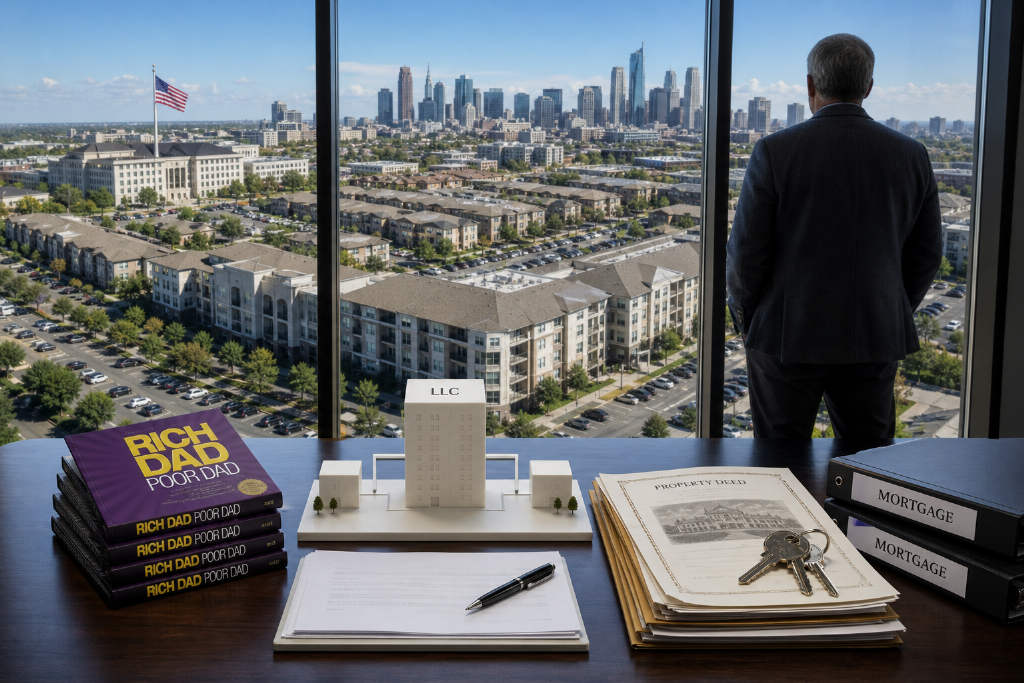
Robert Kiyosaki, author of Rich Dad, Poor Dad, said on a podcast that he "owes $1.2 billion," drawing renewed attention in U.S. financial circles to both the size of the debt and the investment logic behind it. According to the New York Post, the comment has opened a wider debate over how much of that figure is actually his personal liability and how his leverage-based strategy works in practice.
Kiyosaki, 79, built his public profile on teaching personal finance and wealth-building, and his books have sold more than 44 million copies. The latest discussion centers on his repeated claim that he carries $1.2 billion in debt and his framing of that structure as a method used by wealthy investors.
What the $1.2 billion figure refers to
Kim Kiyosaki, Robert Kiyosaki’s former wife and business partner, said the public has misunderstood the number. She told media outlets that she, Kiyosaki and their partners jointly own about 1,500 apartment units, and that the $1.2 billion figure represents the total loans attached to those real estate holdings rather than debt borne by Kiyosaki alone.
She said his personal share is much smaller. The report added that outside estimates, based on annual income of about $3 million, place his actual personal debt burden at roughly $30 million to $60 million.
Kim Kiyosaki also said the large number was used to grab public attention first, then to explain why Robert Kiyosaki views investment debt as "good debt."
How the strategy works
According to the report, Kiyosaki’s approach is to borrow against rising equity after a property appreciates, then use the proceeds as what he describes as tax-free income. Because the underlying asset is not sold, that cash generally does not trigger income tax.
He also places each investment in a separate limited liability company, or LLC, creating a legal barrier between assets. Under that structure, if one investment runs into trouble, the others are not automatically pulled down with it.
Kiyosaki was quoted as saying: "If it all goes bad, go talk to my lawyer. Firewall — that’s how rich people play."
Experts split on the risk
Financial professionals cited in the report took sharply different views. David A. Perez, a registered tax preparer, said borrowing against real estate equity is a standard and effective tax strategy, and that carrying large amounts of debt backed by property is "actually normal," even though it can weigh on monthly cash flow.
John Poole, founder of advisory firm JPTD Partners, offered a much harsher warning. He said leverage looks attractive when markets keep rising, but once that trend stops, "financially it’s like a chainsaw cutting downward."
Poole said a model built on repeated borrowing against appreciating assets will eventually face a reckoning. He added: "He can call it ‘Rich Dad debt,’ but for ordinary investors, it could quickly turn into ‘Poor Dad bankruptcy.’"