
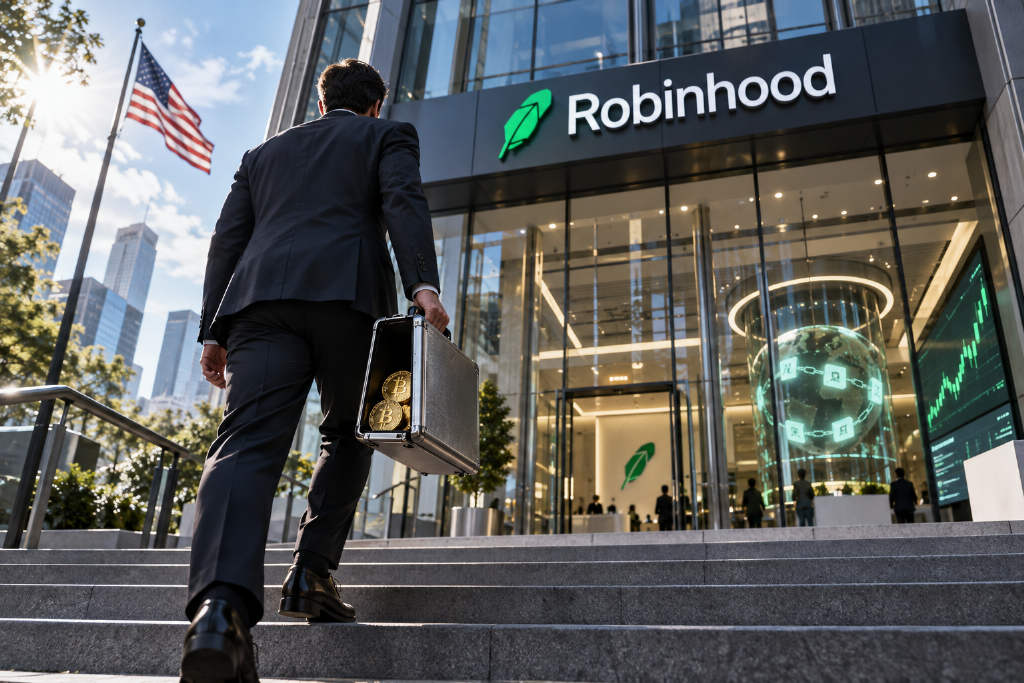
Robinhood has added $25 million worth of Bitcoin to its balance sheet, with crypto vice president Johann Kerbrat saying the purchase was intended as a statement of commitment to the Bitcoin ecosystem.
In an exclusive interview on The Block’s "The Starting Block," Kerbrat said the company bought the Bitcoin to show the crypto community that Robinhood takes the sector seriously. He said, "We care deeply about Bitcoin and its ecosystem. This aligns the company’s vision with the values of the crypto community."
Measured against Robinhood’s roughly $100 billion market capitalization, the $25 million position is small. Kerbrat acknowledged that directly, saying, "This amount will not change the company’s current trajectory." Even so, the move puts Robinhood into the group of listed companies that hold Bitcoin on their balance sheets, a symbolic step for a platform that started with zero-commission U.S. stock trading and is now treating crypto as a core business line rather than an add-on.
Three crypto fronts are moving at once
The Bitcoin purchase is only one piece of Robinhood’s broader crypto expansion. Over the past few months, the company has been advancing on three fronts: perpetual futures, Robinhood Chain, and tokenized stocks.
Robinhood has 28 million funded accounts in total, including 27 million in the United States and 1 million overseas.
Perpetual futures are nearing launch
Robinhood CEO Vlad Tenev recently said on X that compliant U.S. users will be able within months to trade perpetual futures on BTC, ETH, SOL, XRP, DOGE, ADA, LINK, and HYPE. The contracts will support both long and short positions, have no expiry date, and settle profit and loss every 15 minutes.
Tenev described the rollout as "a new chapter for U.S. derivatives." It would also mark Robinhood’s first leveraged product of the kind commonly offered by crypto exchanges.
Robinhood Chain has crossed $1.05 billion in TVL
Robinhood Chain is a Layer 2 built on the Arbitrum technology stack. Its mainnet went live in July this year, and total value locked has reached $1.05 billion.
Kerbrat said, "This is the first time an L2 has connected to a distribution channel this large. Robinhood Wallet is now available in more than 120 countries."
That scale matters for Robinhood’s chain strategy. The company is trying to use its large funded-account base to drive on-chain activity and TVL.
Tokenized stocks trade around the clock
Robinhood is also offering compliant users the ability to trade tokenized U.S. stocks directly on Robinhood Chain, extending access beyond traditional market hours.
Kerbrat said the U.S. Securities and Exchange Commission’s innovation exemption framework places limits on both trading volume for tokenized U.S. stocks and the types of assets that can be tokenized. He said, "We are still figuring out all the parameters. Looking only at our tokenized stock trading volume, it is already quite high, and we will hit some limits soon."
A balance-sheet signal more than a treasury overhaul
The timing of Robinhood’s Bitcoin purchase fits into a broader pattern of public companies adding Bitcoin to their balance sheets. Strategy, formerly MicroStrategy, disclosed in early October that it had purchased another 334 BTC for about $28.7 million at an average price of $85,838.80 per coin, taking total holdings to 848,000 BTC. In Japan, Metaplanet sold 10,000 BTC in September and quickly bought back 11,000 BTC, with the stated aim of proving liquidity to rating agencies.
Against that backdrop, Robinhood’s $25 million Bitcoin position looks more like a signal than a major treasury allocation. The report noted that for a technology company with a market value of about $100 billion, the holding accounts for less than 0.03% of assets.
Still, the message is clear in the context of Robinhood’s business shift over the past five years. The company has moved from a zero-commission stock-trading startup toward a broader lineup that now includes crypto trading, on-chain infrastructure, tokenized stocks, and perpetual futures. The Bitcoin holding is one of the most direct ways for Robinhood to show investors that it takes this ecosystem seriously.
Regulatory limits remain the main variable
The biggest uncertainty around Robinhood’s crypto push is regulation, not market demand.
On tokenized stocks, the SEC’s innovation exemption was designed to give projects room to operate within a compliant framework. But if volume caps are reached, one of Robinhood Chain’s most visible features — 24/7 trading in tokenized U.S. equities — could be forced to slow down.
On perpetual futures, the challenge is different. Perps are a core product on exchanges such as Binance and Bybit, but the U.S. regulatory stance on leveraged crypto derivatives remains unclear. Whether Robinhood can establish a workable compliant path is still an open question.
Kerbrat said in the interview, "This may be the first time an L2 has connected to a distribution network this large." Behind that comment is Robinhood’s effort to use its 28 million funded accounts to pull traditional brokerage users onto on-chain rails. Whether perpetual futures and tokenized stocks can scale at the same time may depend on how far regulators are willing to let those products run.