
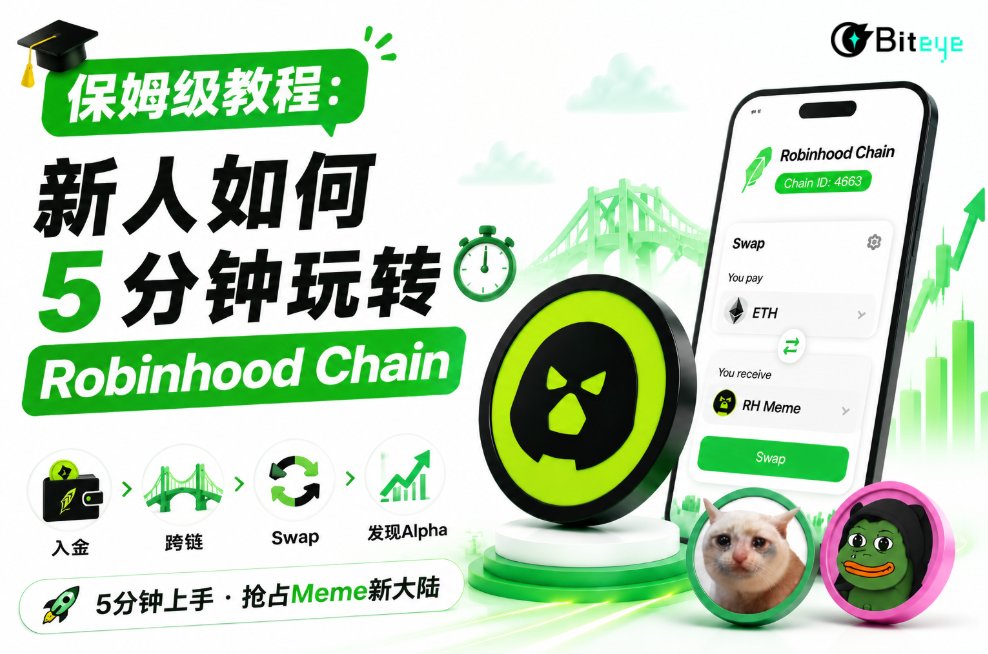
Robinhood Chain is still in its early stage, but activity around the network’s meme ecosystem is picking up. In a beginner tutorial published by TechFlowPost and attributed to Biteye, the outlet said more capital has been moving into Robinhood Chain in recent days, from $CASHCAT to a broader batch of RH meme tokens.
The article also said established market participants such as 0xsun have returned to the meme sector and shared their observations on Robinhood Chain. For first-time users, the tutorial focuses on three things: how to bridge funds in, how to complete a first swap, and which parts of the ecosystem are worth tracking.
How the guide says users can get started
Adding the Robinhood Chain network
According to the tutorial, major Web3 wallets including OKX Wallet and Binance Web3 Wallet already have built-in support for Robinhood Chain, allowing users to select the network directly from the network list. For wallets such as MetaMask, connecting to dApps like Uniswap will usually trigger a prompt to add the network automatically.
For manual setup, the guide lists:
- Chain ID: 4663
- Currency symbol: ETH
Once the network is selected, ETH should appear as the gas token. A zero balance at that stage is normal because no assets have been bridged in yet.
Moving ETH from an exchange to a wallet
The tutorial says most exchanges do not yet support direct withdrawals to Robinhood Chain. As a result, it recommends a three-step route: exchange, then wallet, then bridge. Using Binance as an example, it tells users to buy spot ETH, withdraw it to a Web3 wallet address, and double-check the destination address before sending funds.
It also stresses that the withdrawal network must match the bridge route a user plans to take afterward. If the official bridge is used, Ethereum (ERC20) is the typical choice. If a third-party bridge is used, networks such as Arbitrum or Base may be available depending on what that bridge supports.
The article adds a basic warning for newcomers: assets sitting inside an exchange account are not yet in a self-custodied on-chain wallet and cannot be used directly on Uniswap. It also says choosing the wrong withdrawal network is one of the most common mistakes for new users, and suggests making a small test transfer first.
Bridging ETH to Robinhood Chain
The guide describes Robinhood Chain as an L2 network with a ledger separate from Ethereum mainnet. That means funds cannot simply be sent from Ethereum straight to Robinhood Chain without using a bridge.
It lists three tools:
- Arbitrum Portal: https://portal.arbitrum.io/bridge?destinationChain=robinhood-chain&sourceChain=ethereum. The tutorial calls it the official route, says deposits take about 10 minutes, and says withdrawals back to Ethereum usually require about seven days because of the challenge period.
- Relay: https://relay.link/bridge/robinhood. The article describes it as a faster option for users moving in and out frequently.
- Across: https://across.to/?to=robinhood. The guide says it offers a smooth bridging experience.
For a first attempt, the piece suggests bridging 0.03 to 0.08 ETH. It also warns users not to swap all of their ETH into smaller tokens because ETH is still needed to pay transaction fees across the network.
Making a first swap on Uniswap
The tutorial says on-chain trading only starts once the ETH has actually arrived on Robinhood Chain. It points new users to Uniswap and similar decentralized exchanges for buying tokens.
Its process is straightforward: open Uniswap or a project link, connect a wallet, verify that the selected network is Robinhood Chain with Chain ID 4663, choose ETH in the “You pay” field, and paste the token contract address into the “You receive” field to import the asset.
Before confirming, users are told to review the estimated output, price impact and slippage. They then click “Approve” to authorize the contract, followed by “Swap,” and confirm the transaction in the wallet pop-up.
If the purchased token does not show up in the wallet afterward, the tutorial says it may need to be imported manually by pasting the contract address into the wallet’s token import function.
Tools mentioned after the basics
Once users are comfortable with Uniswap, the article points to DexScreener for charting and pool checks, especially to review liquidity and potential security issues before buying. It also mentions GMGN and trading bots as tools commonly used in meme trading, though it warns that convenience can also increase the risk of accidental trades.
Accounts the guide says are worth monitoring
The tutorial argues that price charts alone are not enough on Robinhood Chain because narratives can shift on a single post, a changed bio, or a product update. To handle that, it recommends sorting key X accounts into lists.
Meme signal group
The daily watchlist includes @vladtenev, @ShivVerma, @JohannKerbrat and @RobinhoodCrypto. According to the article, profile changes, screenshots and interactions from these accounts can move market attention quickly.
Ecosystem and product group
The second group includes @BaijuBhatt, @abhishekf96 and @SPintoPeyronel. The piece says these accounts are useful for tracking product iterations, incubation activity and protocol launches.
Announcement group
The official announcement channels listed are @RobinhoodComms and @RobinhoodApp. The guide says these posts are generally already public by the time they appear and are more useful for timing than for early discovery.
Accounts it says can be filtered out
The article places @AskRobinhood, @RobinhoodApp_EU, @Robinhood_UK and various customer service accounts in a lower-priority bucket, saying they are largely focused on regional operations, complaints or service issues rather than on-chain meme signals.
Meme categories and tokens named in the article
The guide says Robinhood Chain’s official narrative centers on RWA and tokenized stocks, but that memes are what currently drive the strongest retail attention and FOMO on-chain.
Core meme categories
It breaks Robinhood Chain memes into several buckets: platform culture references tied to the Robinhood brand and internal jokes; executive narratives linked to CEO Vlad or other senior figures; native on-chain narratives based on Chain ID, employee addresses or test data; and application or agent-related themes that overlap with AI or ecosystem tools.
Five representative meme assets
- CASHCAT: roughly $155M market cap, with an all-time high above roughly $200M, according to the guide. Contract address: 0x020bfC650A365f8BB26819deAAbF3E21291018b4. The article says the token is widely seen by the community as the leading sentiment name because of a cultural link to employee bios, and notes that weekly gain discussions often mention moves above 4000%.
- JUGGERNAUT: roughly $13M market cap and an all-time high around $21M. Contract address: 0xD7321801CAae694090694Ff55A9323139F043B88. The guide ties it to Vlad’s “the juggernaut” reference and says the community treats it as a CEO-themed meme.
- HOODRAT: roughly $11M market cap. Contract address: 0x8e62F281f282686fCa6dCB39288069a93fC23F1c. The tutorial places it in a Pepe and Matt Furie-style lane and says it was one of the names highlighted by 0xSun.
- VEX: roughly $7M market cap with an all-time high around $19M. Contract address: 0x8Ff92566f2e81BDd68EDfAa8cde73942A723796b. The piece says it leans toward AI agent and application themes rather than being a pure meme trade.
- WALLET: roughly $5M market cap with an all-time high around $9M. Contract address: 0x0339f5459FC690aC85F1782e15782A151b4A9E1b. The article describes it as an “employee/test wallet” detective-style narrative and says that while the story is eye-catching, fake setups are also common.
Risk note included in the original article
The piece closes by comparing Robinhood Chain’s current stage with earlier meme cycles on Tron and Base, naming Sundog, Brett and Toshi as examples. It says public-chain meme cycles often move through a sequence of leader emergence, sector expansion, deep pullback and a second breakout.
It also includes a risk warning, stating that meme markets are highly volatile and that Biteye’s post does not constitute investment advice.