
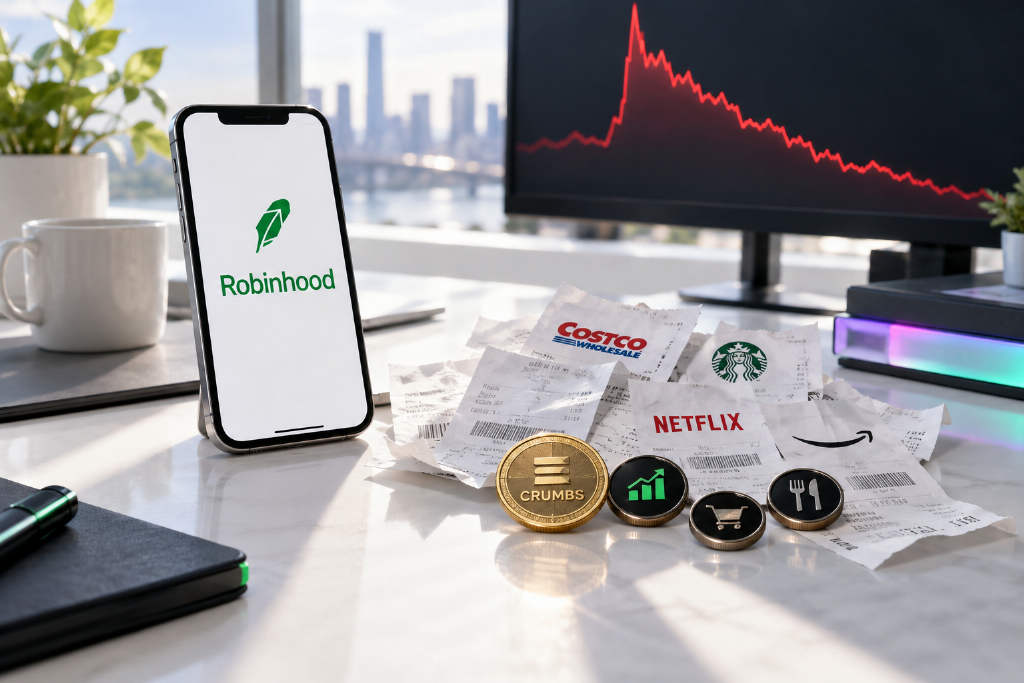
Crumbs, a new project on Robinhood Chain, has gone live with a pitch built around turning everyday spending receipts into tokenized stock rewards. According to the project, shopping at Costco can earn users $COST, while a Netflix subscription can earn $NFLX. Eligible purchases can receive as much as 5% back in stock tokens.
The launch drew criticism within hours. Multicoin Capital co-founder Kyle Samani said that when he first saw Crumbs 12 hours earlier, he found it interesting, but now thinks it is "basically a scam." He also said publicly that if someone wanted to build this kind of product on Solana for real, he would be willing to help.
$CRUMBS quickly lost momentum after launch
On the GMGN 15-minute chart, $CRUMBS briefly reached a market capitalization close to $8 million after listing, then fell back quickly to around $2 million. From the local high, the token gave back more than 70% in a short period.
How Crumbs works
The idea behind Crumbs is straightforward: users exchange purchase receipts for stock tokens. They do not need to apply for a new credit card. Instead, they can photograph an existing paper receipt and upload it. For supported online orders or subscription services, they can submit a PDF. Crumbs says it reviews each spending record and, once it confirms eligibility, sends the corresponding Robinhood stock token directly to the user’s wallet.
The team currently says it supports 31 brands, with reward rates between 1% and 5%. Examples provided by the project include:
- Amazon purchases: 2% in $AMZN
- GameStop purchases: 3% in $GME
- Netflix subscriptions: 3% in $NFLX
- Celsius purchases: 5% in $CELH
If an offer applies only to specific products, Crumbs says it calculates rewards based only on eligible items on the receipt rather than the entire basket.
This setup depends on Robinhood having already turned stock exposure into stock tokens that can circulate onchain.
Fee structure and open questions
Alongside the stock-token rewards program, Crumbs also launched its native token, $CRUMBS. The project says 75% of fees collected from token trading and protocol usage will be used to buy back $CRUMBS and burn the repurchased tokens.
What remains unclear from the public information is who pays for the rewards distributed in tokens such as $COST, $NFLX, and $AMZN after users upload receipts. The project has not clearly explained whether those rewards are funded by the brands themselves, by Crumbs, or through $CRUMBS trading fees and other revenue. Community discussion has also focused on whether a "spend and earn stocks" model can last if it relies mainly on token issuance, trading activity, or protocol fees and that activity later cools.
Why Kyle Samani called it "like a scam"
Market skepticism intensified after Samani’s public comments. He said: "When I first saw it 12 hours ago, I was pretty interested. Now I think it is basically a scam."
At the same time, his criticism did not appear to reject the underlying business model itself. He said that if someone truly wanted to build a similar product on Solana, they could contact him directly and he would help as much as he could.