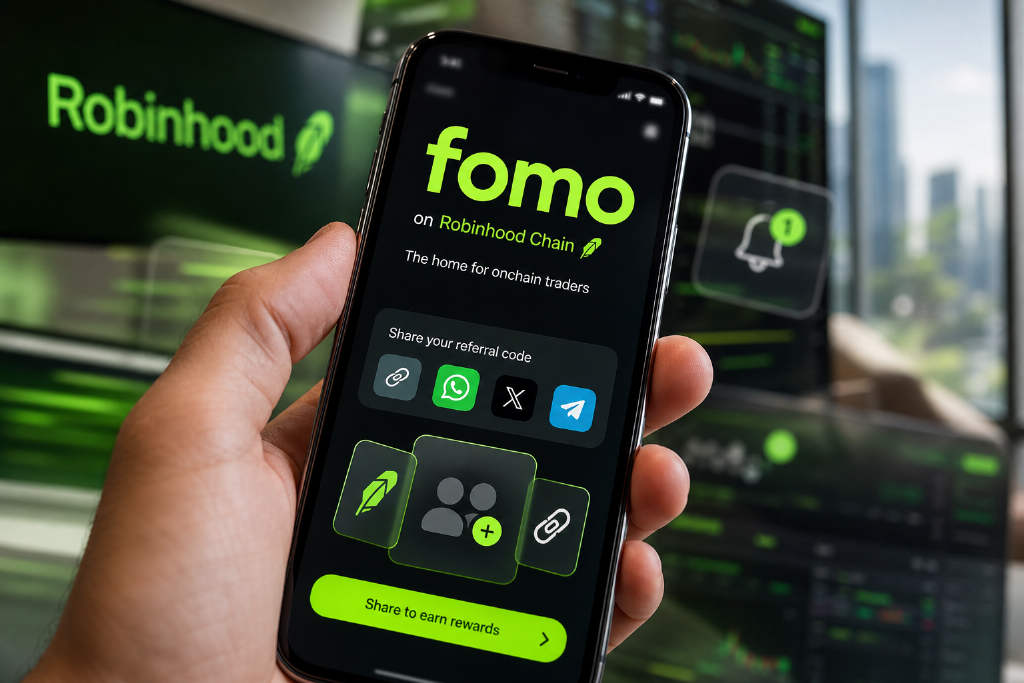
As trading on Robinhood Chain picked up, the fight for users and order flow accelerated with it. fomo has become one of the clearest growth stories in that race.
Posts showing profits tied to fomo have been circulating heavily on social platforms, with gains often running into hundreds of thousands or even millions of dollars. On Aug. 31, fomo said in an official newsletter that the platform’s leaderboard had produced its first trader with PnL reaching $10 million. At the same time, a growing number of KOLs began pushing their fomo invite codes and directing followers straight to the app.
Robinhood Chain now drives most of fomo’s trading volume
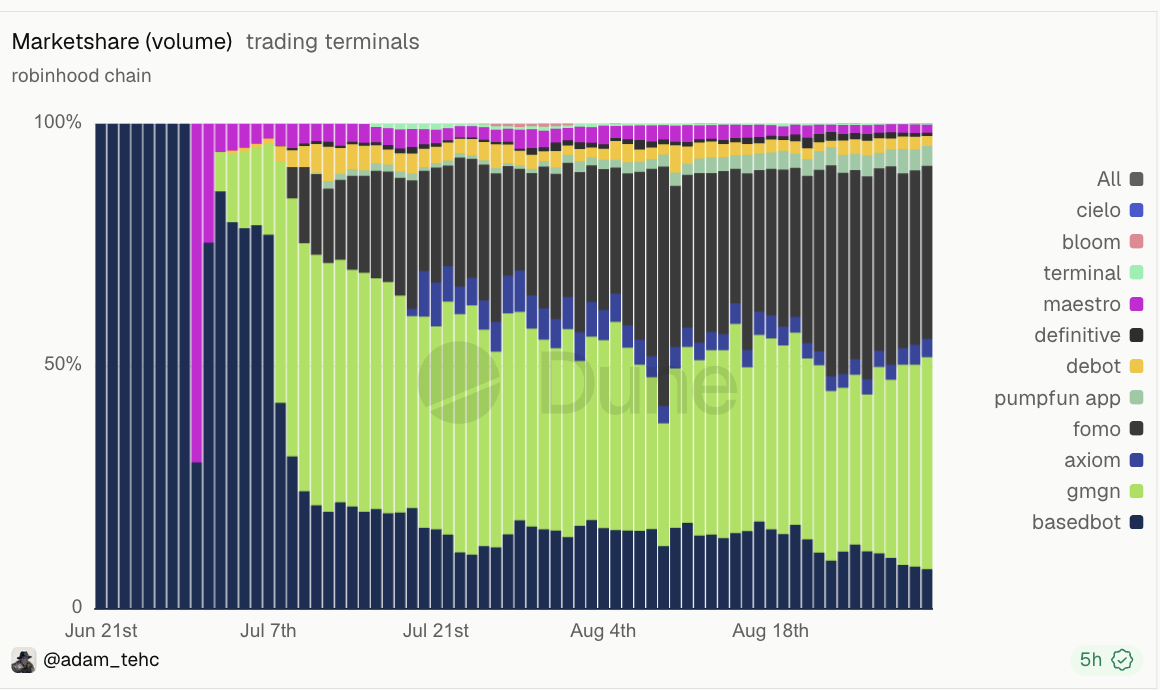
Adam Tehc’s Dune dashboard includes a section called "Trading Bot Wars." On Aug. 31, GMGN accounted for about 43.6% of Robinhood Chain trading terminal volume, while fomo took about 35.6%. Together, the two platforms represented roughly 79.2%. The metric tracks trading terminal volume rather than the entire chain, but it still shows that fomo has become one of the main gateways for Robinhood Chain trading.
fomo started out with Solana as its main market, but its volume mix has been shifting with each new trading hotspot.
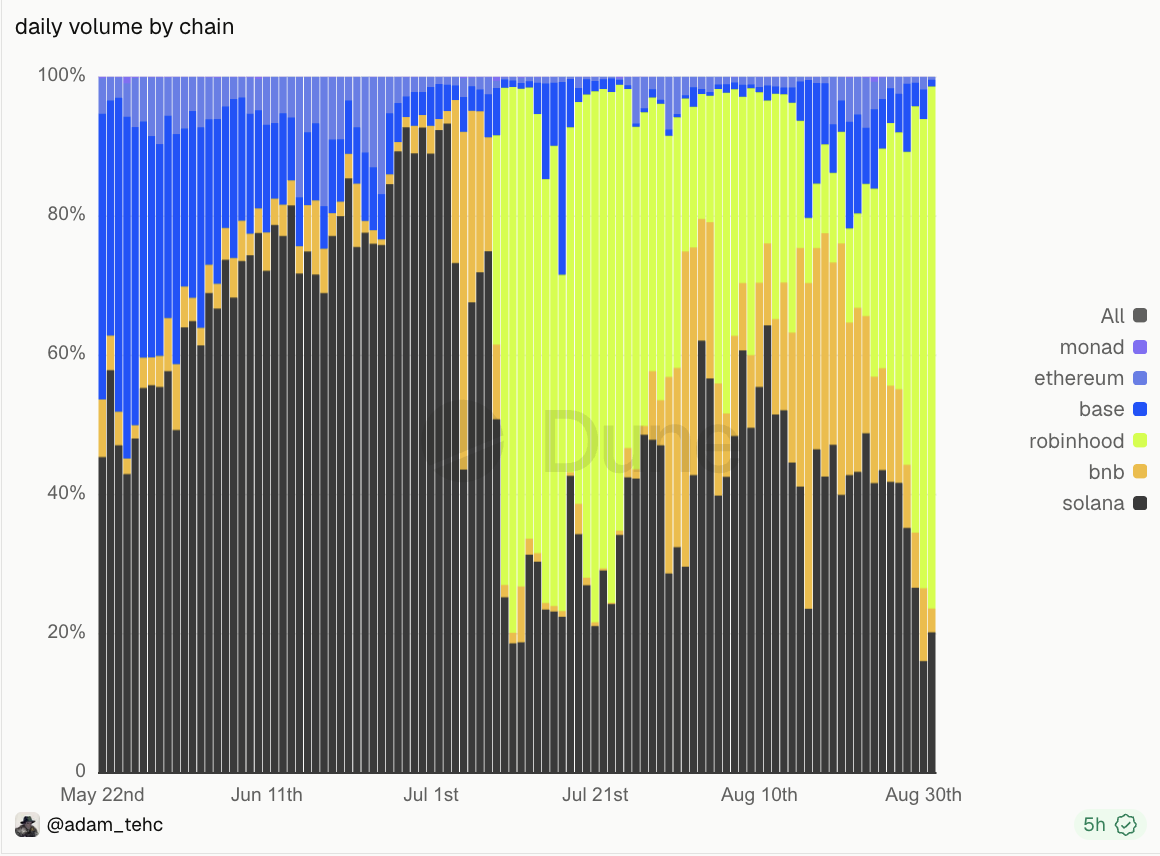
The same Dune dashboard shows that in late May 2026, most of fomo’s daily trading volume came from Solana and Base. By early July, Solana at one point contributed close to 90%. After fomo added support for Robinhood Chain and activity on that network climbed, the balance changed again.
On Aug. 31, Robinhood Chain represented about 75% of fomo’s daily volume, while Solana was around 20%, BNB Chain was about 3.4% and Base was about 1%. Those figures are approximate readings from the latest chart interval cited in the source, and the mix changes from day to day with market attention.
The rise in active traders has tracked that shift. From March through May 2026, fomo’s daily active traders were mostly in the low thousands. The figure was still below 10,000 in early June, then rose quickly. By late August, daily active traders had spent multiple days in the 80,000 to more than 100,000 range, with the peak above 100,000, at least an order of magnitude higher than in early June.
User count climbed from 120,000 to 1.9 million in 10 months
The broader business numbers released by fomo point in the same direction. In November 2025, Foresight News had previously reviewed the product in an article titled "Gold Rush Guide: Why top VC Benchmark backed fomo?" At that point, fomo had disclosed more than 120,000 users, about 35,000 traders and cumulative trading volume of just $850 million.
By Aug. 31, 2026, fomo said its total user count had surpassed 1.9 million. More than 1.2 million users were active during August, and the platform was adding more than 30,000 users a day.
Volume expanded sharply as well. The company said monthly trading volume rose from $500 million in June to $1.5 billion in July, a 200% increase, or three times the prior level. It then projected August volume above $2.8 billion, which would mark at least another roughly 87% increase from July.
fomo also estimated about $17 million in revenue for August, implying an annualized run rate above $200 million.
Why invite codes are everywhere
The flood of fomo invite codes shared by KOLs is not simply organic promotion. The company has built three connected mechanisms around user growth and social trading: Clans, Trader Rewards and referral incentives.
The most direct of the three is the referral program. According to official information released by fomo on June 2, 2026, when a new user signs up with a referral code, the referrer can receive 25% of the trading fees generated by that user. At the time, fomo said it had paid out more than $2 million in referral fees to users.
Trader Rewards targets what fomo described as people who help spread trading ideas. In a post published on Aug. 28, the company said users can share their own trade ideas or investment logic inside the platform. If that content leads other users to trade, the person who posted it can receive rewards in real time. fomo did not disclose the exact formula, reward ratio or the scope of eligible trades in that post, so the mechanism cannot be treated as a fixed-rate rebate.
Clans turns individual trading into a team-based activity. A user can join only one Clan at a time, can enter by invitation and can display Clan affiliation on a personal profile page.
From mobile trading app to web product and perpetuals
fomo’s ability to catch activity across multiple chains is tied to its product design. Users can access several blockchains through a single account and balance without switching networks themselves, bridging assets or preparing different gas assets for each chain. Rankings, trading feeds and quick-buy tools also shorten the path from asset discovery to execution.
Over the past few months, the platform has added web access, advanced charting, perpetuals and team competition features. Based on data disclosed by fomo in late August, web trading has represented about 25% of total platform volume since April 2026.
In June, fomo launched fomo Perps. The product is supported by Hyperliquid and TradeXYZ and covers perpetual contracts tied to crypto assets, stocks, pre-IPO companies, equity indexes and commodities. It offers long and short trading, leverage, isolated margin and take-profit and stop-loss functions.
Those perpetuals are still tied into the platform’s social layer. Related positions are fed into user profile pages and activity streams, allowing users to see when other traders open positions.
fomo acquires Mobula software and intellectual property
As daily active traders grew from the low thousands to more than 100,000, while the platform handled networks including Solana, Robinhood Chain and BNB Chain, pressure shifted to the on-chain data layer.
When a new token appears, the app needs to identify the contract address, token name and host network. It also needs to keep pulling in trades, liquidity, price data, holder addresses and wallet behavior, then organize raw records from different chains into something users can read.
That is the type of infrastructure Mobula provides. Public documentation for Mobula shows that its data products cover token prices and market data, wallet assets and transaction records, token metadata, position PnL and real-time data streams, delivered to other applications through APIs and related tools.
On Aug. 31, fomo said it had acquired proprietary software and intellectual property developed by Mobula. Axios, citing fomo CEO Paul Erlanger, reported that the deal was worth $17 million, though fomo’s own announcement did not disclose a price.
Mobula founder Sacha Marcus, co-founder and CTO Sacha Delhoux, and infrastructure lead Cyril Conan will join fomo’s engineering team. One detail that drew wide attention: Delhoux was 19 years old when the transaction closed.
He later posted a thread on X under the title "How I sold my company for 8 figures at 19," where he attributed Mobula’s progress to a small but technically dense team, trust built over time with B2B clients, and product differences customers could feel directly in latency, stability and responsiveness.
fomo’s formal announcement drew a clear line around the scope of the deal. It said the company acquired software and intellectual property developed by Mobula and brought in part of the core team.
The competition is moving beyond execution alone
At this stage, fomo is no longer just a mobile app that simplifies trading steps. It is building a product system that spans asset discovery, social distribution, creator-driven user acquisition, trading entry points and data support.
As the operational barrier for on-chain trading keeps falling, competition among consumer crypto apps is shifting from whether they can complete a trade to who can control users, distribution and data at the same time.