

Robinhood Chain is still drawing heavy on-chain activity, but trading on it is getting much more expensive.
In the two months since launch, the chain has recorded 463 million cumulative transactions, 12.08 million active wallets, $52 billion in cumulative DEX volume, and nearly 594,000 meme-token trading targets, according to the source article.
Fees show the shift most clearly. The article says cumulative gas paid on Robinhood Chain has reached 4,274 ETH. DefiLlama data cited in the piece shows daily gas costs climbed from about $56,000 on Aug. 23 to roughly $3.75 million on Sept. 1.
Part of that increase reflects rising transaction volume. Part of it comes from the chain itself not being cheap to use. Community complaints about higher trading costs have intensified, with some users saying fees have even exceeded those on Ethereum mainnet.
The article frames the question in practical terms: under this fee environment, does it still make sense to keep fighting high-frequency meme-token PvP battles, or is it now more efficient to provide liquidity in stronger pools?
Why fees are high on Robinhood Chain
Robinhood Chain is built as an Arbitrum-family Layer 2, and its fee structure has two main components:
- L2 execution fee
- L1 data fee
The project’s documentation, as cited in the article, says the L1 data fee changes with Ethereum congestion and calldata size. That means a plain transfer and a more complex swap or launchpad transaction do not sit in the same cost bracket.
The piece adds that transactions on platforms such as Pons and long.xyz carry extra calldata and contract calls, so gas is only the first layer of cost. In effect, launch platforms can amplify user expenses.
Pons is used as the clearest example. The article says Pons charges 0.0005 ETH to launch a token, 1% on V1 swaps, and a default 1% curve fee on V2. Creator tax on V2 can go as high as 10%, and after a token graduates, a Uniswap v4 hook can continue to charge 1%. Those fees are distributed across the protocol, creators, PONS buyback and burn, meme-token buyback and burn, and Uniswap or LP participants.
Pons itself acknowledged in a post the day before that it had been the launchpad where users paid the highest total fees on-chain over the past 24 hours.
The article therefore breaks Robinhood Chain’s cost burden into three layers: on-chain gas, token trading tax and miscellaneous platform charges, and the repeated cost of failed attempts in high-frequency PvP trading.
How much a profitable trade can lose to fees
The article walks through one microduck trade to show how these costs accumulate.
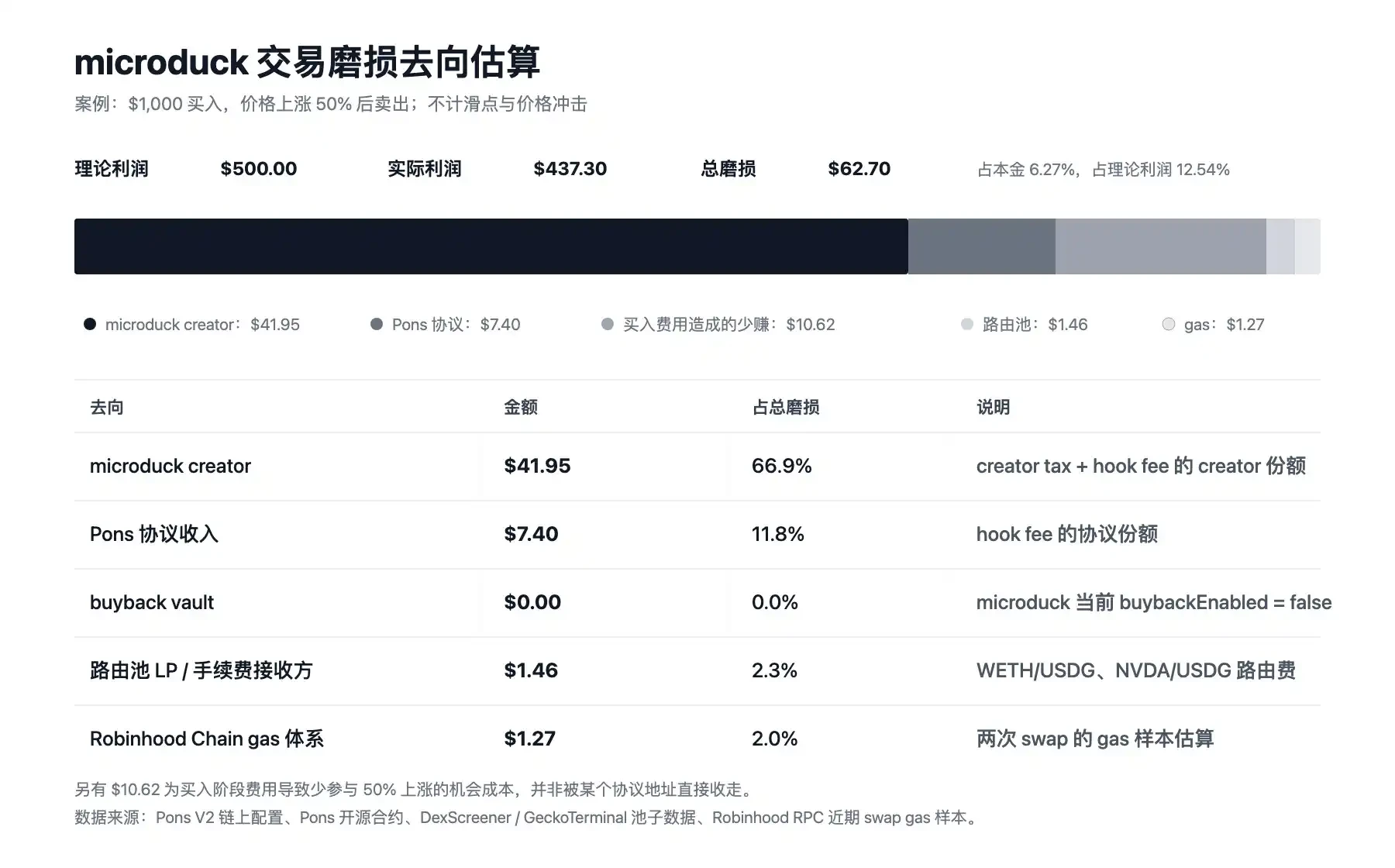
It assumes a user buys the token with $1,000 worth of ETH. The aggregator route is given as WETH--USDG--NVDA--microduck. Using the most liquid pools on each hop, the user would spend more than $20 in costs just on the buy side, mainly from the Pons V2 hook fee and creator tax, both at 1%.
If microduck then rises 50% and the user sells, the transaction cost on the way out would exceed $30. That leaves a trade with a theoretical $500 profit at only $437.3 in realized gain, after roughly $62.7 in transaction costs.
In percentage terms, 12.54% of the profit is lost to intermediated trading costs even after the trader correctly catches a winning token.
Win rate in trench PvP is turning into a cost-control problem
The article says many traders treat trench trading as an information game. With fees rising, it looks more like a cost-control game.
Dune data cited in the piece shows that over the past 30 days, among traders who sold memecoins on Robinhood Chain:
- 479,514 addresses were profitable
- 716,383 addresses were unprofitable
- the loss ratio was about 59.9%
The author notes that this profit-and-loss split is not especially poor in a crypto market that has not fully turned bullish. But the figures include outcomes from the chain’s first 50 days, when trading conditions were simpler. With capital pouring into RH chain, community feedback now describes trench trading as having reached "hell mode," and the article says comments on X are filled with complaints from users saying they were farmed. The ratio of losing addresses could deteriorate from here.
The cost structure also sharpens a familiar PvP paradox. The higher the fees, the higher the win-rate threshold for smaller accounts. The heavier the tax burden, the larger the move a short-term trade needs before it becomes worthwhile.
The article’s view is not that trench trading has no opportunities left. It is that the strategy now demands that traders be earlier, faster, and more accurate than most others while also paying steadily higher friction costs. Over time, low-win-rate speculation becomes much harder to sustain.
Liquidity provision is starting to look more attractive
That is where LP strategies come in. The article’s distinction is simple: PvP earns from the counterparty, while LP earns from the trading system itself.
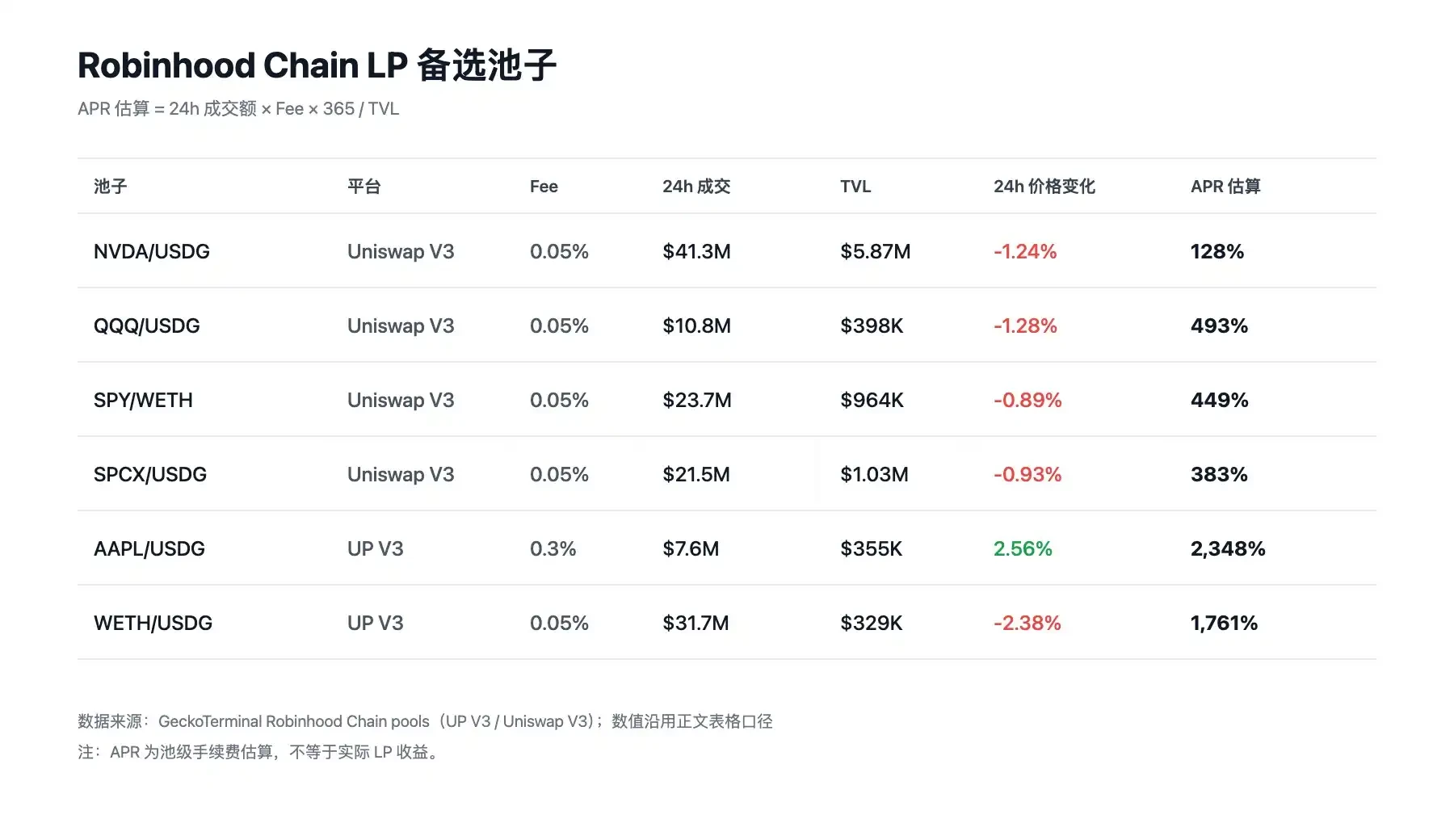
Against the current Robinhood Chain narrative around stock-themed meme tokens, the piece highlights several pools worth watching and explains why the returns can look elevated. Many tokens launched through platforms such as Pons are stock-linked tokens, and most users do not hold them in size for long. As a result, routing often requires an extra hop, and that extra hop becomes an additional source of fee income for LPs.
The article also notes that APRs on UP’s AAPL/USDG and WETH/USDG pools look high because UP is an RH-native ve(3,3) protocol, but TVL is still relatively small, so the durability of those returns remains uncertain.
Another route is to hold infrastructure projects on RH chain over a longer period and pair them in LP positions. The article says investors should watch native protocols that already have products in the market.
One example is Up, the ve(3,3) protocol mentioned earlier. Helped by a rapid rise in token valuation, its token paired with WETH on the platform is showing an APR of 21,950%.
The article also points to NET, an OHM-like protocol; Index, an officially recognized stock-dividend protocol; and Mancer, a Robinhood Chain-native order-book DEX. Barring surprises, the piece says these projects could deliver solid long-term performance. Their largest mainstream pools are currently offering APRs of 2,341%, 1,261%, and 1,059%, respectively.
High-fee LP tactics are also emerging around hot meme tokens
The article describes a more aggressive approach as well. Some on-chain traders are using the high volatility of popular meme tokens and the scarcity of liquidity to create custom high-fee LP positions on Uniswap v4, attempting to monetize bursts of FOMO.
Rabbit is the example used in the piece. After the token briefly surged in popularity the day before, one trader created a USDG pool with an 8% fee tier. The pool had $328,000 in TVL, generated $239,000 in volume over 24 hours, and produced $19,000 in revenue, implying an APR of 2,124%.
The article is careful not to present that as a free lunch. It says this approach still resembles a different version of meme trading, because the key bet is that the token does not collapse to near zero too quickly.
A strategy shift on Robinhood Chain
The article’s broad conclusion is that the operating logic on Robinhood Chain may need to be reset. In a low-fee market, traders can tolerate frequent trial and error. In a high-fee market, every click becomes part of the cost basis.
For ordinary users, trench PvP offers a win rate of only about 40% and still leaves returns exposed to gas, platform fees, slippage, and failed transactions. By contrast, choosing stronger stock-token or index-token pools for liquidity provision effectively puts the user on the fee-collection side of trading flow.
The piece closes with a portfolio idea rather than a blanket call. In the current phase of rapidly rising fees on Robinhood Chain, it argues that a better risk-reward setup is not indiscriminate trench trading. Instead, it suggests using a small allocation for high-conviction narratives and the main allocation to screen for LP pools with higher volume, steadier pricing, and TVL that is not too thin.
The final line sums up the distinction neatly: trench trading profits from judging direction in chaos, while LP profits from the chaos itself.