Robinhood has built an on-chain route for tokenized equities, but the first users racing onto that road have not been long-term holders of tokenized NVIDIA or Apple. The early wave has come from meme issuance, NFT experiments, launchpads, bots and fast-turn trading.
That mismatch sits at the center of Robinhood Chain’s current phase. The network is being marketed around stock tokens, while much of its early activity is still being powered by meme launches, short-term traders and execution tools. Robinhood’s stated vision points to financial infrastructure for AI agents. The earliest revenue, however, is showing up in launchpads, trading terminals and liquidity protocols.
The source article from Foresight News breaks the ecosystem down through chain-level data, launchpad competition, terminal market share, the relationship between memes and stock tokens, changing NFT designs, lending structure, and the network’s agent economy.
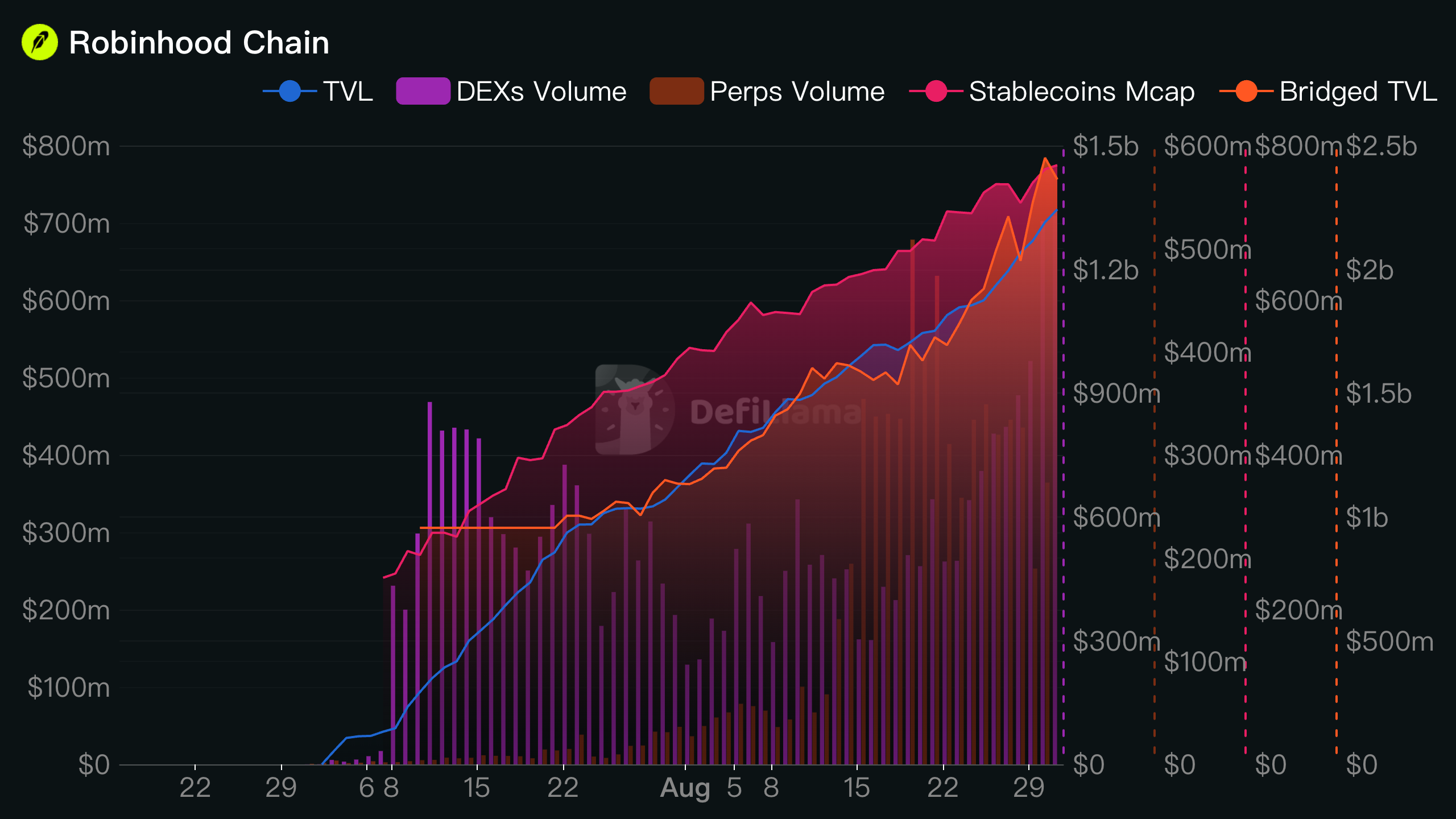
Chain-level activity has expanded across TVL, stablecoins and trading volume
According to DefiLlama data cited in the article, Robinhood Chain’s DeFi total value locked stood at about $720 million as of Aug. 31, 2026. Stablecoins on the network had a combined market cap of roughly $775 million, with USDG accounting for about 57.6%. Ethena USDe followed at about $324 million, or roughly 42%.
Using DefiLlama’s broader methodology, the network’s active RWA market cap was about $151 million. The article notes that this figure also includes other real-world assets, so it should not be treated as a direct proxy for the circulating market cap of stock tokens alone.
On trading activity, Robinhood Chain’s rolling 24-hour DEX volume was about $1.32 billion during the period reviewed in the report, already above DeFi TVL. Over the same period, on-chain perpetual futures volume reached about $270 million in 24 hours.
The chain’s bridged TVL was also listed at about $2.242 billion. That number reflects assets that have at some point entered the network through bridges, not assets that are necessarily still sitting inside DeFi protocols.
Taken together, the figures point to rising capital and rising turnover at the same time. Growth in stablecoins and TVL suggests new funds are still entering the network. DEX volume running well above TVL suggests that once funds arrive, they are being rotated aggressively through trades.
Pons has taken the lead in the launchpad race
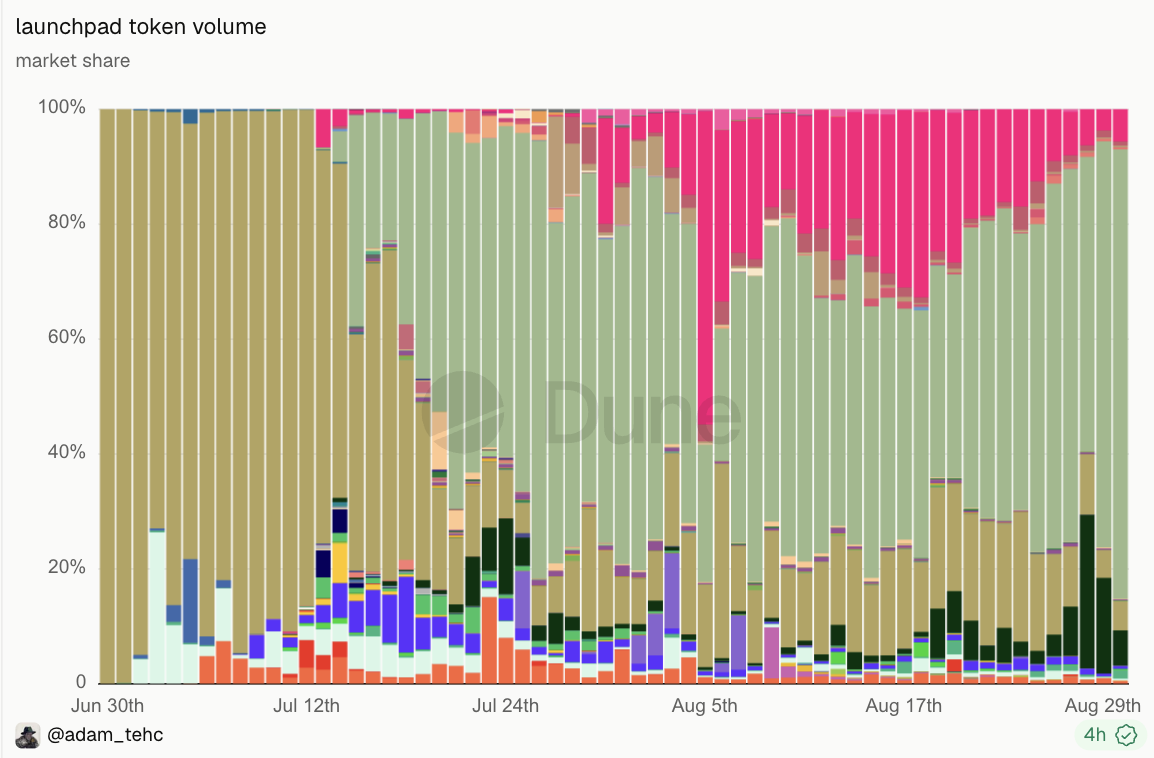
Robinhood Chain’s early launchpad market shifted quickly. By trading-volume share for launchpad tokens, Noxa controlled nearly all related volume around the start of mainnet trading, then stopped operating. Pons moved in fast and absorbed the flow. Although activity briefly spread out in early August, Pons had climbed back to nearly 80% share by the end of the month, according to Dune data referenced in the article.
Its scale is already notable. As of Aug. 31, Pons had launched about 389,000 tokens in total. Excluding its platform token PONS, 10 projects on Pons had market capitalizations above $5 million. Of those, six were above $10 million, and four were between $5 million and $10 million. They span pure memes as well as liquidity management, index products, social trading and lending.
- Delta (DELTA), valued at $29.3 million, is a liquidity management project focused on LP staking, yield compounding and fee capture.
- Thinking Cat (HMM), valued at $24.78 million, is a community meme with a “thinking cat” theme and no clear protocol utility at this stage.
- microduck, valued at $17.78 million, is a meme paired with the NVDA stock token. The article says it links community trading momentum with the NVIDIA asset narrative and traces back to the open-source Microduck robot released by Hugging Face on Aug. 27.
- Copper Inu (COPPERINU), valued at $12.87 million, originated from a January 2026 post by Cobie. The article says its move on Robinhood Chain was mainly pushed by crypto KOL Him.
- YOLO, valued at $11.18 million, is a pure meme built around the “all in” cultural motif.
- Golden Goose (GG), valued at $11.11 million, is a community meme themed around a “golden egg-laying goose” and paired with GLD, a tokenized gold ETF quoted on Robinhood Chain.
- Down to Finance (DTF), valued at $6.88 million, is a decentralized portfolio platform that lets users package baskets of assets or strategies into a single token and plans to share part of protocol fees with DTF stakers.
- clan.tech (CLAN), valued at $6.24 million, is a social trading product built on Fomo Clans, where users can buy community keys, access private chat and share in trading revenue.
- Motion (MOTION), valued at $6.12 million, is positioned as a TipFi and social-graph product on Robinhood Chain, using identity, interaction and token tipping to build relationship networks.
- Longbow (BOW), valued at $6.15 million, is a lending project built on Morpho Blue that allows borrowing USDG against stock tokens, RWAs, crypto assets and some ecosystem tokens.
Six of those 10 projects came from Pons V2. Compared with earlier versions, Pons V2 allows projects to use ETH, USDG and even stock tokens such as NVDA and TSLA as quote assets. Once a token completes its bonding curve, liquidity moves into Uniswap v4 and is permanently locked.
That makes Pons something more than a Robinhood Chain copy of Pump.fun. It is trying to tie meme issuance, stock tokens and Uniswap liquidity into one mechanism.
The platform has also generated meaningful cash flow. Based on the latest DefiLlama data cited in the article as of Aug. 31, 2026, Pons had produced about $46.06 million in user fees in total, with about $10.14 million counted as protocol revenue and about $3.61 million used for PONS buybacks and burns.
Over the last 30 days, the article says, Pons generated about $26.53 million in fees, $5.2 million in protocol revenue and $1.62 million in buybacks and burns. Over the last seven days, those figures were about $16.778 million, $2.985 million and $494,000.
If those 30-day figures are annualized mechanically, Pons would be running at about $323 million in annualized fees, $63.3 million in annualized protocol revenue and about $19.7 million in annualized buybacks and burns. Using DefiLlama’s then-current circulating market cap estimate of about $270 million for PONS, the article says the annualized buyback amount would equal roughly 7.3% of circulating market value.
Foresight News also stresses that this should not be read as a holder yield. Buybacks and burns do not pay cash directly to token holders, and Pons has only been live for a short time. Issuance and trading activity have accelerated recently, so the durability of current revenue is still unclear.
Trading terminals are fighting for order flow
On Robinhood Chain, trading bots are not a side tool. They are a meaningful source of both transaction count and volume.
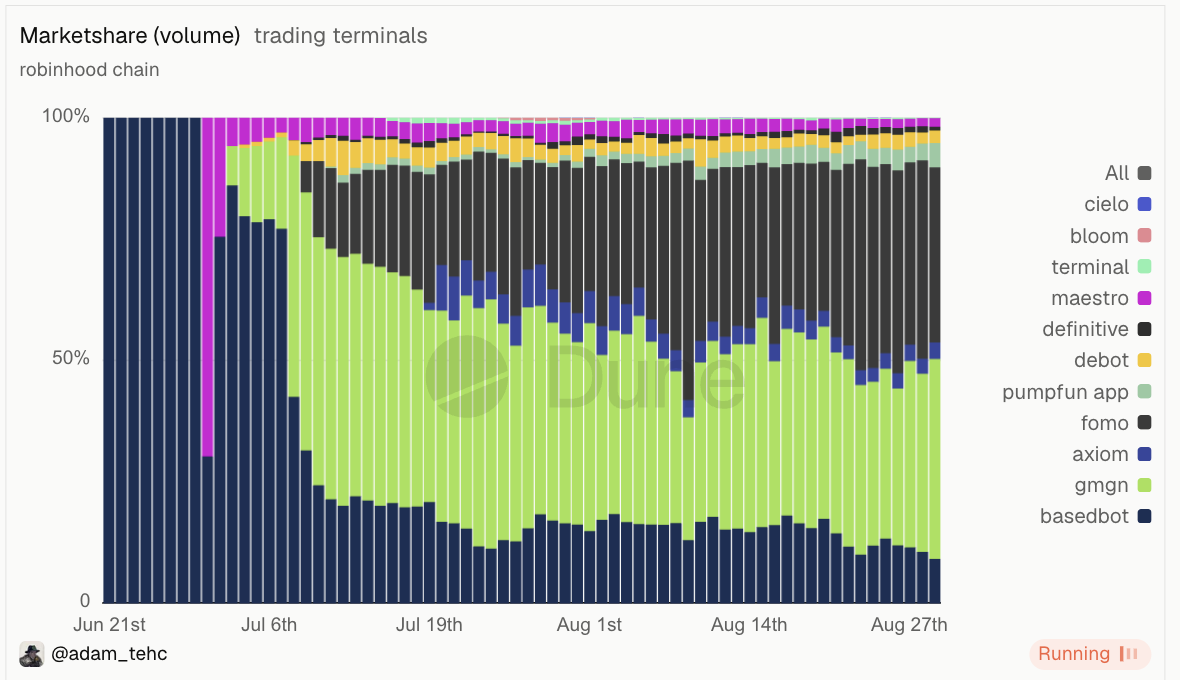
Using data from Adam Tehc’s Dune dashboard through Aug. 29, the article says GMGN accounted for about 41.2% of trading-terminal volume, while FOMO took about 30%. Together they represented about 71.2%.
That puts competition on two levels. DEXs are fighting for liquidity, but trading terminals are also fighting for user order flow. The products that can surface new tokens faster and make buying, copy trading and take-profit execution smoother are in a stronger position to own the trading entry point.
The more distinctive experiment is the link between memes and stock tokens
Issuing meme tokens on its own is nothing new. What gives Robinhood Chain a clearer identity, according to the article, is the attempt to connect memes and stock tokens at both the asset level and the fee level.
The report outlines three broad models.
The first is to use stock tokens directly as quote assets for meme trading. The article points to Artificial Inu (AI) on Long and microduck on Pons V2 as examples built around the NVDA narrative.
When users buy and sell these memes, stock tokens are pushed into liquidity pools. That gives those stock tokens additional trading volume and additional locked-liquidity demand.
The second model uses transaction taxes to buy stock tokens and distribute them to holders. The Index charges about 3% on each INDEX token trade, then uses the proceeds to buy a basket of 18 stock tokens including NVDA, AAPL and MSFT, distributing them to eligible INDEX holders according to project rules.
The article says that may look like an index product, but it is not the same as a traditional redeemable index fund. Its cash flow comes from token trading taxes, and its value depends on continued trading in INDEX itself. If trading falls, the cash available to buy stock tokens also falls.
The third model is to place stock tokens inside NFTs or token-bound accounts. Compared with the first two, this design also tries to redefine what NFTs are supposed to do.
NFTs are being used as programmable financial wrappers
Some of the more visible NFT projects on Robinhood Chain are no longer focused mainly on artwork and scarcity. Instead, they turn NFTs into programmable financial interfaces.
StonkBrokers has a total supply of 4,444. Each NFT comes with an ERC-6551 token-bound account. At mint, stock tokens are placed inside that account, and the account can later receive and manage additional assets. In effect, users are not just trading an image. They are trading a bundle made up of the image, the account and the assets sitting inside it. The article lists the StonkBrokers floor price at 7.31 ETH.
Quotrons combines an ERC-404 token with NFT terminals. Each tradable QUOTRON corresponds to one terminal. Holders can keep the token liquid, or burn the QUOTRON and irreversibly “hardwire” the terminal into the reward system. Each standard terminal maps to one of 10 stock tokens, including NVDA, AAPL, TSLA and SPY. The protocol charges a base 3% trading fee, with 2% periodically converted into the corresponding stock token and distributed to hardwired terminals. The remaining share is used to buy back and burn STONKBROKERS, add locked liquidity and pay creator fees. At the time of writing in the source article, Quotrons had a floor price of about 3.15 ETH.
The Standard Reserve, which had not launched at the end of August, organizes its NFT and token framework around a “central bank and branch-license” narrative. The article specifically notes that it remained largely at the white paper and warm-up stage as of late August.
Across these examples, the shared direction is to package assets, claims on rewards, access rights, community identity and interaction rules into a single on-chain credential. Whether that has more value than a conventional PFP model will depend, the article argues, on whether these structures can attract real users and whether there is enough underlying asset value, revenue and usage demand behind them.
Lending needs to be split into a USDG base layer and ecosystem experiments
The article warns that if every project carrying a “lending,” “yield” or “stock-backed” label is grouped together, it becomes easy to overstate how mature stock-token finance already is on Robinhood Chain.
The real TVL base is being provided by Robinhood Earn, Morpho and Steakhouse.
Robinhood Earn lets users deposit USDG into a Morpho vault curated by Steakhouse, with the interface showing an estimated annual yield of about 7%.
At the time checked in the report, Morpho’s TVL on Robinhood Chain was about $480 million, making it the largest single component of chain-wide TVL. Steakhouse data overlaps heavily with Morpho because Steakhouse is the curator of the Morpho vault, so the two figures should not be added together.
More importantly, the large-scale lending base is still centered on USDG and similar assets rather than on stock tokens such as NVDA or TSLA used as collateral. Robinhood Chain has already built a dollar-denominated lending foundation, but stock-token lending remains at an experimental stage.
Arrow Finance has disclosed that it would launch on mainnet on Aug. 31 with 16 collateral markets, covering stablecoins, WETH, tokenized stocks and indices.
Longbow, meanwhile, uses Morpho to create isolated lending markets that let users borrow USDG against some stock tokens as well as assets such as PONS and INDEX. Even so, the article points out that Longbow’s TVL was only $130,000, while the BOW token’s market cap had already reached $6.15 million at the time of writing. That does not mean the project has no value, but it does suggest the token price is reflecting expectations of future growth more than currently established capital or revenue.
Agent economy and x402 are still early in practice
Compared with the steady flow of on-chain agent tokens, the article says the more important development from Robinhood is the company’s broader product stack around agent trading, delegated account control and payment capabilities.
Robinhood has already launched a standalone Agentic Trading account that allows authorized agents to execute trades within a restricted account. It has also launched an Agentic Credit Card that uses Banking MCP to create separate virtual cards for agents, with monthly limits, transaction rules and human approval conditions.
Robinhood describes Robinhood Chain itself as an “AI-native” blockchain intended to support on-chain trading, swaps, lending and tokenized-asset usage by agents.
According to self-reported figures in the latest weekly report from Virtuals, agent-related assets issued by Virtuals accounted for more than 1% of Robinhood Chain’s DEX volume after just over a month online.
Even so, actual activity around the agent economy and x402 remains early compared with the much more visible meme, launchpad and trading-bot segments. Agent accounts, machine payments and automated asset management remain part of Robinhood’s longer-term direction.
Robinhood Chain has started the traffic engine, but not yet the full financial conversion
If Robinhood Chain’s current phase has to be reduced to one description, the article presents it as an on-chain financial network kick-started by Robinhood’s distribution power, differentiated by stock tokens, but still driven in day-to-day activity mainly by memes, launchpads and trading tools.
Foresight News highlights four clearer characteristics.
- Robinhood’s brand, user funnel and product integration can convert quickly into on-chain capital inflows and trading attention.
- Stock tokens provide differentiation, but they are not yet the main source of ecosystem activity. For now, the livelier sectors are memes, launchpads and trading terminals, while stock tokens are functioning more as quote assets, liquidity components and narrative anchors.
- The more important question is not simply how many stock tokens can be listed on-chain, but what new combinations can be built around them. The article points to meme-stock token pairings, on-chain indices, collateralized lending and NFTs that combine assets, rewards and usage rights. It also notes that some projects launched tokens soon after creating social accounts, with limited operating history and incomplete verification around contract security and team background.
- Current data still shows signs of an early sentiment premium. Real user retention, revenue durability and actual stock-token usage at scale still need verification over time.
The article’s conclusion is straightforward: Robinhood Chain has completed a traffic-level cold start, but it has not yet completed the conversion from trading heat into lasting financial demand. The next stage is not about proving that markets are willing to trade. It is about proving that this trading activity can settle into holding, lending, payments and asset-management use cases that persist after the initial excitement fades.