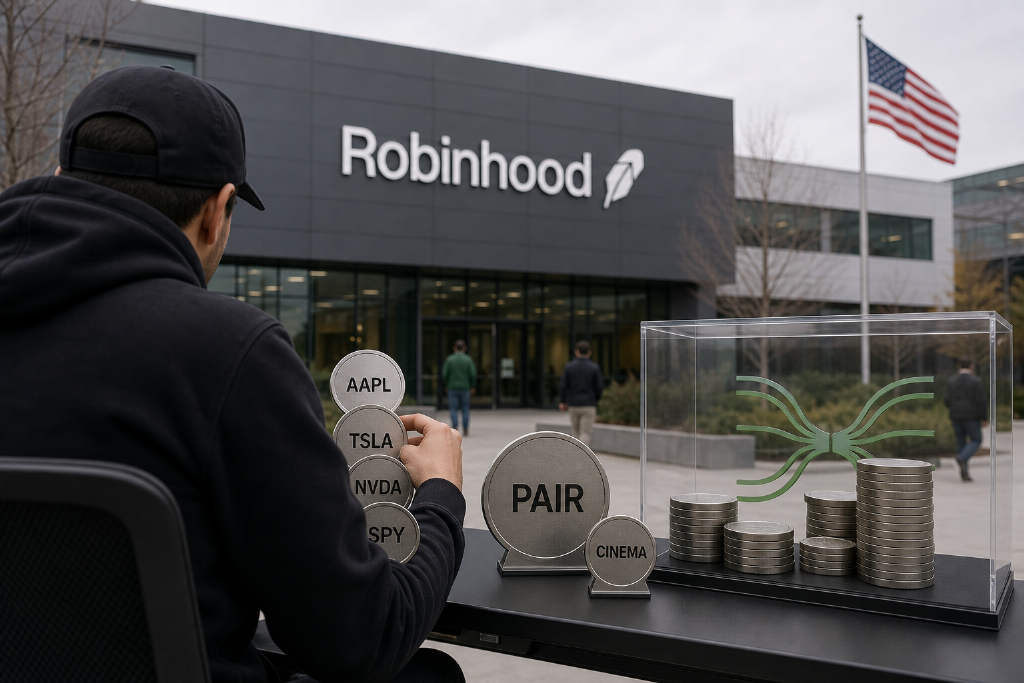
BlockBeats reported on September 4 that the Robinhood Chain has seen a new token launch platform called pair.fund, which allows users to issue ERC-20 tokens with a fixed supply of 1 billion, paired with up to five Robinhood Stock Tokens like AAPL, TSLA, NVDA, and SPY, while permanently locking liquidity in Uniswap V4. The platform's native token PAIR has surged 91.37% in 24 hours to a market cap of $8.53 million, with the largest token on the platform, CINEMA, reaching $3.52 million.
BlockBeats reported on September 4 that on the Robinhood Chain, in addition to a MEME token that surpassed a $100 million market cap in a single day, other projects are gaining traction. Among them, the new token launch platform pair.fund has drawn attention.
According to its official documentation, pair.fund allows users to create an ERC-20 token with a fixed supply of 1 billion, selecting 1-5 listed Robinhood Stock Tokens (such as AAPL, TSLA, NVDA, SPY) as quote assets, while permanently locking liquidity in Uniswap V4.
As of press time, data from GMGN shows that the platform's native token PAIR has a market cap of approximately $8.53 million, up 91.37% in 24 hours. The largest token issued on the platform, CINEMA, has a market cap of approximately $3.52 million.
This article was originally published by Bit.Fan. For more cryptocurrency news and market insights, visit www.bit.fan. Disclaimer:
The market information, project data, and third-party content displayed on this platform are for industry information sharing only and do not constitute any form of investment advice or return commitment.
Cryptocurrency trading carries high risks. Users should fully assess their risk tolerance and make independent decisions. All profits, losses, and legal responsibilities are borne by the users themselves.