
A research report by ACJ, translated by Odaily, says Robinhood’s broader business is still expanding, but its crypto segment has lost momentum. The same report says Robinhood Chain has delivered one of the strongest recent Layer 2 launches, though its current revenue base is still too small to materially change the company’s crypto picture.
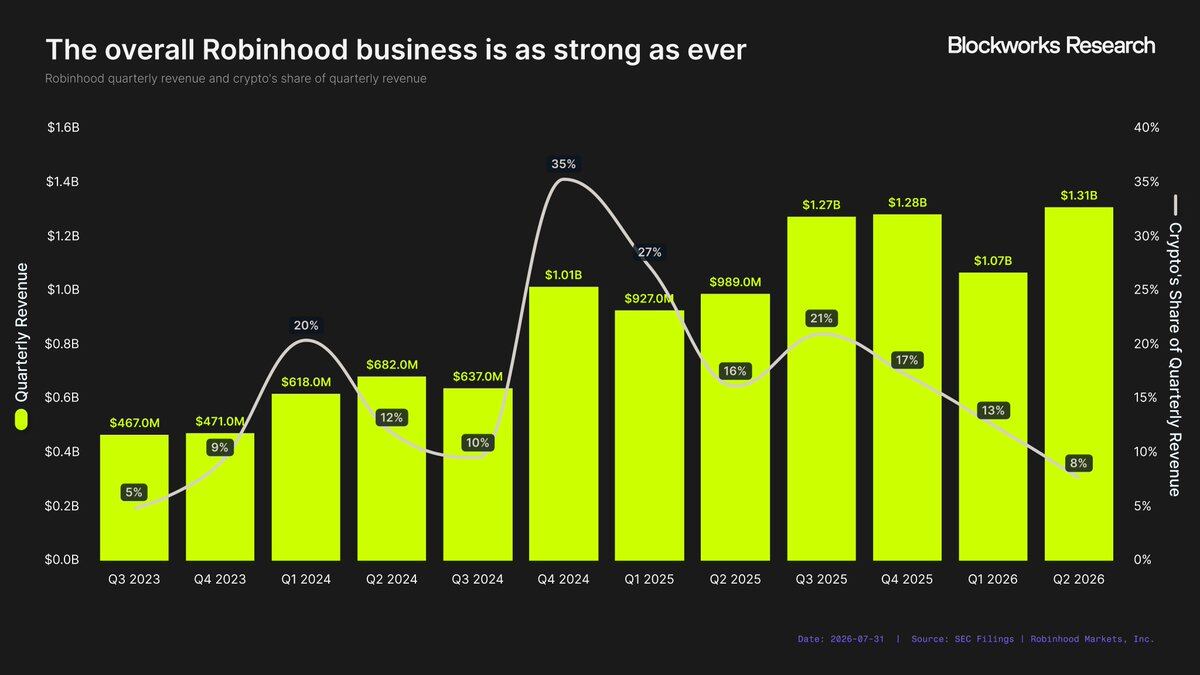
Robinhood hit a revenue record, while crypto moved in the opposite direction
In the second quarter of 2026, Robinhood posted $1.31 billion in quarterly revenue, a record for the company. That was up 32% year over year and 92% higher than the second quarter of 2024. The report says Robinhood now has 13 business lines generating more than $100 million in annualized revenue, and every transaction-based revenue line posted double-digit year-over-year growth in the quarter.
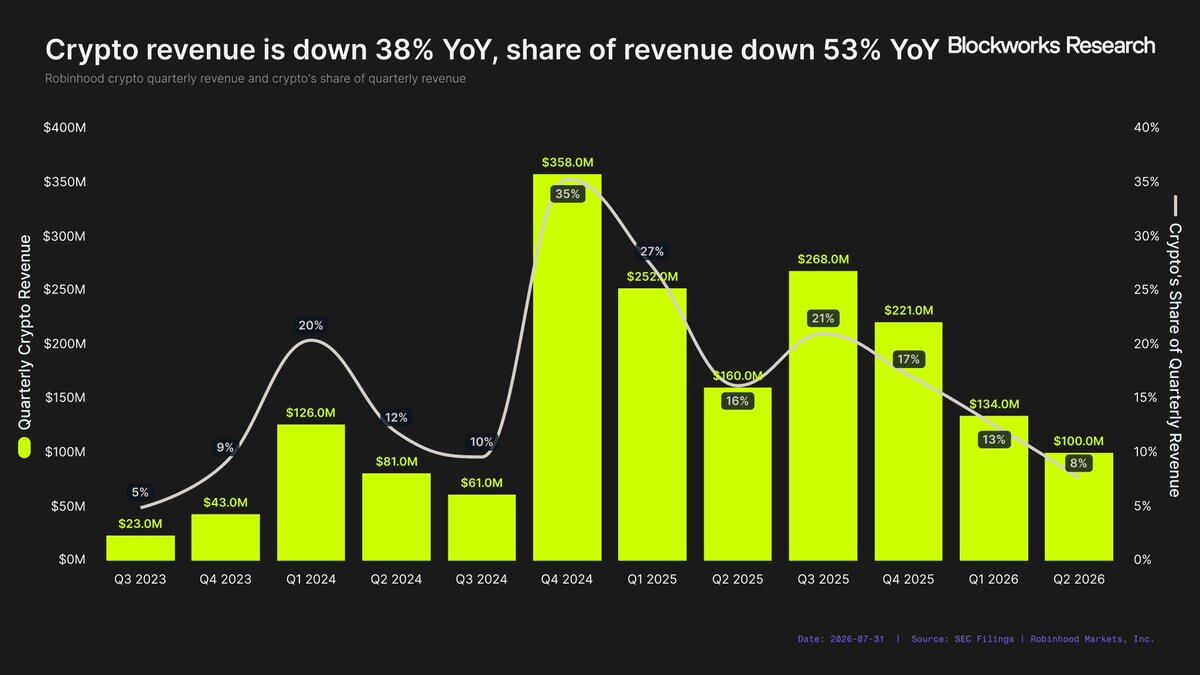
Crypto was the exception. Robinhood’s crypto revenue fell 38% from a year earlier to $100 million in the second quarter of 2026, making up only 8% of total company revenue, its lowest share since the third quarter of 2023.
The report notes that crypto once contributed more than a third of Robinhood’s revenue. It now carries far less weight in the company’s mix. Event contracts, a product Robinhood introduced only last year, generated $156 million in the second quarter, compared with $100 million for crypto.
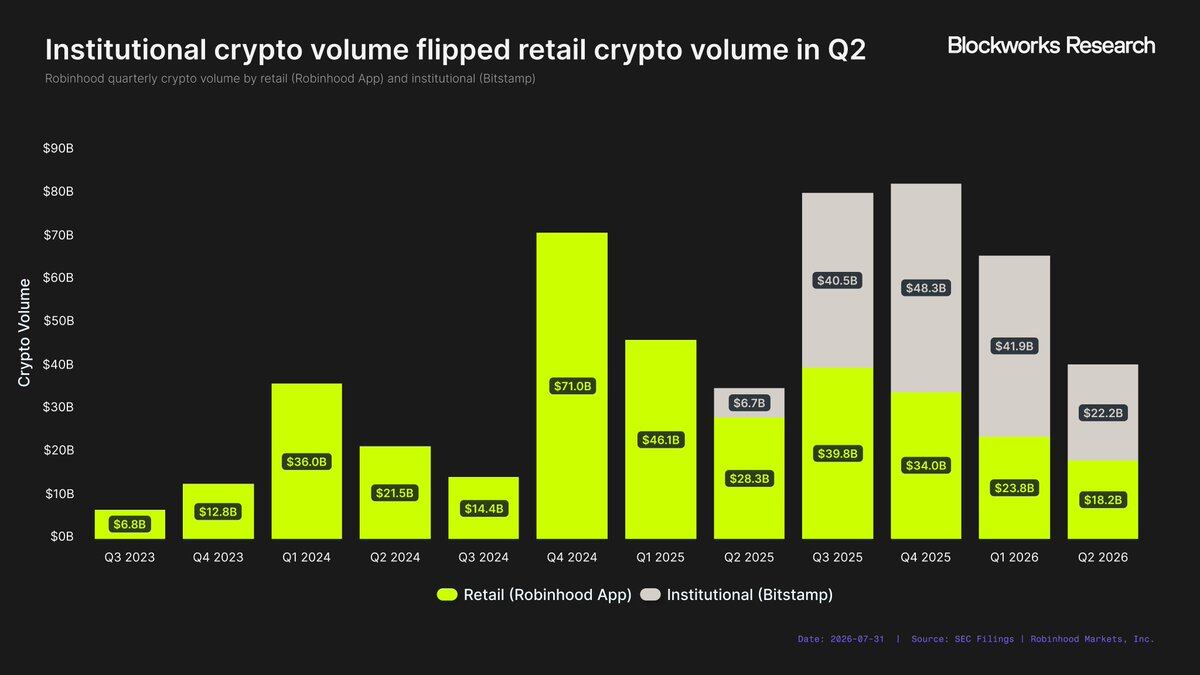
Trading activity tells the same story. Retail crypto trading volume on the Robinhood app came in at $18.2 billion in the second quarter of 2026, down 36% year over year and marking the lowest quarterly level since the third quarter of 2024. Over the same period, institutional trading volume at Bitstamp reached $22.2 billion, exceeding Robinhood’s retail crypto volume for the first time. The report adds that Bitstamp’s figure itself was not especially strong and stood as its second-lowest quarter on record.
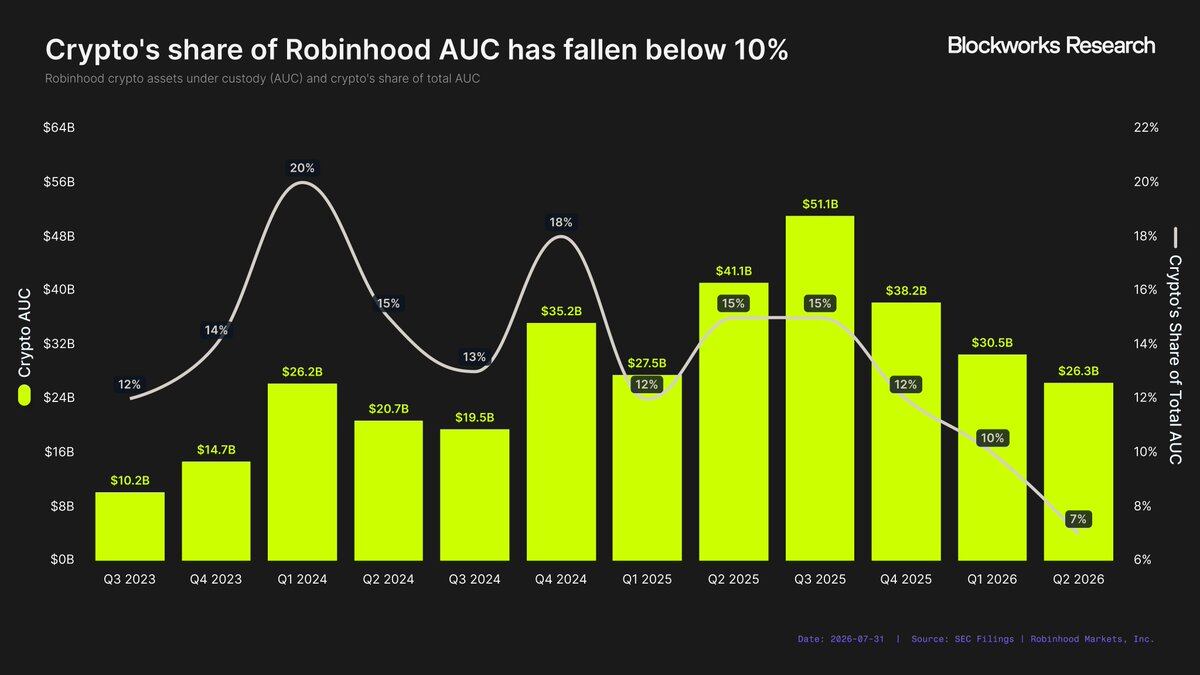
Custody data also points to a shrinking crypto footprint inside the business. In the first quarter of 2024, crypto assets under custody, or AUC, totaled $26.2 billion and represented 20% of Robinhood’s total AUC. More than two years later, crypto AUC was roughly flat at $26.3 billion, yet its share of total AUC had fallen to just 7%, the lowest quarterly mix on record.
The report’s framing is straightforward: Robinhood as a company is still growing, but crypto is not.
Robinhood Chain generated $3.6 million in REV in its first month
Rather than step back from crypto, Robinhood made its largest push deeper into the sector with Robinhood Chain. The report says Robinhood officially announced the mainnet launch of Robinhood Chain on July 1, 2026, at its The World Is Flat event. The chain is an in-house Layer 2 built to support Robinhood’s expanding on-chain ecosystem.
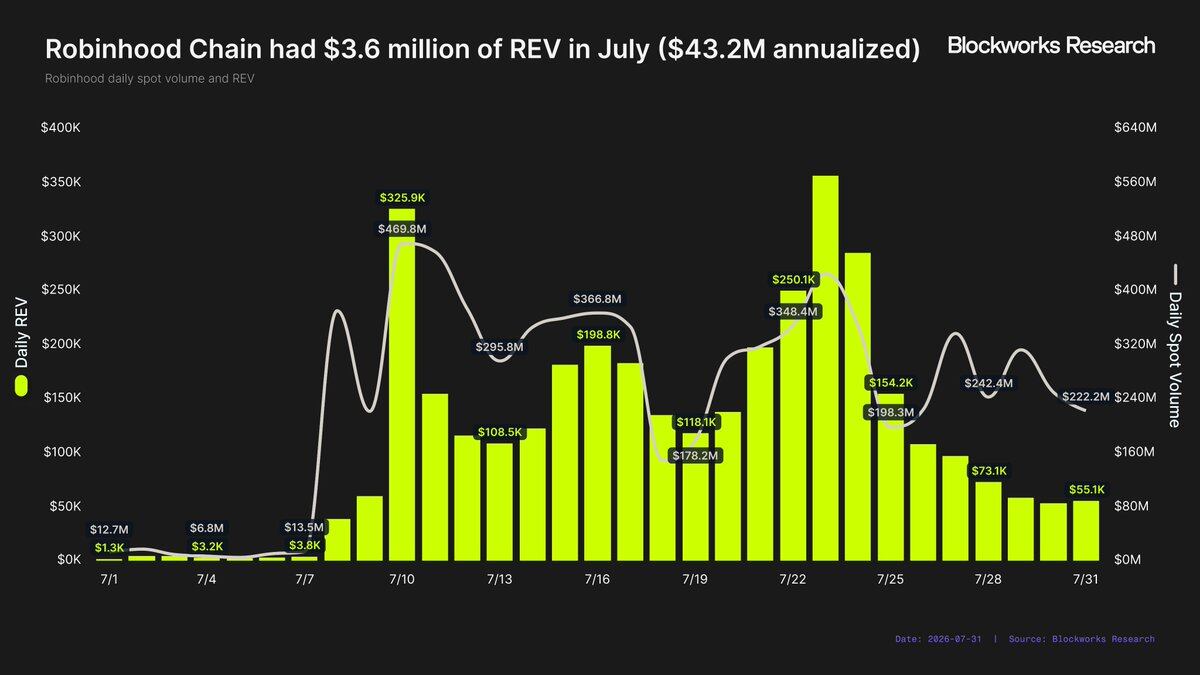
In its first month, Robinhood Chain produced $3.6 million in real economic value, or REV. If that first month is annualized mechanically, the network would be running at about $43.2 million in annualized REV.
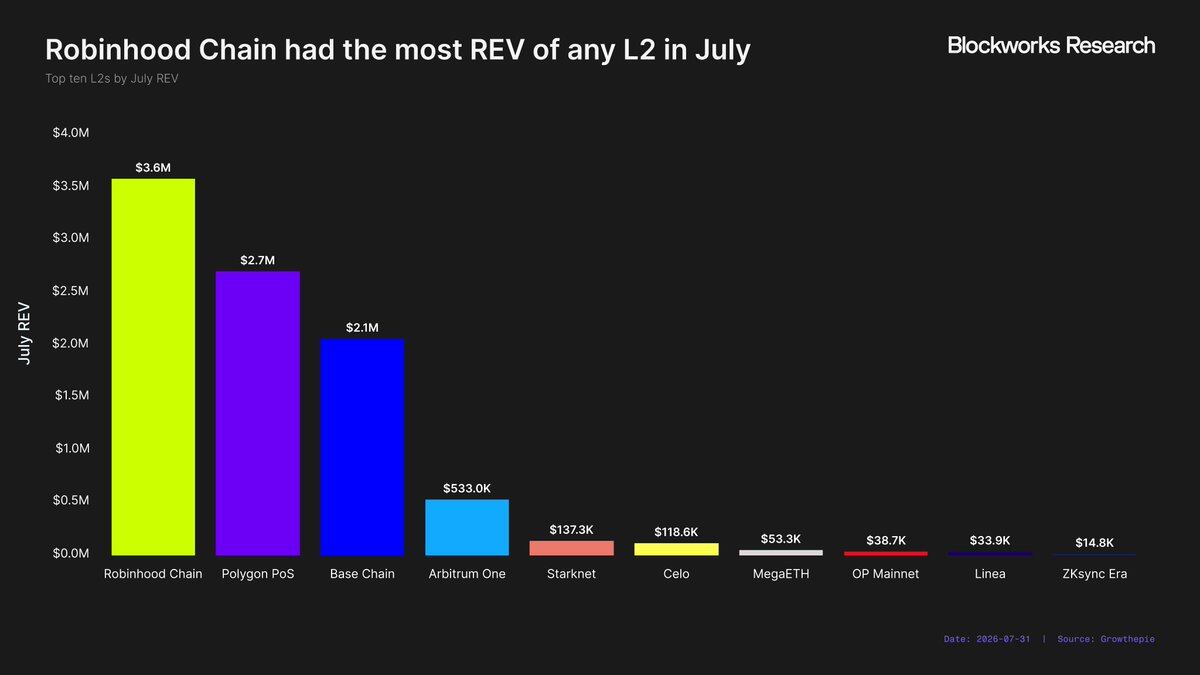
The report calls that a solid opening, but not nearly enough to reverse the decline in Robinhood’s crypto revenue on its own. Even so, the launch was notable. In July, Robinhood Chain ranked first among all L2 networks by revenue, ahead of Polygon at $2.7 million and Base at $2.1 million.
Based on data tracked by growthepie, Robinhood Chain accounted for 38% of all L2 chain revenue. The report says that made Robinhood Chain the top-earning L2 by chain revenue, though 62% of the market still sat with other networks. That leaves room for further growth through share gains even if total L2 revenue does not expand.
Early activity was driven by meme coins, not RWA
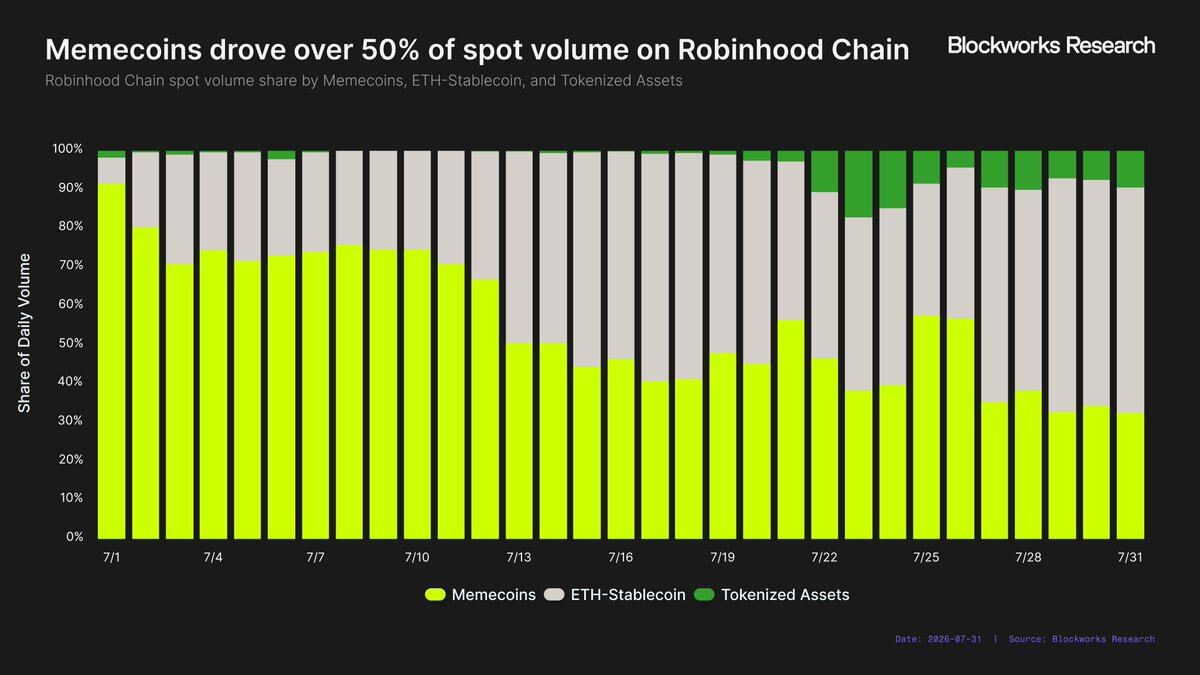
The report stresses that Robinhood Chain’s early traction did not come from real-world assets, the use case Robinhood has highlighted publicly. It came from meme coins.
In July 2026, Robinhood Chain processed $6.93 billion in spot trading volume. Of that, $3.55 billion, or 51%, came from meme coins. RWA volume reached $313.2 million, equal to only 5% of total spot volume.
The report argues that even those figures may understate how much meme-driven trading shaped activity on the network. It points to a strategy promoted by meme launch platform L()ng, where meme tokens are paired in liquidity pools with tokenized stocks or ETFs. In that setup, part of what appears as RWA trading can still be pulled by meme token demand.
From July 6 to July 31, 48% of RWA trading volume on Robinhood Chain took place in liquidity pools pairing RWA with meme coins. The report says that means meme coins likely influenced more of the chain’s activity than the headline 51% share alone suggests.
It also warns that meme-driven activity has rarely been a durable revenue base over time. Ethereum, Avalanche, TRON, and Base all had speculative phases of their own before users and capital shifted elsewhere. Whether Robinhood Chain can retain this activity is still unclear, and one month of data is not enough to show whether meme coins will become a sustainable REV source or only another stop in a broader capital rotation.
Chain revenue alone is unlikely to build the next $100 million business line
The report places Robinhood Chain inside a larger industry trend and reaches a restrained conclusion. Blockchain network revenue, it says, is in structural decline. Earlier smart contract platforms benefited from scarce blockspace and stronger fee capture, but blockspace has become more commoditized, making it harder for new chains to generate large revenue from infrastructure alone.
In July, blockchains tracked by Blockworks produced a combined $122.4 million in network revenue, the lowest monthly total in three and a half years. That compares with $333.7 million in July 2025, a year-over-year drop of 63%. The report also says the decline cannot be explained simply by market cycles, since chains still generated $300.1 million in network revenue in July 2023 during the prior bear market.
Against that backdrop, the report argues that even if Robinhood Chain keeps taking a larger share of L2 activity, chain revenue is still likely to run into a market ceiling of roughly $100 million in annualized revenue. For a company that already has 13 business lines above $100 million annualized, that is not enough to become a major contributor.
The report adds that Robinhood still faces limits in moving its existing user base on-chain. Because much of that user base is in the United States, current regulation means most of those users cannot yet access Robinhood Chain through the Robinhood app. That transition may take time.
The report sees the clearer monetization path at the application layer
The core argument is that value capture in crypto has been shifting away from infrastructure and toward applications. The report uses Solana as its example.
In January 2024, when Solana’s recovery began, applications on Solana generated $40.9 million in revenue while the Solana network itself produced $21.4 million in REV, putting app revenue at roughly 1.9 times network revenue. In January 2025, at the bull-market peak cited in the report, Solana app revenue reached $1.13 billion while Solana REV was $551.7 million, still about a 2x relationship. Later, the gap widened. By July 2026, the report says that for every $1 in revenue generated by applications in the Solana ecosystem, the network itself captured only about $0.2.
Its conclusion is that if Robinhood wants Robinhood Chain to become the next $100 million business line, it will need to monetize economic activity above the chain itself rather than rely on fees from the chain alone.
USDG already represents a measurable revenue stream
Among the application-layer opportunities, the report presents Robinhood’s stablecoin strategy as the clearest case. Unlike many chains that depend mainly on Circle’s USDC or Tether’s USDT, Robinhood positioned USDG as the native stablecoin of Robinhood Chain. That gives Robinhood an additional source of income through interest earned on reserve assets backing the stablecoin.
By the end of July, USDG’s market capitalization on Robinhood Chain stood at $333.1 million. Assuming a 3.5% reserve yield and that 90% of the related interest income goes to Robinhood, the report estimates USDG can generate about $10.5 million in annualized revenue.
The report says scaling USDG further should not be difficult. If supply reaches $1 billion, which it calls a reasonable target because 11 blockchains already have stablecoin supply of at least that size, annualized income would rise to $31.5 million, nearly matching Robinhood Chain’s current chain-revenue run rate.
Later in the report, another framing appears. At a 3.5% yield, every $1 billion of USDG supply would produce $35 million in annualized revenue if Robinhood retained all related interest income. At $10 billion in supply, that figure would rise to $350 million a year, close to Robinhood’s current annualized crypto revenue.
Lighter and Morpho point to an uneven distribution business
Outside stablecoins, the report also looks at Robinhood’s early experiments in application-layer commercialization. Lighter has launched a custom deployment of its perpetual DEX on Robinhood Chain and will split trading fees 50-50 with Robinhood. As part of that partnership, Robinhood Wallet displays Lighter perpetuals directly in the app.
The report also mentions market talk that Morpho paid Robinhood for integration inside the main Robinhood app. If accurate, that would mark a model that differs from more common blockchain arrangements, where chains pay incentives to attract applications. Robinhood, in this case, would be trying to charge for distribution instead.
Robinhood Wallet distribution looks limited; the main app looks much stronger
The report divides Robinhood’s distribution channels into two buckets: the main Robinhood app, as seen with Morpho, and the separate Robinhood Wallet, as seen with Lighter.
On-chain data tied to Robinhood Wallet shows that wallet users generated $119.6 million in trading volume in July. Daily volume peaked at $11 million on July 8, then fell to an average of $2.1 million a day in the last week of the month. Average daily active wallets in July came in at just under 7,000. The report notes that sybil filtering was not applied, so the true number of independent users may be lower.
Compared with the broader ecosystem of wallets and trading apps on Robinhood Chain, Robinhood Wallet remains a relatively small participant. Tracked wallets and trading apps produced $3.08 billion in volume in July, leaving Robinhood Wallet with less than 4% share at $119.6 million. At the same time, Robinhood Wallet ranked fourth by daily active wallets even though it ranked sixth by volume, suggesting a user base that differs from the heaviest trading platforms.
Lighter’s data strengthens that reading. Since integrating with Robinhood Wallet, Lighter’s Robinhood deployment has accounted for only 0.2% of its total perpetual trading volume. In July, that amounted to $86.8 million, below the spot trading volume generated through Robinhood Wallet over the same period.
The report also says Lighter is directly incentivizing perpetual trading through Robinhood Wallet by allocating 11 million LIT tokens, worth about $25 million at current prices cited in the report. That means even the limited activity seen so far has been supported by incentives and might have been lower without them.
The main Robinhood app looks very different. Morpho is the clearest example in the report. Robinhood users can deposit stablecoins into Morpho directly through the main app and receive an incentivized 7% annual yield. By the end of July, the market deployed by Morpho on Robinhood Chain accounted for 5% of Morpho’s total deposits and nearly 6% of all loans. In only one month, Robinhood Chain had already become Morpho’s third-largest TVL market.
The report acknowledges that Morpho’s TVL also reflects incentives. Still, it says the gap between the two channels is hard to miss. While Lighter and Morpho are not a perfect apples-to-apples comparison, the share of Morpho deposits represented by the Robinhood Chain market is still 25 times larger than the share of Lighter’s total perpetual volume represented by the Robinhood deployment.
From those early cases, the report draws a split conclusion. Distribution value appears high for protocols that can secure direct integration into the main Robinhood app. Distribution through Robinhood Wallet alone appears much less compelling. The report argues that the real value in Robinhood’s distribution power does not come from being associated with the Robinhood brand or from deploying on Robinhood Chain. It comes from direct access to users inside the main Robinhood app.
Known annualized revenue streams total about $54.8 million
The report returns to its central question: can Robinhood Chain make crypto a meaningful growth driver for Robinhood again? For now, its answer is no.
Robinhood generated $100 million in crypto revenue in the second quarter, equal to roughly $400 million on an annualized basis. By comparison, the report says the known and quantifiable revenue streams tied to Robinhood Chain, including chain REV, interest income from USDG, and Robinhood’s share of fees from Lighter, add up to only about $54.8 million annualized. That is roughly 14% of Robinhood’s annualized crypto revenue.
The report cautions that this comparison is based on annualizing Robinhood Chain’s first month and should not be mistaken for a long-term ceiling. Even so, at the current stage, Robinhood Chain has been a strong blockchain launch without becoming a meaningful contributor to the business.
Three paths stand out: scale USDG, monetize app distribution, or use the chain as an entry funnel
The report lays out three possible paths for Robinhood Chain to carry greater financial weight over time.
The first is to scale USDG. The report argues that reserve-based stablecoin interest income is already a proven business in crypto, citing the broader example of Tether and Circle. If USDG grows substantially, that revenue line could move much closer to Robinhood’s current annualized crypto revenue.
The second is to monetize direct distribution through the main Robinhood app. The report says Robinhood has something most blockchains do not: direct access to a large retail user base. If on-chain protocols are willing to pay for that access, or share revenue in exchange for it, Robinhood can monetize its user funnel rather than depend only on fees from the chain itself. The early evidence suggests this works when the protocol reaches users through the main app.
The third possibility is that Robinhood does not view Robinhood Chain as a standalone profit engine at all. Instead, the chain may function as an entry point and conversion channel. In that model, Robinhood Chain would introduce users to tokenized assets first, then route them into the broader Robinhood ecosystem, where they may end up trading stocks, options, crypto, and other higher-value products. Under that setup, the chain’s value would not necessarily show up in network revenue, but in stronger engagement and revenue elsewhere across Robinhood.
Based on the data available so far, the report stays cautious. Robinhood Chain is not yet a meaningful growth driver for Robinhood, and chain revenue alone will not make it one. For that answer to change, Robinhood will need to scale USDG or build a durable business around monetizing user distribution through its main app. If that does not happen, Robinhood Chain may carry only indirect financial value as a funnel into the higher-value products that already drive Robinhood’s business.