

Robinhood Chain burst onto the scene after launching on July 1 and quickly became one of the busiest public chains by onchain activity. That momentum has faded in recent weeks, and the latest analysis cited by MarsBit says the chain’s September slowdown has revived questions over whether the early run was only temporary.
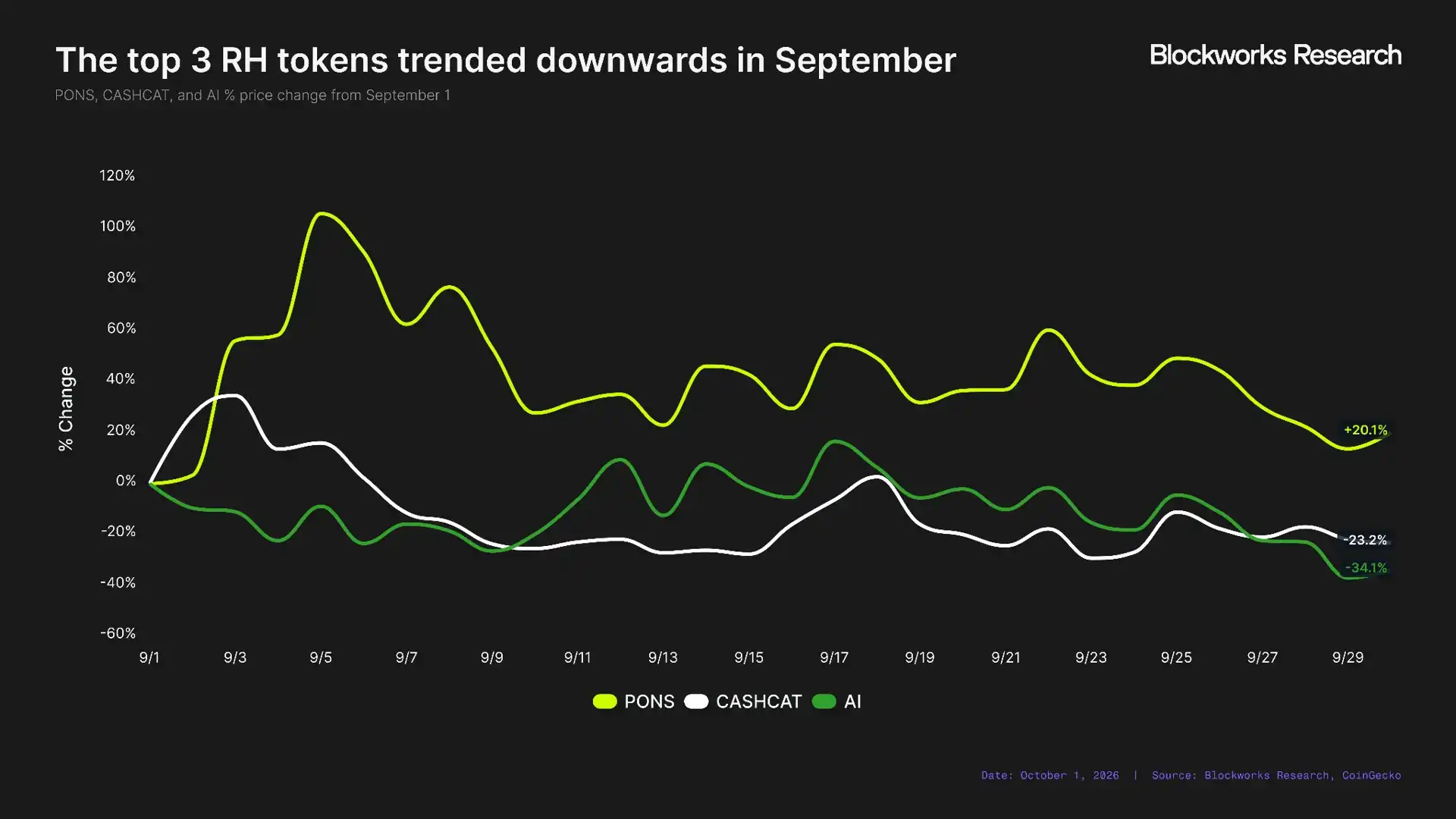
Top native tokens have weakened since the start of September
The shift is most visible in the chain’s three largest native tokens by market value: PONS, CASHCAT and AI. After being repriced around late August and early September, all three moved into a choppy decline over the following weeks.
Since Sept. 1, AI has fallen 34% and CASHCAT is down 23%. PONS is still up 20% over the same stretch, but at its current price of $0.526, it remains 45% below its $0.96 peak. The report says weakness has spread across leading projects in the Robinhood ecosystem, with the contrast becoming more obvious when compared with the broader crypto market’s performance in the second half of September.
Daily network REV has fallen back to pre-surge levels
The cooling trend is not limited to token prices. Underlying chain data show that Robinhood Chain’s daily network REV has retreated to where it stood before the late-August and early-September frenzy.
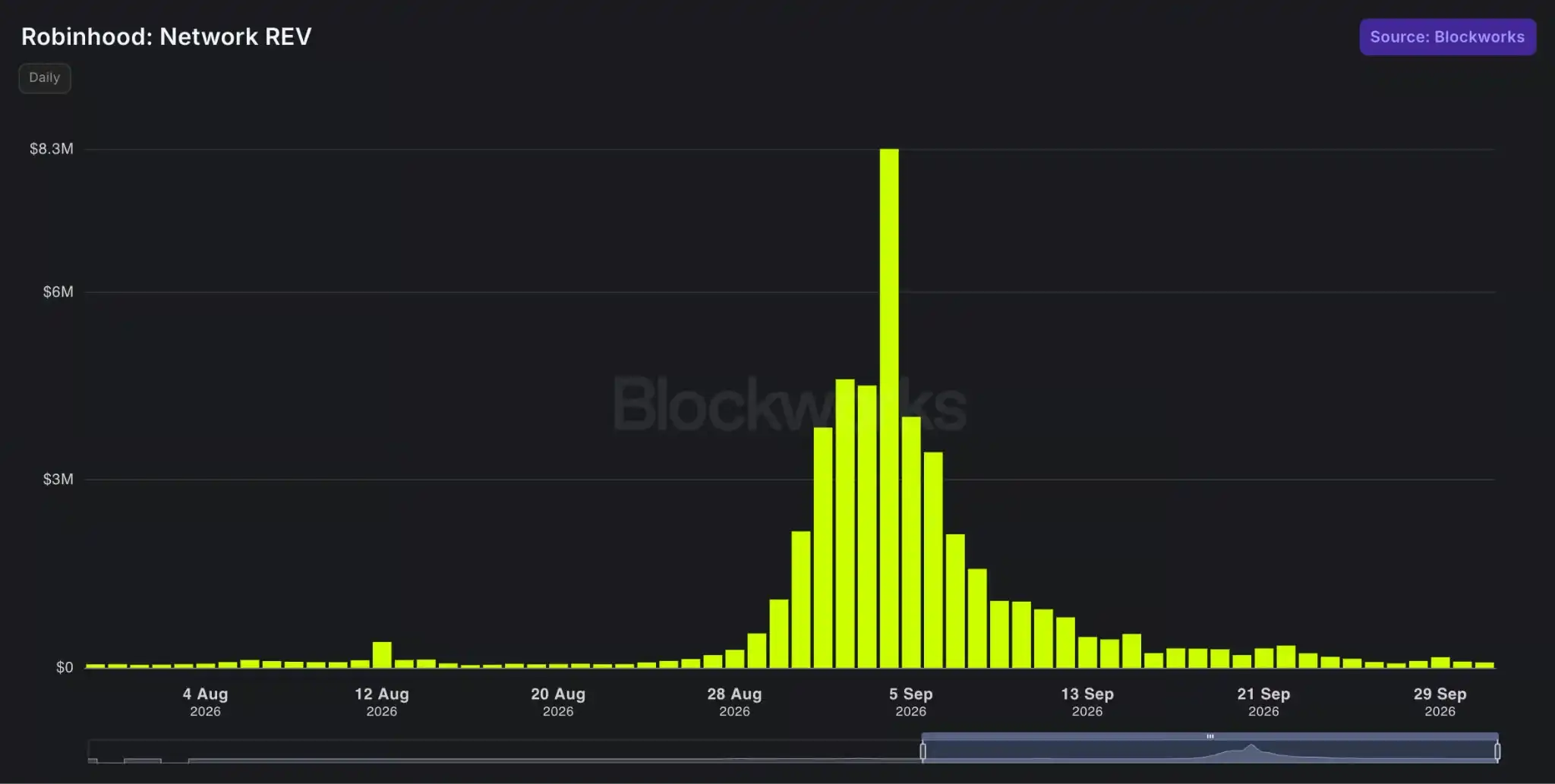
The analysis adds one caveat: Robinhood raised the chain’s gas limit, which partly exaggerates the size of the move down from the peak. Even with that adjustment in mind, the chain is still showing what the report describes as classic signs of an onchain bubble unwinding.
Meme-coin speculation helped bootstrap stock-token growth
The piece argues that weaker activity matters because healthy and durable speculative trading may be central to Robinhood Chain’s longer-term success. The chain was not built for meme-coin trading, but meme coins appear to have served as an effective bootstrap mechanism for its stated goal of becoming a major onchain hub for real-world assets, or RWAs.
Robinhood stock token TVL rose alongside the increase in activity, climbing from $48 million on Aug. 30 to $140.6 million on Sept. 1. Once the “trenches” cooled, that growth stalled. As of Oct. 1, Robinhood stock token TVL stood at $145.8 million, roughly unchanged from early September.
LONG trading volume shows the clearest link
According to the analysis, the biggest driver of Robinhood stock-token adoption has been speculative onchain activity, especially meme coins paired with Robinhood stock tokens on launch platforms such as LONG and Pons.
That relationship is clearest in LONG’s trading volume. Measured on a seven-day basis, stock-token TVL tended to rise when LONG volume increased, producing a correlation of 0.86. When LONG volume was flat or falling, the correlation dropped to -0.03. In most seven-day samples, a decline in LONG volume was followed by little to no movement in stock-token TVL.
The next phase may still rely on speculative users
The report says this may offer a clue to Robinhood Chain’s next stage, or at least to where incentives are likely to be directed. If Robinhood truly wants to build the chain into an onchain hub for real-world assets, it may still need market participants on the chain to get there.
So far, the analysis says Robinhood has not shown a more effective tool than meme-coin activity for driving sustained growth in stock-token TVL. Given what it describes as Robinhood’s cultural fit with meme coins, continuing to support and incentivize that activity as a way to keep bootstrapping stock tokens would make sense.
Until Robinhood shows that it has other levers to expand onchain real-world asset adoption, the author expects the chain to keep leaning on the “trenches” because the setup has worked for both sides. On that basis, the report stops short of saying Robinhood Chain is finished and instead frames the current lull as a pause before the next phase of adoption.