
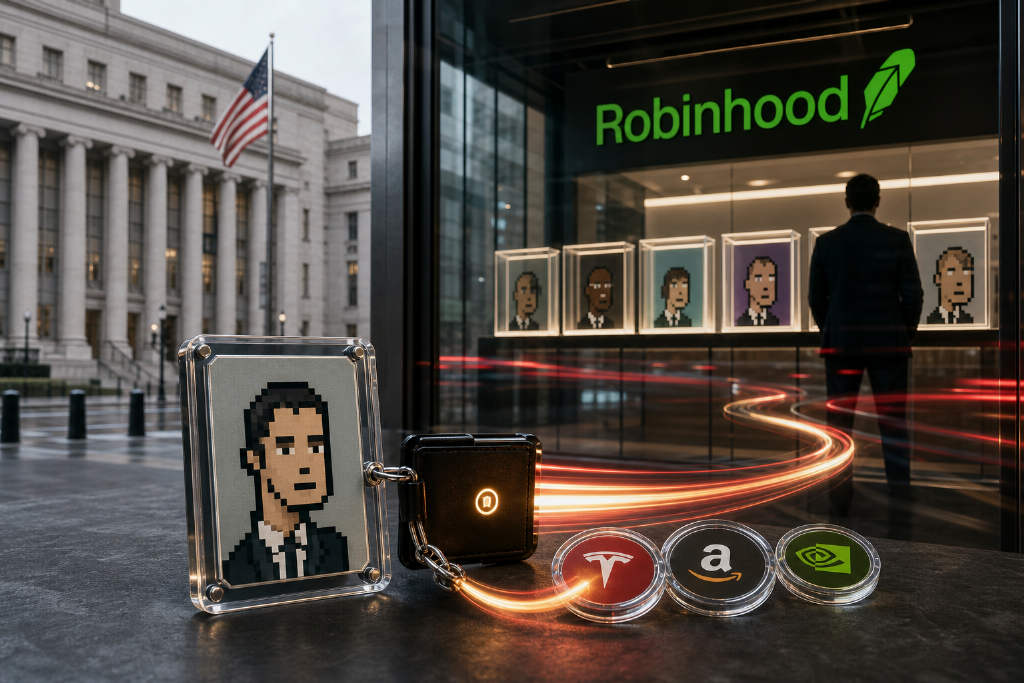
A fast-rising NFT collection on Robinhood Chain is forcing a fresh legal question into view: when does a digital collectible start to look like a security?
StonkBrokers, a 4,444-piece collection of colorful, suit-wearing pixel avatars, has climbed 77% in floor price over the past month. The project lets holders accrue Stock Tokens as rewards on Robinhood’s Ethereum layer-2 network, giving them exposure to Wall Street names including Tesla, Amazon, and Nvidia.
Robinhood has made those tokens available to investors in more than 120 countries, but not in the U.S., U.K., Canada, or Switzerland. In the U.S., the rules that would govern this type of product are still unsettled. The Securities and Exchange Commission’s proposed exemption for tokenized securities was removed from its agenda in August and has never been published.
The team appears to have considered earlier NFT projects that ran into U.S. securities law, including Ashton Kutcher’s Stoner Cats 2. Under the project’s terms, StonkBrokers holders must pass what it calls “geographic and network screening” and complete a “Program attestation” stating that they live in a “permitted jurisdiction” before they can earn Stock Tokens. At the same time, the NFTs can be purchased by anyone on secondary markets outside the same Know Your Customer procedures Robinhood customers must complete.
That combination places the project in new territory, according to Ariel Givner, founder and principal attorney of Givner Law. “Nobody’s done it before,” she told Unchained. “It’s a gray area, and it’s bringing together a lot of new things that we don’t have precedent on.”
A sharp rally, a pullback, and another move higher
Clutch Markets, the Grand Cayman company behind StonkBrokers, said on X on Aug. 25 that the project had distributed more than $1.57 million in what it described as marketing rewards. In early August, the collection’s floor moved above Bored Ape Yacht Club’s, then gave back roughly 60% of that rally, and later moved above it again. By Tuesday afternoon, StonkBrokers traded at a floor of 8.50 ETH, or about $20,500, versus Bored Ape’s 7.65 ETH.
That floor is not set through open bidding. The project’s own automated market maker prices every broker at a flat 666,666 $STONKBROKER plus a 10% fee, so the floor follows the token itself. On Tuesday, $STONKBROKER fell 14% even as the floor reading climbed.
The collection has stood out in a slow market for profile-picture NFTs. It had no mint price, although allocation required burning an earlier Clutch NFT before a July 16 deadline. Pseudonymous crypto analyst Diamond estimated the mint cost at around $37.
In March, the SEC and the Commodity Futures Trading Commission said a “digital collectible” is not itself a security, while leaving open that one can still be sold as part of an investment contract. Givner told Unchained that StonkBrokers has tied itself directly to financial products that operate within strict regulatory boundaries.
Freely transferable NFTs, while U.S. users stay blocked
StonkBrokers can hold Stock Tokens because of ERC-6551, an Ethereum standard that gives each NFT its own smart-contract wallet, known as a token-bound account. According to the project’s documentation, every StonkBrokers NFT comes with a wallet “seeded with tokenized stock at mint and, once activated, can receive stock-token reward drops through the StonkBrokers rewards program.”
Because the Stock Tokens sit inside the NFT’s sub-account rather than in a user’s personal wallet, selling the NFT on a secondary market effectively transfers that portfolio along with it.
Ryón Nixon, founding partner of crypto-native law firm Horizons Law, told Unchained that this gap appears important. Robinhood’s Stock Tokens, he said, are debt instruments issued by an offshore affiliate. U.S. persons cannot directly purchase or redeem them, but they can be transferred freely like other ERC-20 tokens, including stablecoins.
“In simple terms, StonkBrokers engineered the protocol in a way where they don’t let people in certain jurisdictions, like the U.S., interact with the touchpoints that might trigger compliance requirements like a customer identification program,” Nixon said.
He added that the offshore separation creates a distinctive legal buffer. Even if a Stock Token ends up in a U.S. person’s wallet, Robinhood’s offshore affiliate still does not allow U.S. persons to directly purchase or redeem those tokens, so from its perspective the transactions are intended to remain entirely offshore.
Robinhood’s own base prospectus makes the picture less straightforward. It reserves the issuer’s right to declare a transfer “null and void” and to “freeze, block, seize, transfer, redeem and/or recreate” a token. It also says the contracts will be programmed to block addresses identified as sanctioned.
Why Stoner Cats 2 still matters
Before the SEC adopted a more collaborative tone under its current leadership, the agency brought several enforcement actions against NFT issuers. One of the best-known cases involved Stoner Cats 2, LLC, the company behind an animated web series backed by actors Mila Kunis and Ashton Kutcher. The SEC argued that the firm had offered unregistered securities because buyers had “a reasonable expectation of obtaining a profit based on SC2’s managerial and entrepreneurial efforts,” pointing to its marketing campaign and its 2.5% cut of secondary sales. The company paid a $1 million penalty.
Commissioners Hester Peirce and Mark Uyeda dissented, writing that the analysis “lacks any meaningful limiting principle.”
The SEC’s position rested on the Howey test. Under that framework, a transaction can qualify as an “investment contract,” and therefore a security, if it involves an investment of money in a common enterprise with an expectation of profits derived from the efforts of others.
The project avoids the language of passive returns
StonkBrokers has tried to strip out the idea of passive income. Holders must stake $STONKBROKER to activate a broker and then perform work to receive payouts. Any wallet can trigger the “Clock In” that releases a round of rewards, but only activated brokers can collect them.
According to the terms of service, participants receive rewards for “the creation and publication of qualifying social media posts promoting the StonkBrokers game, collection, art, or Clock In.”
The same document strictly bans words such as “royalty,” “dividend,” “yield,” and “passive income.” Instead, it says the compensation is “payment for services rendered” to users who are technically classified as independent contractors.
An untested defense
Whether that structure would work under scrutiny remains untested. The March interpretation’s safe harbor for token distributions applies only where recipients provide “no money, goods, services, or other consideration,” and it specifically lists social-media promotion as a form of service.
In a 2018 case against Tomahawk Exploration, the SEC found that tokens paid out for promotional posts amounted to an offer and sale of securities.
The project’s documentation says rewards are funded mechanically through 70% of trading fees from its automated market maker, along with fees from lending, its Safety Deposit Box, and a slot-machine game. Its terms of service describe something looser, saying the project funds the pool “in its sole discretion.” Buyers, then, may be relying on a funding narrative that is not the same as the one the project has committed to in writing.
Expansion continues while the legal questions stay open
The project has kept building. On Aug. 29, it launched Stonk Exchange, a venue built on Uniswap v4 pools where liquidity providers collect premiums from leveraged traders. Covered-call vaults are scheduled for September.
Robinhood’s crypto account retweeted the team on Aug. 28, boosting a Robinhood Chain block explorer the project had built. Robinhood, however, has not publicly addressed the stock-token rewards program itself.
StonkBrokers is also arriving early in Robinhood Chain’s life. The network’s mainnet launched on July 1 after a public testnet in February.
Interest in tokenization has risen sharply this year. dYdX Labs brought leveraged stock and crypto tokens onto the same chain last week. On Tuesday, the SEC proposed its first overhaul of transfer-agent rules since the 1970s and asked for comment on how blockchain systems should interact with the official record of who owns a security.
Nixon said the structure is unusual, but it reflects a wider appetite for experimentation. “It’s a very interesting approach that opens the market up to new design spaces, which is refreshing to see in the current market conditions,” he said.
Unchained said it had reached out to Clutch Markets and Robinhood for comment.