
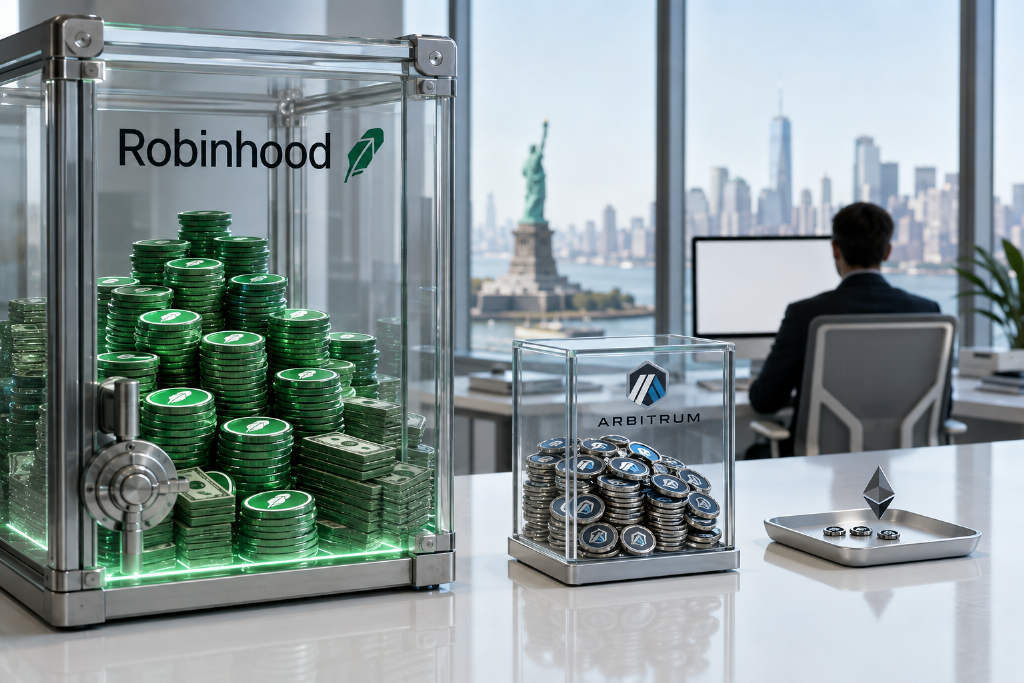
Robinhood Chain pulled in $16.78 million in user fees over the past seven days. Ethereum got just $2,008 for settlement and data costs, or 0.012% of the total, according to BlockTempo.
Put it more bluntly: for every $100 users spent on gas on Robinhood Chain, only $0.012 made its way back to Ethereum, the report said.
During that same stretch, Arbitrum—the tech stack underneath it all—took about $2.28 million under its expansion deal, equal to 10% of Robinhood Chain’s net revenue. From that, $1.82 million went to the Arbitrum DAO treasury. Ethereum, handling base-layer settlement and security, got $2,008 in that same seven-day period.
How the $2,008 paid to Ethereum breaks down
BlockTempo said $1,748 of the total went to gas for posting transaction batches to Ethereum mainnet. Another $260 was spent on blob data fees. Over the past week, Robinhood Chain posted 13.5 GB of data to mainnet.
The report tied the cheap cost to the Fusaka upgrade late last year. That change increased blob capacity and drove down the per-unit price L2 networks pay for mainnet data space.
Mainnet costs did not rise with transaction activity
The article said these L1 costs do not move in lockstep with chain activity. Batch uploads run on a fixed schedule, so whether users make 1 million transactions or 100 million transactions on the L2, the mainnet bill stays about the same. So yes, the busier Robinhood Chain gets, the smaller Ethereum’s cut becomes.
BlockTempo also pointed back to its July report on comments from ARK Invest research director Lorenzo Valente. At the time, Valente said Ethereum was getting 0.15% and described the setup as Ethereum “selling its most valuable settlement layer at marginal cost.” He suggested a different split: Robinhood 75%, Arbitrum 10%, and Ethereum 15%. Two months later, the real split had fallen from 0.15% to 0.012%.
One L2 out-earned Ethereum mainnet in fees
Ethereum mainnet produced $2.38 million in total fees over the past seven days. Robinhood Chain alone brought in $16.78 million—seven times the mainnet number.
Across 16 L2s tracked by growthepie, total fees for the same period reached $17.78 million. Robinhood Chain by itself made up 94.4% of that total. And those 16 chains together paid Ethereum only $8,047 over the period, the report said.
Application-layer protocols collected even more
In some cases, apps on Robinhood Chain made more in fees than the chain itself. The report said Uniswap V4, the network’s main trading protocol, generated $43.68 million in fees over the past seven days, with most of that going to market makers. Token launch platform Pons collected $28.56 million, and trading bot GMGN brought in $13.38 million.
ARB, UNI and HOOD outpaced ETH
Price action over the same seven-day stretch was lopsided too. ARB jumped 48.8%, and UNI gained 38.9%. Robinhood shares rose from $104.81 on Aug. 31 to $122.11 on Sept. 4, up 16.5%. ETH was up 0.4% in that same window.
On Sept. 3, HOOD traded 51.63 million shares, triple the previous day’s volume. BlockTempo said the gains were concentrated in Arbitrum, which gets a share of the revenue, and in application-layer names like Uniswap. Ethereum, despite providing settlement, did not get a similar price move.
What Robinhood Chain was built for, and what comes next
The article said Robinhood Chain was first built for tokenized U.S. stocks. Robinhood CEO Vlad Tenev has laid out a plan to move the broader Robinhood ecosystem on-chain.
For now, though, the chain’s main fee engine is meme coin issuance and trading. The report also said Robinhood Chain’s gas discount campaign is due to end after September, which leaves an obvious question: does activity cool off after that?
Questions raised in the report
Why is Robinhood Chain paying so little to Ethereum?
Because an L2’s payment to Ethereum is the cost of batch submission, not a revenue stream that grows with transaction count. Robinhood Chain uploaded 13.5 GB of data to mainnet over the past seven days and spent only $2,008, including $260 in blob fees.
What share should Ethereum’s settlement layer receive?
BlockTempo cited Valente’s July proposal for a 75% / 10% / 15% split among Robinhood, Arbitrum, and Ethereum. The real split now is 0.012%, equal to $2,008 over the past seven days.