
Crypto’s old question has not gone away: should a team build a blockchain first and then look for users, or build up users and business demand first and decide later whether a chain is needed? For the past few years, the industry has mostly followed the first route.
The standard pattern was familiar. Launch a new chain, set up an ecosystem fund, recruit developers, hand out incentives and airdrops, and then work to pull users in. That model became common across the sector.
Its weaknesses also became harder to ignore. A blockchain can exist without users. A collection of projects can exist without revenue. Strong technical specifications do not automatically bring adoption, and the industry has seen plenty of examples.
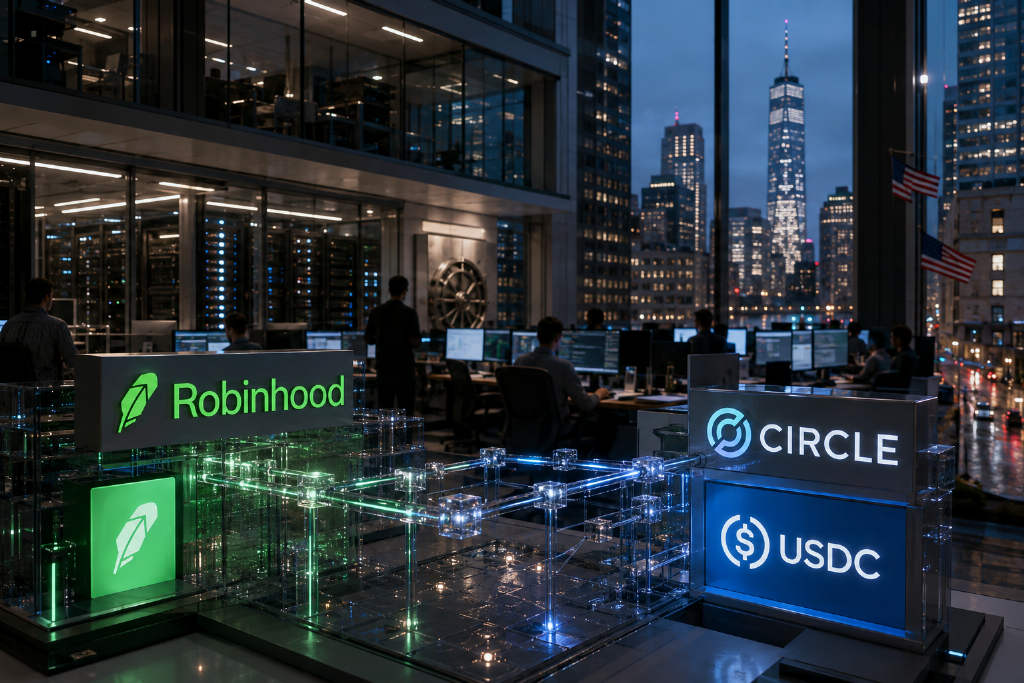
Robinhood and Circle are taking a different route
Robinhood’s recent move points to another path. The company already has a large user base, an established trading system, and real capital flows.
Against that backdrop, launching RH chain is not described as building a blockchain for its own sake. The idea is to move trading activity and assets that already exist onto the chain over time.
That flips the usual public-chain sequence. Instead of starting with technology development, then ecosystem deployment, then user acquisition, the process begins with users and trading demand, with the chain added later as infrastructure.
In that sense, the chain is not the starting point. It is the outcome.
Circle’s Arc is moving in a similar direction. According to information released by Circle, Arc is scheduled to launch mainnet on Sept. 16. It is positioned as an open network for financial markets, with a focus on stablecoins, payments, settlement, and on-chain finance.
The issue is no longer basic awareness
For Circle, the biggest question is not whether people know the company. The question is how to run those assets and capital flows on infrastructure that is better suited to financial activity.
That is why Arc is not presented as just another general-purpose Layer1. Circle has said that more than 100 institutions and ecosystem participants have joined Arc’s construction and validation system.
Robinhood brings investment users and trading scenarios. Circle brings stablecoins, a payments network, and financial institutions. Their resources differ, but the direction of travel looks increasingly similar.
From technology product to business infrastructure
Once users, capital, and business activity have already reached scale, a chain stops looking like only a technology project. It can become part of the business infrastructure.
Industry debate around blockchains used to center on TPS, gas fees, and cross-chain capability. As real financial activity moves on-chain, the requirements become more specific.
Different businesses do not ask for the same mix of speed, cost, privacy, permissions, and security. A general-purpose public blockchain can offer core functions, but it may not be the best fit for every financial use case.
From that perspective, the blockchain market of the future may not narrow to just a handful of mega public chains, and it also may not require every project to launch one of its own.
A more likely setup, according to the article’s framing, is that some large networks continue to serve as open ecosystems and liquidity hubs, while companies with large user bases, asset pools, or transaction volumes build blockchain networks that better match their own businesses.
Under that trend, chains themselves may be treated less as standalone products. Users may not need to care which chain they are using, while blockchain becomes part of the backend.