
ChainFeeds digest centers on five market themes
ChainFeeds’ Oct. 1 research digest brought together five topics: Michael Saylor’s latest explanation of Strategy’s “digital credit” framework, Robinhood’s direct challenge to Coinbase in the U.S. trading market, the question of where repurchased tokens actually go in cases such as AAVE and PUMP, a renewed debate over token value capture after a shift in tone from the U.S. Securities and Exchange Commission, and the tension between ENA buyback expectations and a large token unlock scheduled for Oct. 5.
Strategy says bitcoin capital can support a digital credit business
In the first item, Michael Saylor described Strategy’s corporate plan as a balance-sheet model built around two complementary products backed by bitcoin capital. MSTR is aimed at investors seeking amplified bitcoin exposure while also owning equity in what he called a growing digital credit business. STRC is designed for a different profile, one that prioritizes lower volatility, shorter duration and dollar income.
Saylor’s argument is that MSTR investors are not simply buying bitcoin exposure. They are buying equity in a company that seeks to create value by accumulating bitcoin capital, developing credit products and actively allocating capital. That structure can produce amplified long-term upside, but it also carries amplified volatility and downside risk. STRC, by contrast, is meant for investors who care more about dollar-denominated income, lower price swings and a shorter duration profile.
Both products sit on the same balance sheet. Strategy said it manages bitcoin, dollars, debt, preferred stock and common stock together, adjusting financing tools and asset mix as market conditions change. Common equity issuance serves two main purposes. The company can issue MSTR to buy BTC, increasing bitcoin holdings without adding more senior payment obligations. It can also issue MSTR to raise dollars, which can then be used to build payment reserves, repay existing debt or preserve flexibility for future opportunities.
For STRC, the company said supply can be managed in both directions. If STRC trades above par and financing conditions are attractive, Strategy can issue more STRC to raise funds. If STRC trades below par, the company can buy it back, retire preferred shares at less than face value and reduce future dividend obligations. Strategy also stressed that a buyback policy does not amount to a guaranteed price floor for STRC.
Saylor summarized the MSTR thesis as “Amplified Bitcoin + Digital Credit.” In that framing, common shareholders participate in potential appreciation of the company’s bitcoin capital and also in value created through product innovation, broader investor adoption, stronger financing capacity and capital allocation. He reduced the digital credit objective to three points: reduce volatility, compress duration and extract yield.
Robinhood is attacking several Coinbase businesses at once
Foresight News argued in the digest that Robinhood is no longer competing with Coinbase on crypto trading alone. Robinhood Chain, which launched its mainnet on July 1, crossed 100 million transactions in less than three months and later pushed cumulative transaction volume past 750 million, making it the fastest EVM chain to reach that scale, according to the report.
The operating figures cited in the piece were also notable. Daily fee revenue on Robinhood Chain was about $200,000 in July. By early September, that figure had at one point moved above $4 million, and fee revenue over the following week reached roughly $25 million. On Sept. 1, daily DEX volume was about $1.595 billion, DeFi deposits onchain were around $738 million and stablecoin supply was close to $800 million.
The report said Robinhood’s approach differs from the usual Layer 2 playbook. Many chains launch first and then try to attract users, assets and liquidity. Robinhood started from the other end. It already had more than 28 million funded users, then moved the assets and financial products those users might trade onto the chain. In that sense, Robinhood Chain was not built as a general-purpose public chain. It was built for financial assets moving onchain.
The competitive pressure extends well beyond the chain itself. In the second quarter of 2026, Robinhood’s event contracts generated $156 million in revenue, up more than 10x year over year. That was the first time the category exceeded crypto trading revenue, which stood at $100 million, and it also topped stock trading revenue of $129 million. Total net revenue for the same period reached $1.308 billion, up 32% year over year.
Tokenized equities are another front in the same contest. On July 1, Robinhood expanded Stock Tokens to more than 120 countries and regions, giving global users onchain economic exposure to U.S. equities. Roughly one month after launch, holders of Robinhood’s tokenized stocks had reached about 328,000, equal to around 44% of holders across the major tokenized stock platforms at the time.
That lead in user count did not translate into a lead in assets. Robinhood’s tokenized stock assets were about $44 million, well below Ondo’s $857 million and xStocks’ $487 million. Foresight News used that gap to make a broader point: Robinhood’s edge is not serving whales. It is turning financial products into mass-market consumer products.
That changes the comparison with Coinbase. The old question was which company had the stronger crypto business. The report said the better question now is this: when stocks, crypto, prediction markets and real-world assets all move onchain, who becomes the unified trading entry point?
As of the end of August, Robinhood had 28.6 million funded customers and $384 billion in platform assets. Coinbase, by contrast, was described as stronger in crypto-native infrastructure, with an exchange, wallet, Base, the USDC ecosystem, institutional custody, derivatives and a more complete onchain financial stack. The digest stopped short of saying Robinhood has replaced Coinbase. It argued instead that even the label “largest U.S. crypto exchange” is becoming less precise, because Robinhood may be changing what an exchange means in the first place.
Buybacks are not all the same: AAVE and PUMP put the focus on token destination
Deep Tide TechFlow used AAVE and Pump.fun to examine a basic but often overlooked issue in crypto: what happens after a project buys back its own token. In equities, buybacks are commonly linked to a lower share count and higher value per share. In crypto, the report said, repurchased tokens can end up in at least four very different places, and each outcome carries different implications for holders.
One possibility is that the tokens go into a treasury or ecosystem reserve. In that case, they disappear from the open market but not from total supply, and governance may still release them later. A second possibility is a permanent burn, where tokens are sent to an address with no private key and removed from total supply for good. TechFlow described that as the only outcome that truly resembles share retirement. A third path is to move the tokens into an insurance fund, liquidity pool or staking reward pool. That requires a closer look at withdrawal rights, lockups and the chance of future re-entry into the market. A fourth path is distribution to stakers. That is income for stakers, but it can amount to dilution for non-stakers.
The report said investors also need to ask where the money for those distributions comes from. If the source is real protocol revenue, such as fees, interest or licensing income, the mechanism is easier to defend. If the source is treasury token reserves or fresh issuance, the economics look very different.
Pump.fun was the main case study. From launch through April 2026, the platform used 100% of its revenue to buy back PUMP. On April 28, 2026, the team burned all accumulated repurchased PUMP in a single move, worth about $370 million and equal to 36% of circulating supply. It also said that from then on, 50% of revenue would go to buybacks and burns, while the other 50% would go to business development. By the end of July 2026, Pump.fun had spent about $414.6 million to buy back and burn 153.73 billion PUMP.
Price action did not follow the same direction. PUMP fell from its $0.004 issue price to around $0.0013, and it was down about 89% from its all-time high of $0.01214. Analysis from 8Blocks, as cited in the digest, said Pump.fun’s buyback amount covered only about 2% of daily trading volume. The report added a second problem: PUMP has no required use case inside the product. Users do not need to hold or spend PUMP to create meme coins, trade or use PumpSwap. At the same time, team and early investor tokens are still unlocking, so the burn pace has not outstripped new supply entering circulation.
TechFlow’s conclusion was direct. Even if buybacks and burns are transparent and irreversible, they are unlikely to provide durable price support if the token itself lacks internal demand.
The report listed five checks for investors whenever a project announces a buyback:
- Where does the buyback funding come from? Revenue from real business activity is different from treasury recycling or new issuance.
- Where do the repurchased tokens go? Permanent burns reduce supply. Treasury or reserve transfers leave open the possibility of future release.
- Can the buyback pace outrun unlocks? If team, investor or ecosystem incentives are still scheduled to hit the market, net supply may still rise.
- Is the mechanism irreversible or adjustable? A locked contract and a committee- or governance-run process do not offer the same certainty.
- Does the token have internal demand? Without a real use case, buybacks offset sell pressure but do not create new demand.
The report added one more warning. Once the buyback budget runs out, or once a major unlock window arrives, a price-support story built only on buybacks can break down quickly.
After the SEC shift, token value capture is back in the conversation
Jeff Dorman’s contribution to the digest argued that crypto protocols have increasingly come to resemble real businesses. Decentralized exchanges generate trading fees, lending protocols earn net interest income, blockchains collect transaction fees and applications can produce subscription and service revenue. Yet in many cases, the tokens tied to those protocols have little or no economic link to the underlying business.
That disconnect is why, in his words, investors have spent years separating “good project, bad token” from “good project, good token.” Dorman said the problem was not always greed or poor judgment by founders. Often it was a deliberate response to legal advice. Crypto lawyers repeatedly warned founders that if they explicitly linked protocol success to token value, the SEC would be more likely to treat the token as a security.
The result, he said, was a market full of governance tokens with weak economic rights. Projects avoided creating assets with clear claims on value and instead issued tokens that offered voting rights few people truly cared about. At the same time, the easiest tokens to defend legally became, in economic terms, the most absurd meme coins: no promises, no cash flow and no management commitment to build anything.
Dorman said that distorted the entire market. Fundamental investors could not value tokens because many were intentionally designed so they could not capture fundamentals. Founders became used to running two separate capital structures, one for themselves and venture investors in the form of equity, and another for users in the form of tokens. Centralized exchanges listed whatever could generate volume, regardless of whether the asset had durable value. Venture investors made money through private rounds and token unlocks, while secondary-market buyers increasingly served as exit liquidity.
Investors, he wrote, learned the lesson the industry had unintentionally taught them: if fundamentals do not matter, trade narratives or leave the sector. That dynamic helped meme coins, short-term speculation and rotating crypto narratives dominate the market over the past several years.
His central point was that regulatory uncertainty did not protect investors. It encouraged worse token design. With the SEC now loosening its stance, Dorman said the market can finally return to the questions it should have been asking all along: does the protocol create value, does it generate revenue, can the token capture some of that value, is management allocating capital rationally, are insiders aligned with outside token holders, is token supply growing faster or slower than demand, and if the protocol becomes very successful, can holding the token actually make investors money?
He framed the shift in simple terms. The previous generation of crypto tokens was designed around fear of regulatory action. The next generation can be built around a more basic logic: create valuable products, generate real cash flow and make sure the people who hold the asset participate in the value the project creates. As he put it, “We’ve spent too long designing tokens around lawyers. It’s time to start designing tokens for investors.”
ENA faces a buyback narrative test ahead of a 1.4 billion token unlock
The fifth section of the digest turned to ENA and the gap between market expectations and the actual mechanics of Ethena’s token model. Deep Tide TechFlow said one of the main narratives behind ENA’s rebound from its lows has been “protocol revenue used for buybacks and burns.” The report argued that many retail buyers chasing the move have not worked through the trigger conditions in detail.
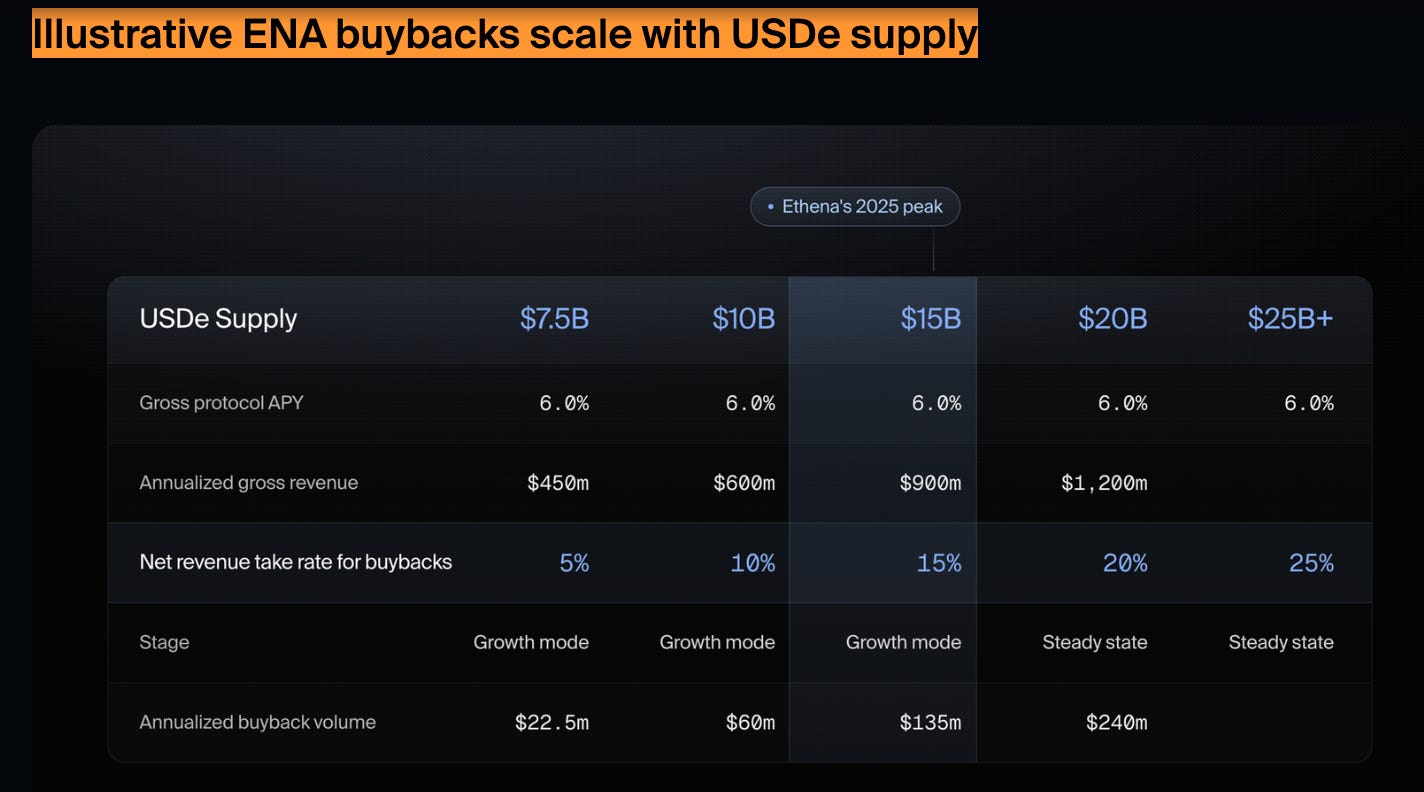
Under Ethena’s design, the hard threshold for revenue sharing that can feed ENA buybacks is a USDe circulating supply of $7.5 billion. The report said USDe is currently hovering around $4.9 billion. That means protocol income is still mainly allocated to sUSDe stakers and distribution partners, and no direct ENA buy pressure is created unless USDe expands by more than 50% from current levels.
Even if USDe does cross the $7.5 billion threshold, the report said the buyback mechanism does not immediately switch into full-scale operation. At the first tier, only 5% of total revenue is allocated to the foundation, and 95% of that net income is used to buy back ENA. TechFlow’s reading was that ENA remains, for now, a governance shell that does not capture the protocol’s core cash flow. Investors may think they are buying a cash-generating asset today, but the report said the economics look more like a forward option with demanding exercise conditions.
The report also pointed to a token-structure change made by the Ethena Foundation at the end of August. It bought out part of the seed allocation thought to be inclined to sell, then canceled the remaining investors’ monthly release schedule and concentrated those tokens into a single unlock on Oct. 5. The market briefly read that as an early clearing of long-term overhang, and the move became one of the catalysts for ENA’s September price rise.
But the same structure creates a concentrated supply event. On Oct. 5, as many as 1.4 billion VC and investor tokens are set to unlock at once, equal to about 14% of current circulating supply and worth more than $300 million, according to the report. The theoretical buyback defense that could absorb some of that pressure cannot be activated yet because the $7.5 billion TVL threshold has not been met.
TechFlow also referenced short-term promotion from Arthur Hayes and other KOLs, along with Standard Chartered’s first coverage report released on the eve of the unlock. The report said Standard Chartered’s note is a meaningful endorsement that shows Ethena has entered the field of view of traditional mainstream capital, but it described the call as a forward-looking check that does not mature until the end of 2028.
As summarized in the digest, Standard Chartered’s $2 valuation model rests on three fundamentals. First is a major expansion in real-world assets, with the bank projecting onchain RWA growth from $40 billion now to $2 trillion by the end of 2028. Second is the growth runway for yield-bearing stablecoins, which currently account for only 5% of total stablecoin market capitalization; the report said USDe, as the fastest stablecoin in crypto history to reach a $10 billion market cap, could capture a large share of that incremental market. Third is a closed-loop buyback flywheel, based on Ethena’s recently approved tokenomics changes that plan to use protocol net income to buy back and burn ENA, shifting it from a pure governance token toward a value-capture asset.
TechFlow’s conclusion was that the macro logic is coherent and supports Ethena’s standing as a leading yield-bearing stablecoin project. But being right on direction, the report said, is not the same as saying the asset should be bought right now.