

By Gemini, TechFlow
Robinhood’s on-chain crypto-stock pairing trade did not cool off over the weekend. It kept evolving, and quickly.
If the first stage was a rough game of slapping meme concepts onto major public companies, the current phase looks different. Traders chasing rebounds are now watching social media accounts tied to U.S.-listed companies and platform executives in real time.
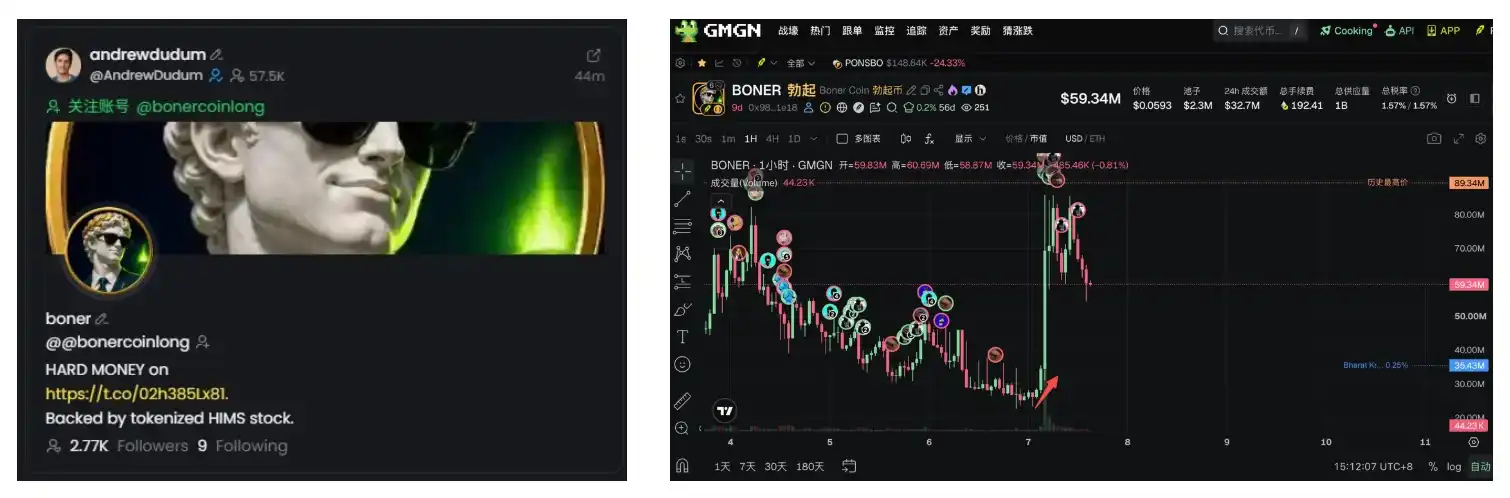
One example is BONER, the token paired with telehealth platform Hims & Hers Health (HIMS). After an earlier pullback, BONER staged a sharp rebound last night after the company’s founder and CEO suddenly followed the project’s official X account.
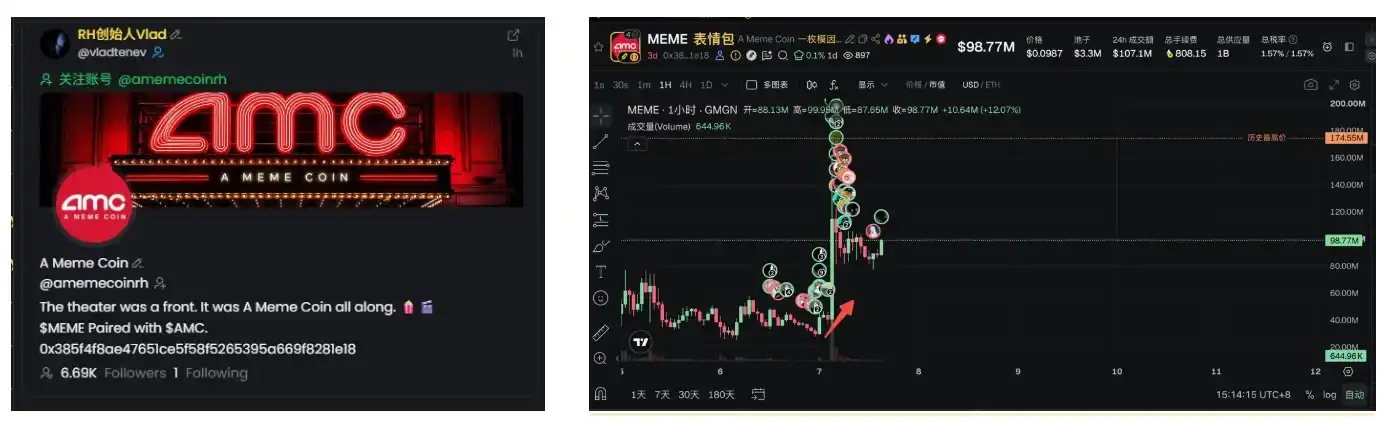
MEME, which had previously been linked to AMC stock and had already drawn a public back-and-forth between two CEOs, also jumped again last night after Robinhood’s chief followed MEME’s official account.
Those two cases quickly produced a fresh consensus among on-chain traders. In this setup, interaction from executives at listed companies is replacing traditional on-chain fundamentals as the most sensitive trigger for short-term price moves. The article compares the shift to an earlier period when the market fixated on Elon Musk’s dog references or Toly’s dragon references. Now the focus has moved to Nasdaq executives.
From one-way name association to a social media watchlist
Under that framework, the article says fast-moving capital is now operating on two layers.
- Waiting for a second wave driven by executive interaction
For pair trades that have already built market value on-chain, including MEME and BONER, traders are now putting the relevant CEOs and communications executives on high-frequency watchlists after the first round of speculation and the following pullback. If those executives like or follow a token’s official account out of curiosity, clarification, or simply to generate discussion, traders may treat that as a high-conviction reversal signal and move in for a rebound trade.
- Positioning early for first-day spikes in new targets
Another group is screening the Nasdaq market in reverse, looking for small-cap names with low market value, high discussion value, and executives who post frequently. Their X accounts are added to monitoring lists. If they make highly controversial comments or mention crypto, on-chain developers may launch paired tokens at high speed, giving early traders a chance to enter at the start of the move.
The article adds that, in today’s attention economy, it is possible that spokespersons at listed companies who understand this game could use crypto-stock pairing as a shortcut to expensive publicity for themselves or their companies through vague social media interaction.
Building a monitoring pool, in that sense, is about getting there a half-step earlier than everyone else.
Still, the article warns that a rally powered only by X interaction rests on a weak base. Executive social media activity can be used as a rebound signal, but traders need to exit decisively once retail FOMO rushes in, sentiment reaches an extreme, and price-volume momentum starts to fade.
Watch for volume divergence in concentrated liquidity pools
Executive interaction can create an emotional burst, but it does not change the underlying token distribution on-chain.
Many traders, the article says, see the rebound signal and chase strength, only to buy the turn where a temporary pullback-and-resume setup becomes a second trap. Citing trader JW (@JW100x), the piece says local tops in leading Robinhood meme trades often do not begin with an outright price collapse. A more common pattern is volume divergence, where price makes a new high or retests a prior high, but volume does not keep up.
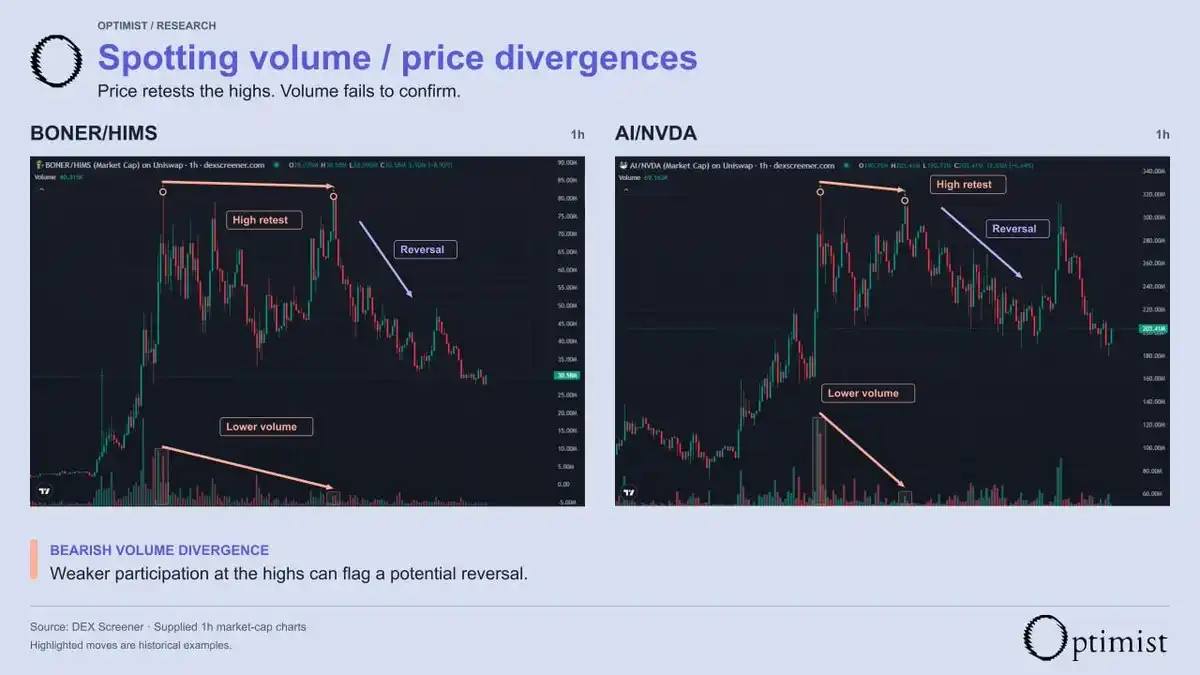
The article highlights BONER/HIMS and AI/NVDA as examples. On the 1-hour chart, price pushed up again and retested the earlier high, while volume at the bottom of the chart visibly contracted. Both tokens then moved into direct downside reversals.
In DEX markets with highly concentrated liquidity pools, real trading volume is hard to fake, and the contest between funds inside the pool is blunt.
- Exhaustion of new money and fading attention
The first move to a peak is driven by a fresh narrative and broad FOMO. The fastest and most aligned capital is already in. By the time price returns to test the high, the trade has lost novelty, and what remains is often rotation among existing participants rather than enough external capital to carry the move further.
- Overhead supply shifts from a vacuum zone to a heavy sell zone
Tokens bought near the first peak and trapped there are waiting to exit at breakeven. Price may appear to be challenging the previous high, but in practice it is absorbing old supply. Without large new buy orders strong enough to cut through that overhang, a push higher driven only by existing capital tends not to last.
Information edge on entry, real volume on defense
The article closes by contrasting CEX and DEX market structure. On centralized exchanges, trading is spread across multiple venues and derivatives markets, which can distort what a single chart shows. In a DEX liquidity pool with much higher concentration, volume often reflects the clearest picture of actual participation.
Price can be pushed higher by a small number of large orders. Volume is much harder to disguise. For this latest round of crypto-stock pairing trades, executive social media activity may decide whether a rebound starts, but volume confirmation on a retest of the high decides whether the move is a true breakout or an exit route prepared by larger players.