
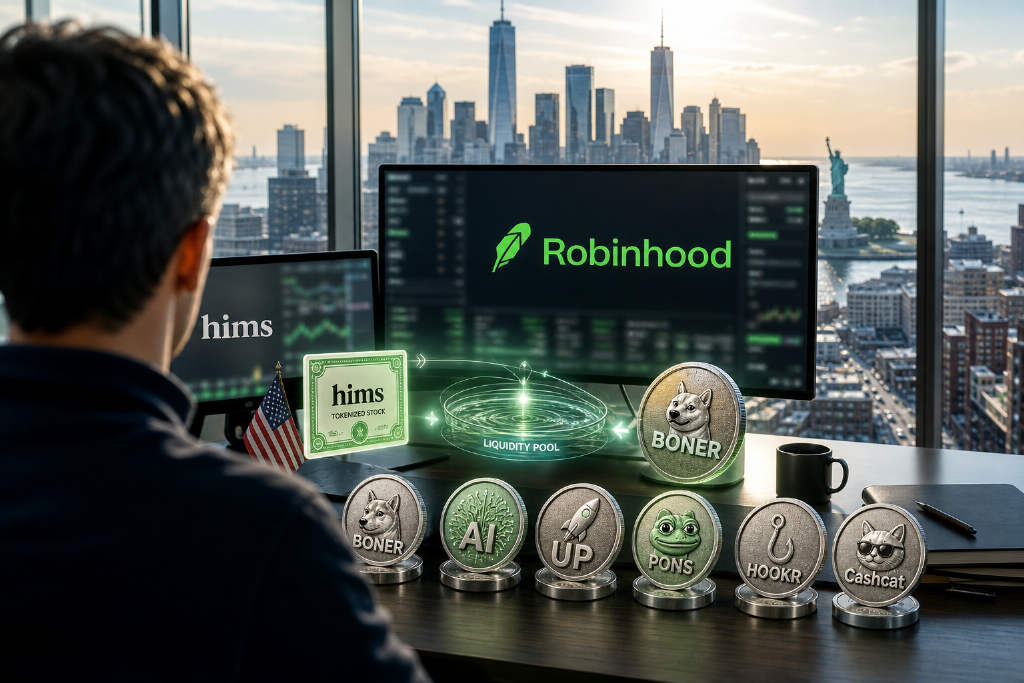
Robinhood’s on-chain market expands
Robinhood’s on-chain ecosystem has developed a broad mix of meme tokens, launchpads, NFTs and DeFi projects in less than one to two weeks, according to an analysis by David of TechFlow. The article describes the market’s central feature as on-chain liquidity beginning to compete for the pricing power of traditional financial assets.

By Sept. 1, Robinhood had produced at least 30 meme tokens with market capitalizations above $1 million and 28 application tokens, the analysis said. PONS and Cashcat were among the assets above $100 million that had already gone through price discovery. Smaller projects also recorded sharp gains as liquidity moved into the ecosystem.
Some assets fell quickly after their gains. The analysis nonetheless identified several directions that attracted capital, including meme tokens paired with tokenized U.S. equities, exchange infrastructure, lending and AI-related trading products.
BONER links a meme token to HIMS stock
BONER was described as the day’s strongest performer. Its market capitalization jumped from $8 million to $80 million, a tenfold increase in one day.
The token’s name refers to male sexual function, matching the business of HIMS, a publicly listed U.S. company focused on men’s health and erectile-dysfunction medication. BONER’s main liquidity pool did not use a stablecoin. Instead, it paired BONER with a tokenized version of HIMS stock.

In conventional on-chain markets, meme tokens are commonly paired with SOL, ETH or stablecoins. Robinhood’s stock-paired meme model allows a meme token to share a pool directly with a tokenized U.S. equity. For BONER, the key pool was BONER/HIMS.
The structure became particularly visible during the weekend. The New York Stock Exchange was closed, and traditional market makers could not issue additional HIMS stock tokens on-chain. The supply of HIMS tokens inside the pool was therefore locked. As funds bought BONER, large amounts of HIMS tokens were absorbed into the pool. The on-chain HIMS price reached $132 at one point, while HIMS closed at $28.8 in Friday’s U.S. stock session.
Arbitrage traders were expected to narrow the premium after Monday’s opening. The analysis said BONER demonstrated a mechanism in which a meme token can lock up the available supply of an equity token. It connects the attention generated by meme issuance with a stock-market reference asset in the same pool.
The article also argued that this model could bring people who trade U.S. stocks into crypto markets. The token itself may still have no underlying asset, but the stock pairing creates a route for crypto liquidity and attention to reach traditional equities. The analysis located this activity on Robinhood’s chain, describing the broker as a link between crypto assets, retail traders and stock-token attention.

AI attracts Nvidia-linked liquidity
Artificial Inu, or AI, is paired with tokenized Nvidia stock, NVDA, and presents itself as an on-chain Nvidia community. Its market capitalization reached $190 million, setting another high.
TechFlow described the move as an outflow of capital from the BONER trade into another stock-paired market. Once BONER showed that the model could attract liquidity, capital looked for a deeper pool and a stronger consensus within the same segment. AI, described as the largest on-chain Nvidia pairing, took in a substantial share of that demand.
Other stock-linked projects also drew follow-on capital:
- MOO / Micron, MU: about $19.3 million;
- SPACEHOOD / tokenized SpaceX, SPCX: about $18.4 million;
- AU / Taiwan Semiconductor Manufacturing, TSM: about $7 million;
- QC / small-cap quantum stock QUBT: about $5.2 million;
- QUANT / SPY: about $4.8 million;
- ORBIO / another NVDA pairing: about $2.6 million;
- a Solana experimental market linked to ZEC: about $2.2 million.
Infrastructure tokens receive market pricing
Capital on Robinhood’s chain has also moved into infrastructure. Launchpads, decentralized exchanges, dividend mechanisms and lending projects are being traded alongside speculative meme assets.

UP is a decentralized exchange and liquidity protocol running on Robinhood’s chain. The analysis said a market that supports 24-hour trading of tokenized U.S. equities needs liquidity, matching and fee settlement as capital moves between memes and stocks. UP supplies those functions. Its incentive model resembles Velodrome’s ve(3,3) structure, using locked voting, emissions to attract liquidity and liquidity to support trading.
From Aug. 31 to Sept. 1, UP generated about $180,000 in fees, becoming the fourth protocol on the chain to produce revenue consistently, according to the article.
PONS reached $442 million and continued to set daily highs. TechFlow compared it with pump.fun on Robinhood’s chain, citing fixed supply, one-click token issuance and a mechanism that directs a large share of protocol revenue back into purchases of its own token.
HOOKR reached about $20.7 million. PONS sells the ability to issue a token, while HOOKR focuses on how the liquidity pool operates after issuance. Its design breaks out functions associated with Uniswap v4 Hooks, including anti-sniping measures, impact fees, automatic burns, LP revenue sharing and prize pools. Token creators can combine those functions.

INDEX reached about $44 million. It charges a 3% trading tax, uses the proceeds to buy tokenized U.S. equities and automatically airdrops the purchases to token holders every 15 minutes. The article presented this as a shift from a pure narrative trade toward receiving stock-token distributions while holding the asset.
DENAR reached about $3.1 million. It is described as an on-chain securities pawnshop that lets users pledge stock tokens to borrow stablecoins. Its loan-to-value ratio for an individual stock is about 62.5%, addressing a use case in which stock tokens can be bought and sold but are not otherwise used for collateralized lending.
PICKLES reached about $2.7 million and was linked to Robinhood’s AI trading agent product. Robinhood launched Agentic Trading in May, allowing Claude, ChatGPT and Grok to place orders through independent accounts. Projects such as hoodpocket and Agents in Hood provide wallets and risk controls for agents on-chain. PICKLES drew on that product news.
Other projects identified in the same segment included the Solana cross-chain utility token STONKBROKER, with a market capitalization of about $83 million, and the early-stage tool or community tokens ARROW, CLAN, TWO, OTC and VLR, valued at about $14.8 million, $9.2 million, $7.5 million, $5.2 million and $4.7 million, respectively.

MARKETPLIER follows a celebrity stock purchase
MARKETPLIER reached a market capitalization of about $3.9 million. Bloomberg reported that YouTuber Markiplier had quietly become the single largest shareholder of GoPro, holding about 8.5% of the company.
GoPro had experienced a prolonged period of weak share performance and faced going-concern concerns, according to the source article. News of the creator becoming a major shareholder sent GoPro shares nearly 100% higher during regular and after-hours trading.
On-chain traders quickly launched the identically named MARKETPLIER token. The community also circulated a claim that Markiplier had committed 30% of his net worth to the stock. Public reports cited in the article placed the purchase at roughly $8 million to $9.3 million, making him GoPro’s largest shareholder.
Other tokens benefited from the same market’s ample liquidity despite having no clearly stated mechanism. They included the independent chef-themed RABBIT, at about $10 million; MACRODUCK and Microduck, associated with a micro-robot Beta, at about $7 million; the dog meme PONGO, which drew attention from the PONS launchpad, at about $5.8 million; and ROBINCAT, based on an unclear expectation that the official project might release something new, at about $1.3 million.

Additional animal and meme-template tokens included HOME at about $5.7 million, APEC at $5 million, FLORK at about $2.4 million, HACHI at about $2.3 million and STARTUP at about $1.7 million.
TechFlow’s analysis characterized the market as an attempt by on-chain liquidity to compete for the pricing of traditional financial assets. Its description of Robinhood’s chain was not simply a Layer 2 for issuing dog-themed tokens, but a network where meme tokens can be issued while U.S. equities are locked into liquidity pools.
The article said the mechanism would face a new pricing test if the speculative rush faded. It also described asset creation during speculative cycles as a recurring feature of crypto markets, where participants move between fear of missing out and taking profits under heavy information flow and limited time.
