
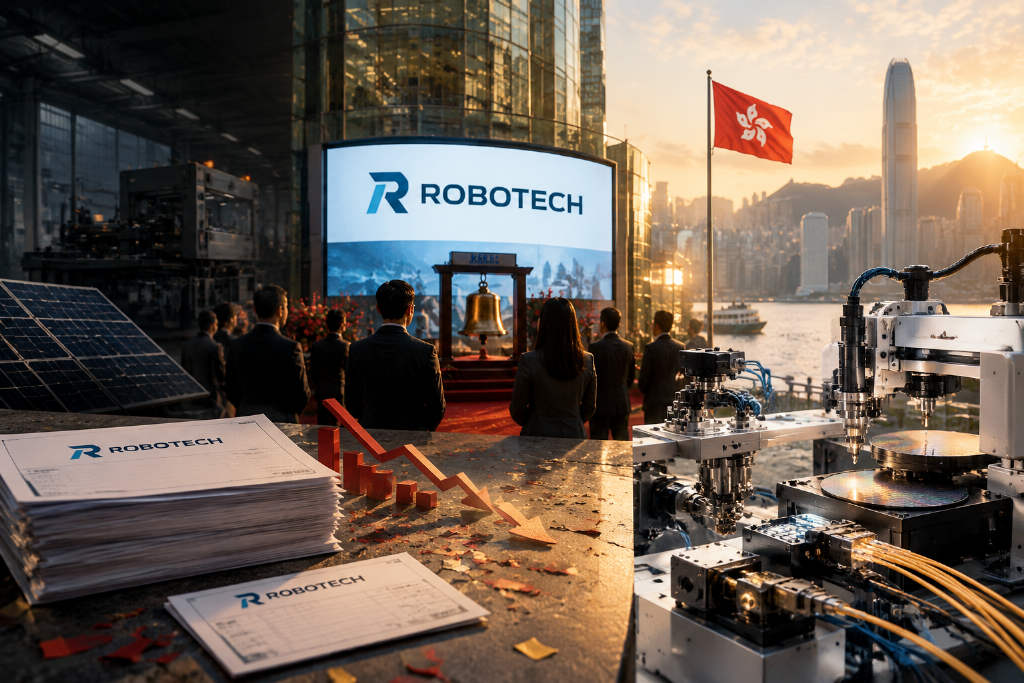
Robotech (300757.SZ/03757.HK) made its Hong Kong market debut on Sept. 29, becoming another company with both A-share and H-share listings.
The company priced its H shares at HK$436 each, according to its filing. Based on a global offering of 11.876 million shares, the deal raised about HK$5.178 billion in gross proceeds and about HK$4.961 billion in net proceeds. At that offer price, Robotech ranked behind New Oriental, Zhongji Innolight, Bilibili and Zai Lab, making it the fifth-highest IPO price in Hong Kong market history.
Cornerstone demand came from 16 investors including Temasek, Shengtian Industrial, Ivy Capital, E Fund and CIG. Together they subscribed for about $232 million, accounting for 35.2% of the offering shares. Temasek subscribed for $45 million, Shengtian Industrial for $40 million and Ivy Capital for $30 million, the three largest commitments in the cornerstone tranche.
Shares slipped in gray-market trading and on debut day
That support did not translate into a strong secondary-market start.
On Sept. 28, Robotech opened at HK$385 in gray-market trading, 11.7% below the offer price. The decline narrowed later in the session, but the stock still closed below issue price at HK$428.
On Sept. 29, the first day of official Hong Kong trading, the shares moved lower and finished at HK$414.40, down 4.95%. Its A shares also gave up early gains and closed at RMB 529, down 0.25%. With a board lot of 50 shares, an H-share investor allocated one lot was facing a paper loss of HK$1,080 before transaction fees.
Solar equipment sales fell sharply over two years
Public information shows Robotech was founded in 2011 and is headquartered in Suzhou. The company supplies high-precision intelligent manufacturing equipment and one-stop smart factory solutions used in the production of optical devices, silicon photonics components and photovoltaic cells.
Dai Jun, one of the company’s founders and controlling persons, was born in 1974. He previously worked as an engineer or product manager at Toshiba Elevator, Universal Appliances in the United States and Henkel China. He now serves as chairman and CEO.
As the photovoltaic industry moved into a period of supply-demand imbalance and intense price competition, Robotech’s legacy solar equipment business came under pressure. Revenue from photovoltaic equipment and integrated solutions, once the company’s main revenue pillar, peaked in 2023 and then declined year by year, reaching RMB 433 million in 2025. Over the same period, the share of revenue tied to the photovoltaic industry fell from 98.06% to below 50%.
The drop in unit sales was even steeper. Sales of photovoltaic automation equipment fell from 1,932 units in 2023 to 110 units in 2025.
China’s photovoltaic sector remained in a deep adjustment phase in the first half of 2026. Citing data from China Insights Consultancy, the prospectus said output across major parts of the domestic photovoltaic supply chain declined during the period. Photovoltaic cell output in the first six months of the year was about 260.7 gigawatts, down about 21.9% year over year.
Shi Zhenwei, a photovoltaic analyst at SMM, told Time Finance that profitability in the industry weakened in the first half of this year compared with the second half of last year. Under a more market-based power trading environment, demand support had softened and companies were facing tougher competition and pressure than in the second half of last year.
Robotech’s own numbers reflected that trend. In the first half of 2026, revenue from its photovoltaic segment was RMB 82.9849 million, down 53.93% year over year. Gross margin for that business, however, was 32.62%, up 9.76 percentage points from a year earlier. The company said the increase mainly reflected changes in customer mix.
The prospectus also showed that India overtook mainland China as the company’s largest source of photovoltaic customers in January through April 2026, contributing RMB 24.059 million in revenue from photovoltaic manufacturing solutions.
In the prospectus, Robotech said: "We have continued to expand overseas markets and build up our order reserve, especially in India. In the first half of this year, we sold 48 photovoltaic automation devices, one photovoltaic process device and seven intelligent manufacturing systems. As of June 30, 2026, the company was executing multiple overseas orders for photovoltaic manufacturing solutions, mainly from Indian customers, with a total contract value of about RMB 100 million. All of these orders are expected to be recognized as revenue in 2026."
RMB 1.654 billion acquisition of Germany’s ficonTEC reshaped the business
With the photovoltaic cycle still under pressure, Robotech shifted its focus toward silicon photonics-related equipment.
In 2025, the company posted revenue of RMB 950 million, down 14.14% year over year, and a net loss attributable to shareholders of RMB 66.4404 million, compared with a profit a year earlier.
According to the prospectus, Robotech’s acquisition of Germany-based ficonTEC stretched from 2019 to 2025. From 2019 to 2023, Feikong Taike, the buyer consortium vehicle led by Dai Jun, first acquired control of ficonTEC. Robotech then completed the purchase of all equity interests in Feikong Taike and the remaining interests in ficonTEC between August 2023 and May 2025, for a total consideration of RMB 1.654 billion. After the transaction, ficonTEC became a wholly owned subsidiary of Robotech.
The prospectus said ficonTEC provides high-precision packaging and testing equipment for CPO packaging and silicon photonic transceiver devices, and has received orders from Intel, NVIDIA, TSMC and Broadcom.
After consolidation, the contribution from that business rose sharply. Wind data showed revenue from Robotech’s optoelectronics and semiconductor packaging and testing equipment business climbed to RMB 439 million in 2025, accounting for 46.24% of total revenue. Citing China Insights Consultancy, the company said it held a 20.5% share of the silicon photonics intelligent manufacturing equipment market, ranking first globally.
In the first half of 2026, revenue from that segment reached RMB 488 million, up 952.17% year over year and already above the full-year 2025 level. The segment accounted for 81.16% of the company’s main business revenue in the period, making it the core driver of growth.
Robotech said the strong quarter-on-quarter increase in second-quarter revenue from the business was driven by the gradual delivery and acceptance of large-scale batch orders in optoelectronics and semiconductors during the second quarter of 2026.
Poland overtook Thailand as the top revenue source for silicon photonics business
By geography, Robotech said its silicon photonics assembly and testing equipment business expanded beyond mainland China and Germany in 2025 and won orders in Poland, Thailand, Taiwan, Israel and the United States. Thailand was the largest source of silicon photonics revenue that year, contributing RMB 169 million.
From January to April 2026, however, Poland surpassed Thailand with doubled revenue contribution and became the company’s largest revenue source.
As AI-related demand accelerated, orders for optoelectronics and semiconductors also increased. As of Aug. 25, Robotech had about RMB 3.386 billion in orders on hand that had not yet been recognized as revenue. Of that total, about RMB 2.452 billion came from optoelectronics and semiconductor business, a record high.
For comparison, as of March 30, 2026, orders on hand in the optoelectronics and semiconductor segment stood at about RMB 1.105 billion. That means the company signed about RMB 1.347 billion in additional orders in less than five months, doubling the backlog.
Hong Kong proceeds earmarked for capacity, R&D and global sales network
With orders rising, the company said the Hong Kong listing proceeds will be directed mainly toward expansion and product development.
According to the prospectus, the net proceeds from the H-share offering will be used as follows:
- about 40.0% for expanding production capacity and improving delivery speed, or about HK$1.985 billion;
- about 20.0% for strengthening product and technology research, development and innovation;
- about 20.0% for strategic investments and or acquisitions;
- about 10.0% for building a global sales and service network;
- about 10.0% for working capital and other general corporate purposes.
Second-largest shareholder sold shares for RMB 1.028 billion
Even as orders climbed and the company pushed ahead with its Hong Kong listing, a concerted party acting with Dai Jun chose to reduce its stake.
Company filings show that from April 7 to May 29 this year, second-largest shareholder Ningbo Kejun sold 2.2015 million A shares at an average price of RMB 467.11 per share, cashing out RMB 1.028 billion in total. After the sale, Ningbo Kejun became the third-largest shareholder.
After that reduction, Robotech’s A shares continued to rise and touched an intraday record high of RMB 714 on June 3 before pulling back. The stock has since retreated by nearly 20% from that peak, though it remains above Ningbo Kejun’s average selling price.
This article was sourced from the WeChat account Time Finance APP (ID: tf-app) and written by Zhou Li.