
Record quarter driven by space systems
Rocket Lab delivered record quarterly revenue and backlog in its 2026 second-quarter results, according to MSX Research’s latest daily note on U.S. equities and RWA. The report said space systems was the main growth engine, while launch services revenue declined on a sequential basis because of the timing of revenue recognition rather than any reduction in launch activity.
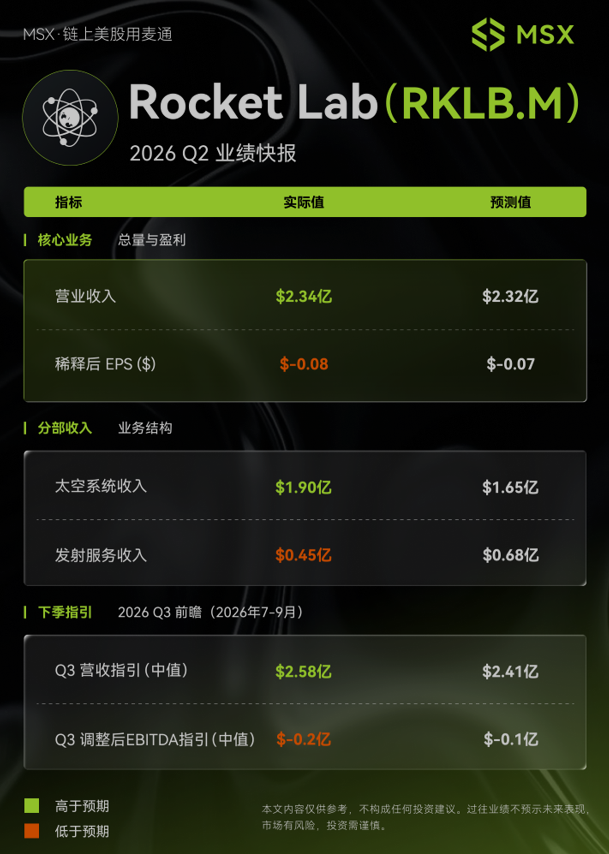
Second-quarter revenue came in at $234.1 million, up 62% from a year earlier and above the $231.9 million market consensus cited in the note.
Launch revenue dipped, but profitability metrics improved
By segment, space systems revenue reached $189.5 million, rising sharply from $105.1 million in the first quarter. Launch services revenue was $44.6 million, down 30% quarter over quarter. The company said the decline was tied to revenue recognition timing, not a slowdown in launches.
Rocket Lab reported a GAAP net loss of $49.26 million, or $0.08 per share. Adjusted EBITDA showed a loss of $8.83 million, with margin at -3.8%, a notable improvement from -19.1% in the same period last year.
Backlog rose to $2.36 billion
Order momentum remained strong. Backlog increased to a record $2.36 billion. Government customers made up 57% of that total, while commercial customers accounted for 43%, compared with 51% and 49% in the prior quarter. About 45.5% of the backlog is expected to convert into revenue over the next 12 months.
During and after the second quarter, the company added 26 launch orders. Newly signed launch contracts totaled more than $437 million, bringing total launch orders to more than 90.
Cash burn increased as Neutron investment continued
Free cash flow was negative $110.1 million, versus negative $77.4 million in the first quarter. MSX Research said the outflow mainly reflected spending on Neutron production ramp-up and inventory. Cash and cash equivalents stood at $2.4 billion at the end of the quarter.
For the third quarter, Rocket Lab guided revenue to $250 million-$265 million, with a midpoint of $258 million. That was above the $241 million consensus cited in the report. At the same time, the company projected an adjusted EBITDA loss of $17 million-$23 million, with a midpoint loss of $20 million, wider than the $10 million loss expected by the market.
MSX says the company is in a heavy investment phase
In its commentary, MSX said the earnings release showed the profile of a company in a key investment period. Revenue and backlog both set records, and operating efficiency kept improving at the EBITDA level. Cash consumption, however, also increased, with spending heavily concentrated on Neutron.
MSX said space systems has become the clear core revenue contributor, and the short-term fluctuation in launch services does not change the broader expansion trend in orders. In its view, stronger-than-expected revenue guidance and weaker-than-expected loss guidance reflect the same underlying choice: Rocket Lab is tying the timing of future growth realization to Neutron’s first flight arriving on schedule and to the subsequent production ramp-up. The note also said the company’s acquisition of Iridium has yet to be completed, and that these two developments will determine whether the current investment cycle can turn into an earnings inflection point next year.
About MSX
The article said MSX is an RWA trading platform focused on providing access to global financial markets. It described itself as one of the earlier on-chain U.S. stock trading platforms and said it combines blockchain technology with a compliance framework to offer spot and derivatives trading in nearly 400 tokenized stocks and pre-IPO assets.
MSX said its product lineup covers U.S. stock spot trading, perpetual contracts, crypto-to-crypto trading, pre-IPO products and research services. Its official website is https://msx.com/, and its app is available on the App Store and Google Play globally.
The note ended with a risk statement saying that macroeconomic conditions and U.S. equity market volatility can be severe, and that the material is for academic and research observation by MSX Research only and does not constitute investment advice.