
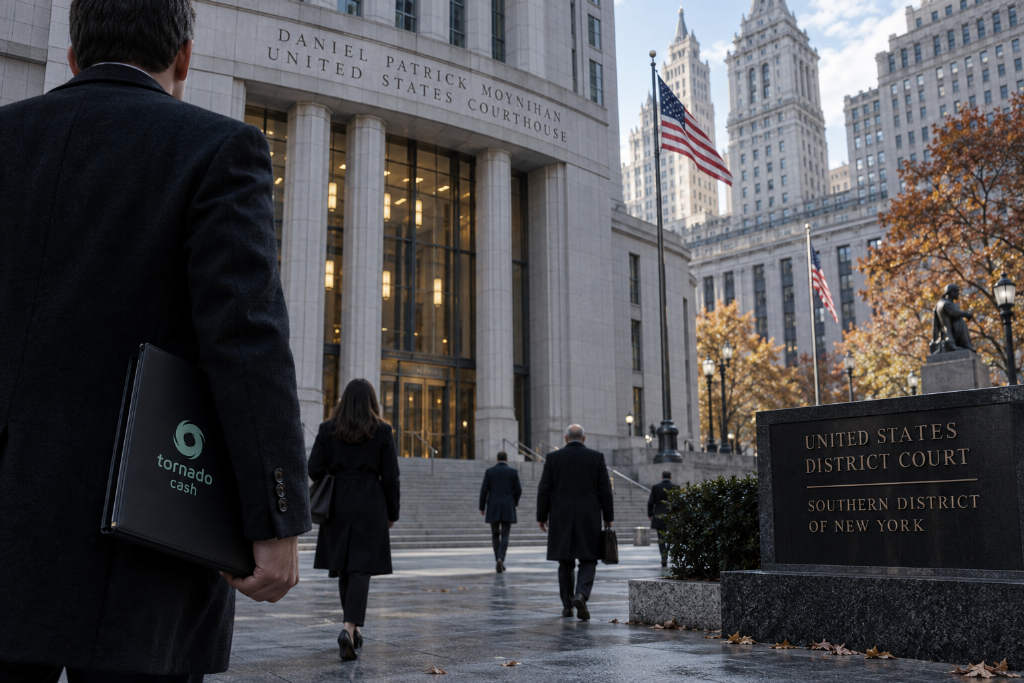
Federal prosecutors have told the judge overseeing Roman Storm’s Tornado Cash case that an appeals court ruling in the Bitcoin Fog case supports their argument that Storm was properly tried in New York.
Tornado Cash and Bitcoin Fog are both coin mixers, software designed to pool users’ crypto and break the on-chain link between where funds come from and where they go.
Letter cites September 25 appellate ruling
The government laid out that position in a letter filed Monday with Judge Katherine Polk Failla in the Southern District of New York. Prosecutors cited the D.C. Circuit’s September 25 ruling, which affirmed the conviction of Bitcoin Fog founder Roman Sterlingov and left in place his 150-month sentence.
Storm’s motion for acquittal, which challenges venue along with other issues, was argued in April and is still pending. A Manhattan jury convicted Storm in August 2025 of conspiring to operate an unlicensed money transmitting business, but deadlocked on money laundering and sanctions charges.
Venue dispute centers on two counts
The new letter addresses the money laundering conspiracy count and the money transmitting count. Under the Constitution, a criminal case must be tried where at least part of the offense took place.
In Sterlingov’s case, the D.C. Circuit found venue proper in Washington largely because of a sting operation. According to the opinion, a special agent deposited about $250 worth of Bitcoin into Bitcoin Fog from Washington, D.C., then withdrew almost all of it the next day.
Prosecutors say Tornado Cash was used in Manhattan
Prosecutors said the same logic applies to Shakeeb Ahmed, a Tornado Cash user who testified that he accessed the service 「in [his] apartment in Manhattan」.
Storm’s lawyers had argued that Ahmed’s funds stayed in Tornado Cash pools too briefly to advance any conspiracy. The government answered that the deposit remained for 「a couple days,」 which it said was comparable to the timeline in the Bitcoin Fog case.
At the April hearing, Storm attorney Brian Klein argued that Ahmed used Tornado Cash before carrying out his crime and 「didn't actually use Tornado Cash for his hack.」
Government points to service for customers in the district
On the money transmitting count, prosecutors said the appeals court found venue proper in the Bitcoin Fog case solely because the mixer had 「served customers in the District.」 They said Ahmed’s testimony shows Tornado Cash did the same in Manhattan.
Storm posts the filing and criticizes DOJ
Storm posted the filing on X on Tuesday and wrote, 「The DOJ is still coming after me with everything it has. They really want to see me convicted.」
He also said it had been 1,139 days since his 「nightmare」 began, adding that his daughter was 3 years old when he was arrested.
Storm also highlights FinCEN notice
Storm pointed to a Treasury notice filed Monday, the same day prosecutors submitted their letter. In that notice, the Financial Crimes Enforcement Network, or FinCEN, withdrew a 2023 proposal that would have required financial institutions to report transactions involving international crypto mixing.
FinCEN said the move was informed by commenters’ concerns that its broad definition of mixing 「could have a chilling effect on legitimate activity.」
The notice also said illicit actors continue to use mixers and that FinCEN will keep monitoring them.
Contrast with argument made at April hearing
Storm contrasted the notice with a position taken by prosecutor Ben Arad at the April hearing. Arad argued that once Tornado Cash was largely serving criminals, 「even the legitimate transactions that went through Tornado Cash became illegitimate.」 Failla pushed back on that point, saying, 「I'm concerned if that's your theory.」
Retrial set for April 2027
Storm’s retrial on the two counts where jurors could not reach a verdict is scheduled for April 26, 2027, after prosecutors had sought to begin the retrial this month.
Alexey Pertsev, who worked on Tornado Cash alongside Storm, was convicted of money laundering in the Netherlands in 2024 and was later released to electronic monitoring while his appeal proceeds.