

Derivatives volume recovered in October while open interest and depth kept rising
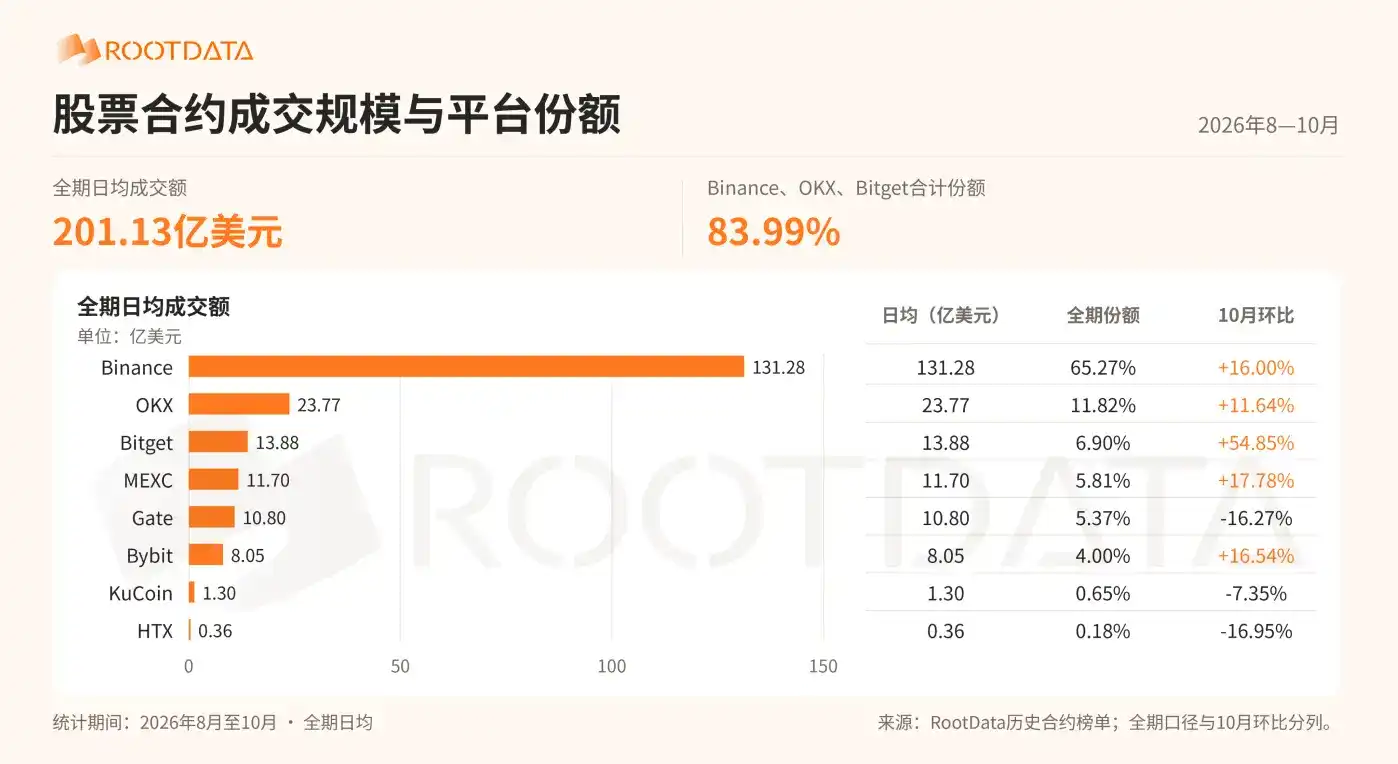
RootData Research’s report, titled “Q4 2026 Crypto Stock Market Outlook: August-October,” found that stock derivatives activity on major crypto trading platforms declined first and then recovered between August and October 2026. Open interest and order-book depth expanded throughout the same period. Across the eight platforms in the sample, stock derivatives trading volume totaled about $1.79 trillion, equal to average daily volume of $20.113 billion.
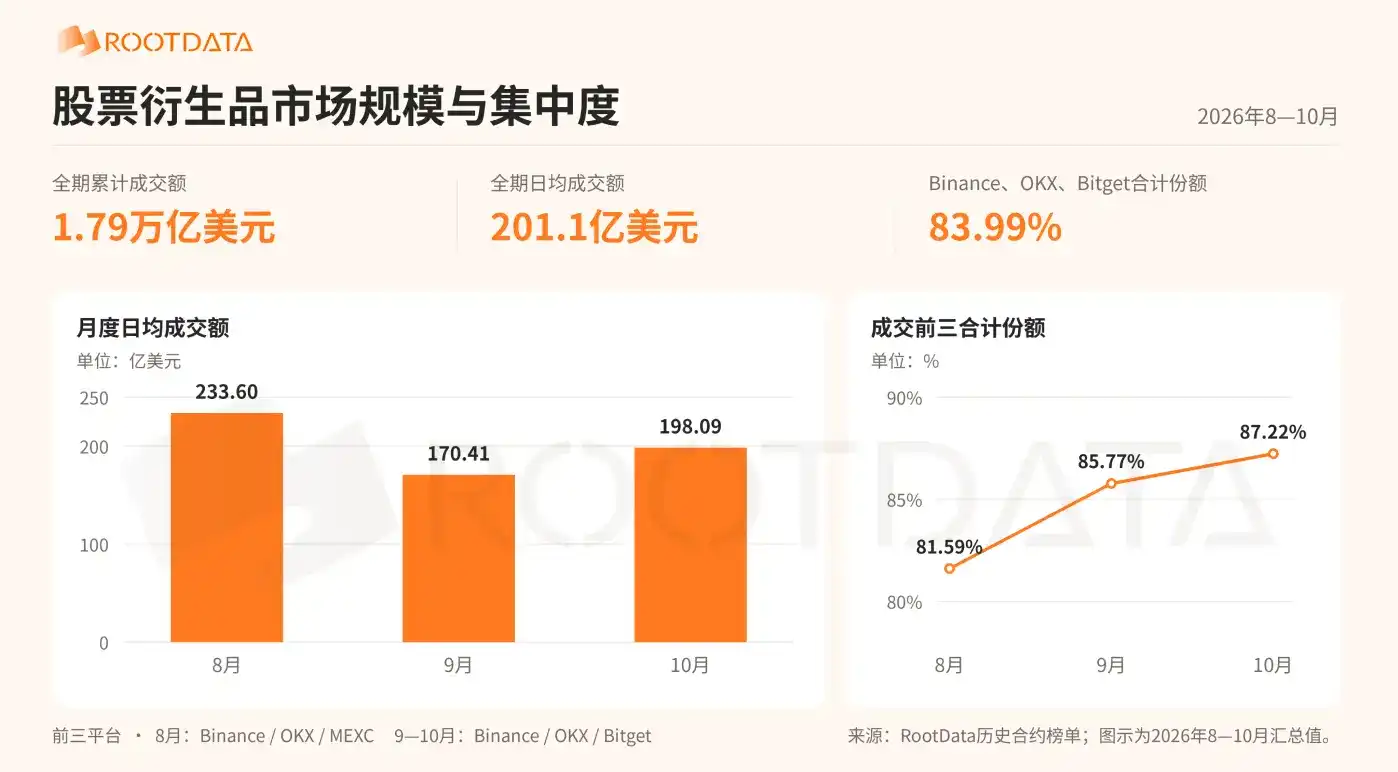
Average daily volume fell from $23.360 billion in August to $17.041 billion in September before returning to $19.809 billion in October. October volume rose 16.24% from September but remained below the August level. Trading also became more concentrated at the top. Binance, OKX and Bitget together accounted for 83.99% of volume across the full period, while the combined share of the top three platforms increased from 81.59% in August to 87.22% in October.
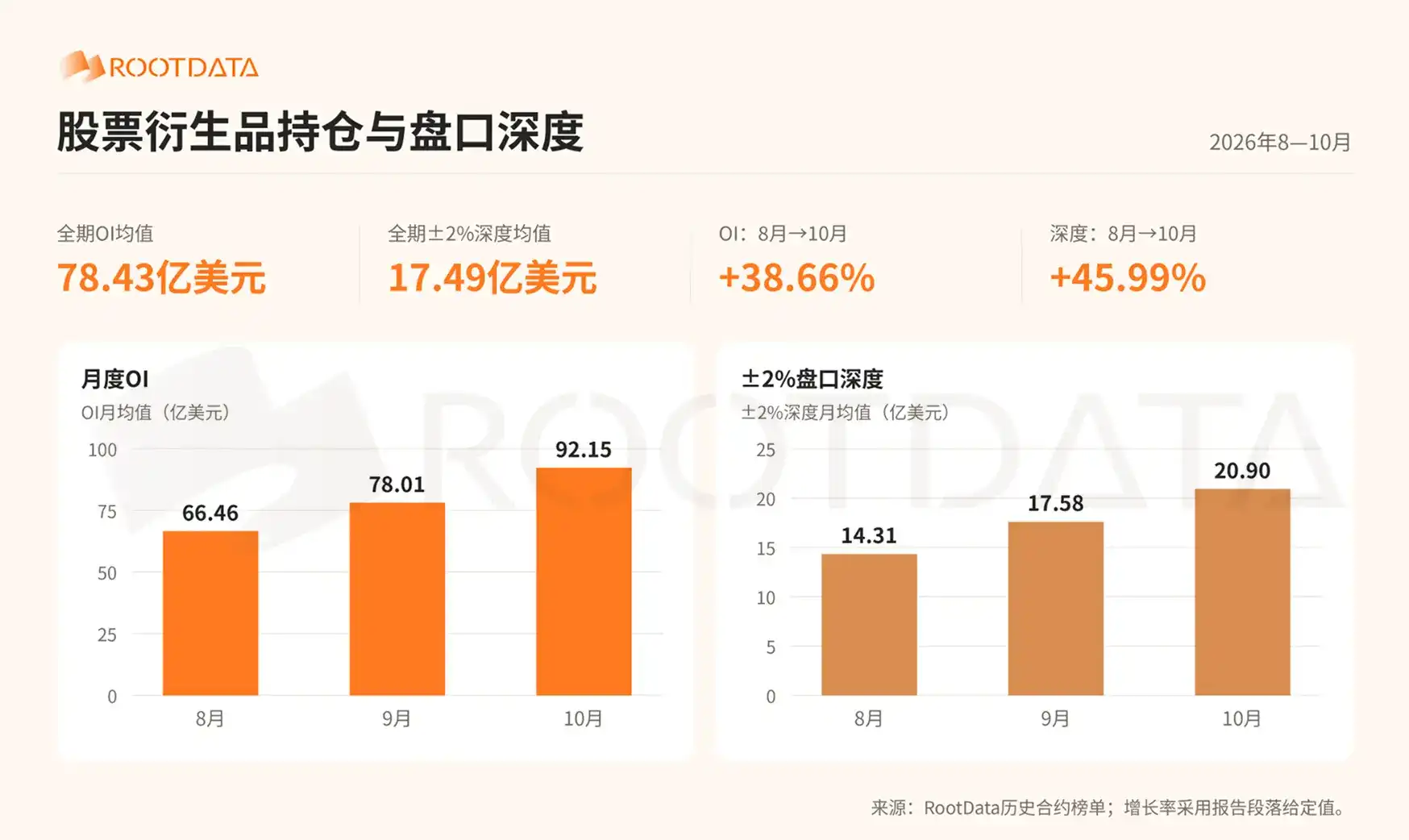
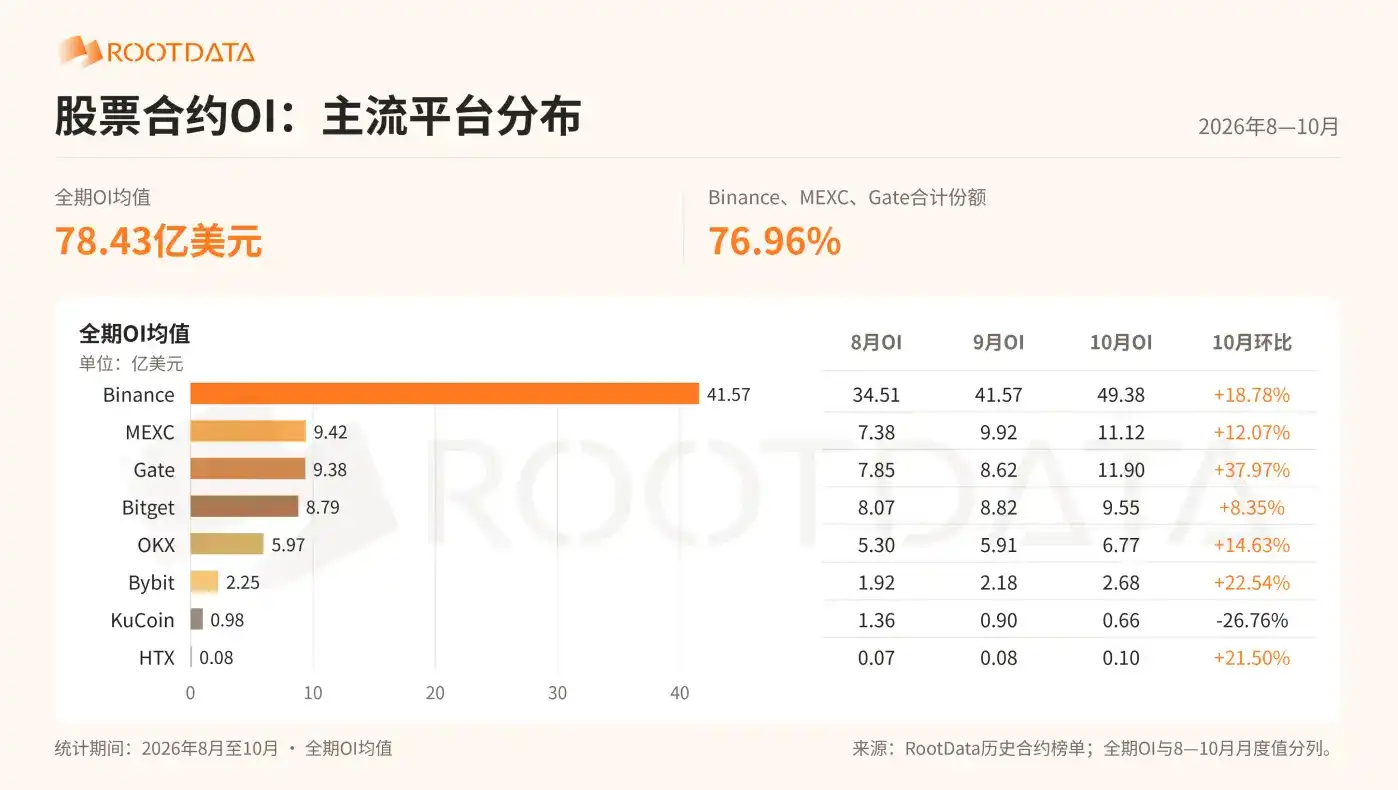
Open interest and order-book depth did not follow the September decline in volume. Average daily open interest across the eight platforms was about $7.843 billion from August through October, while combined average daily depth within a ±2% price range was $1.749 billion. In October, average daily open interest reached $9.215 billion, up 38.66% from August. Average daily ±2% depth reached $2.090 billion, a 45.99% increase from August.
The report said that open interest and posted orders continued to grow during September’s volume contraction. Its reading of the data was that traders shifted more from short-term turnover toward holding positions, while market-making and displayed liquidity also expanded. The liquidity base of the platforms was not reduced in line with the decline in volume, which supported the recovery in October.
Semiconductor, memory and leveraged ETF contracts led activity
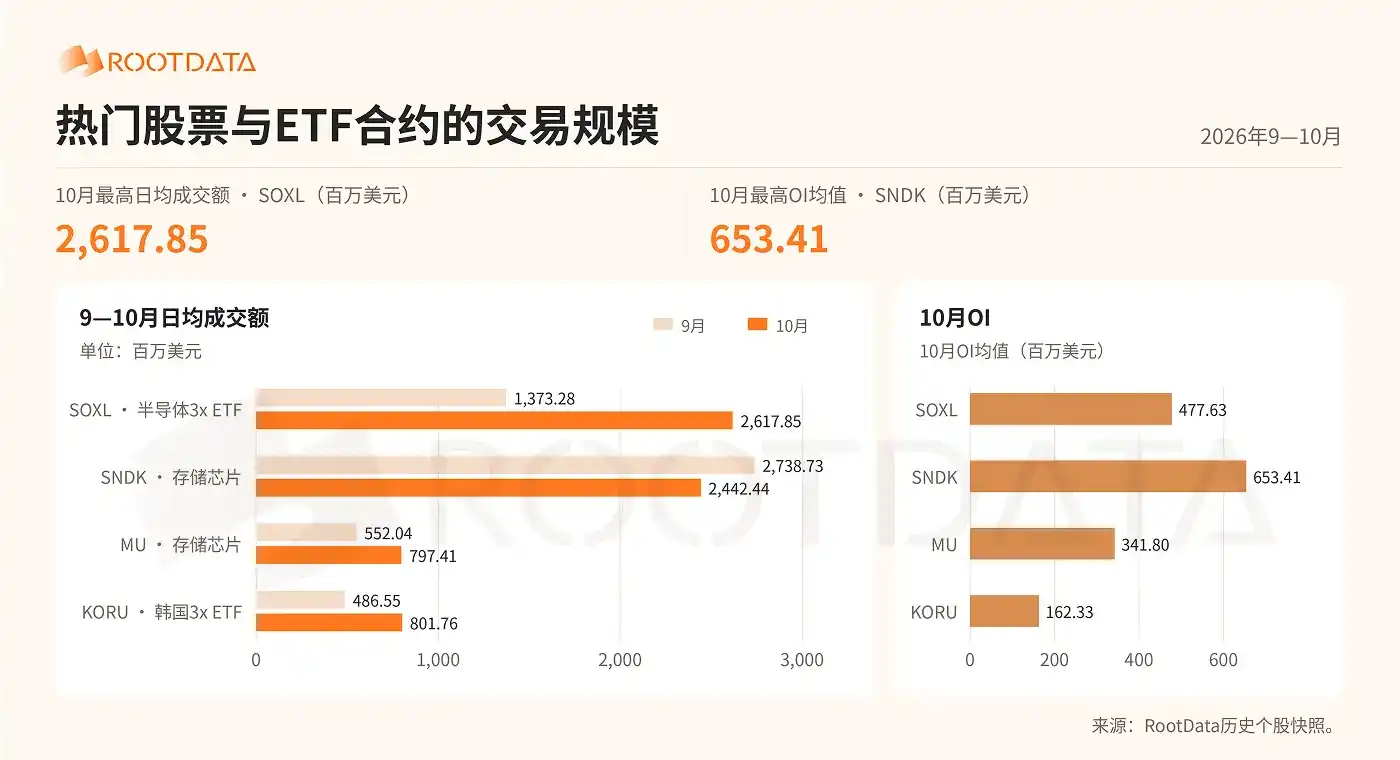
From September to October, individual-stock activity was concentrated in semiconductors, memory stocks and leveraged ETFs. SOXL and SNDK recorded average daily volume of about $2.618 billion and $2.442 billion, respectively, across the eight sample platforms. They ranked among the leading assets and were the most actively traded stock products in the sample.
The exchange sample consisted of Binance, OKX, Bitget, Bybit, Gate, MEXC, KuCoin and HTX. The study covered perpetual contracts for stocks and ETFs quoted or settled in stablecoins such as USDT and USDC.
Tokenized stock spot volume recovered faster than derivatives
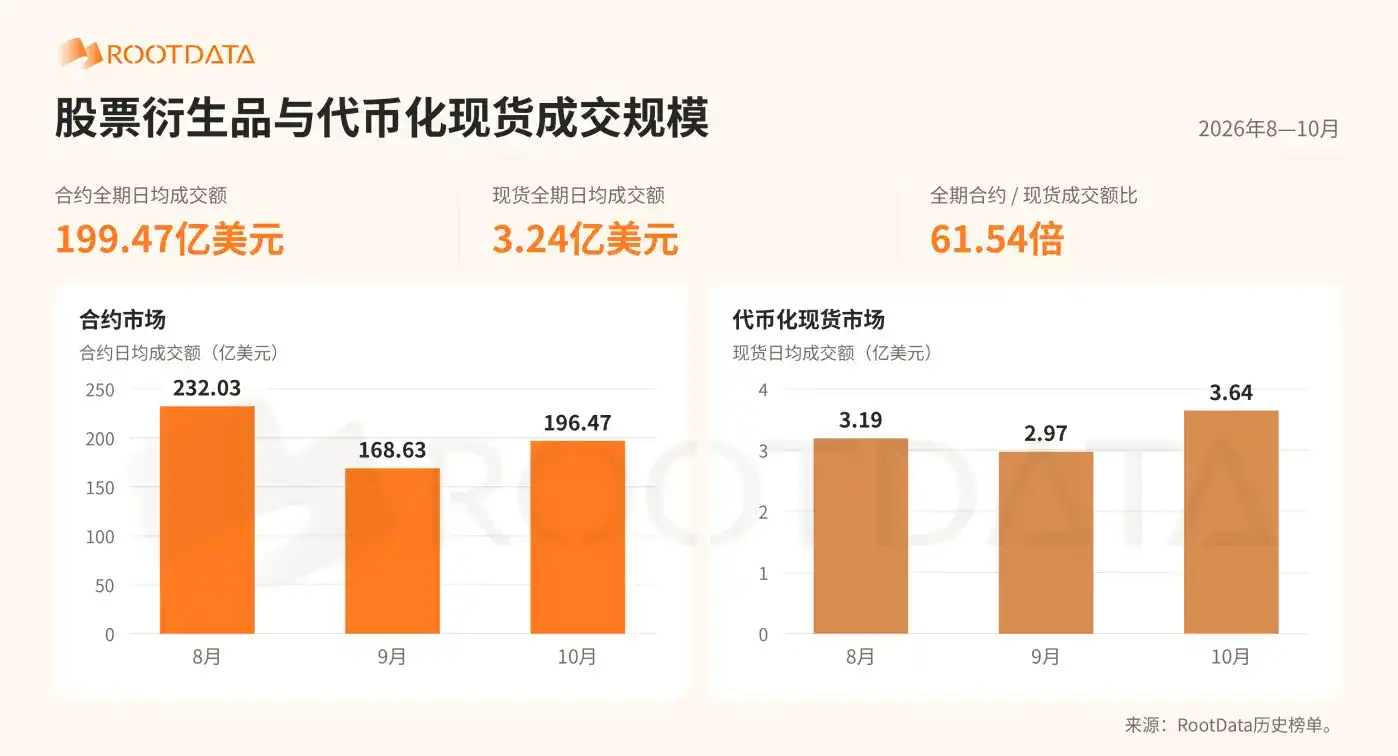
From August through October, the five major tokenized stock issuance platforms in the sample recorded average daily spot volume of about $324 million. On the same platforms, average daily stock derivatives volume was about $19.947 billion, roughly 61.5 times the spot figure. Derivatives remained the primary trading market.
Contract trading was more concentrated than spot trading. Binance, OKX and Bitget accounted for a combined 83.99% of derivatives volume. Binance, OKX and Gate accounted for 78.25% of spot volume, leaving the spot market relatively more distributed.
Average daily spot volume reached $364 million in October, up 22.72% from the previous month. The pace of recovery was faster than in the derivatives market, narrowing the gap between the two segments.
Exchange competition split across scale, coverage and liquidity
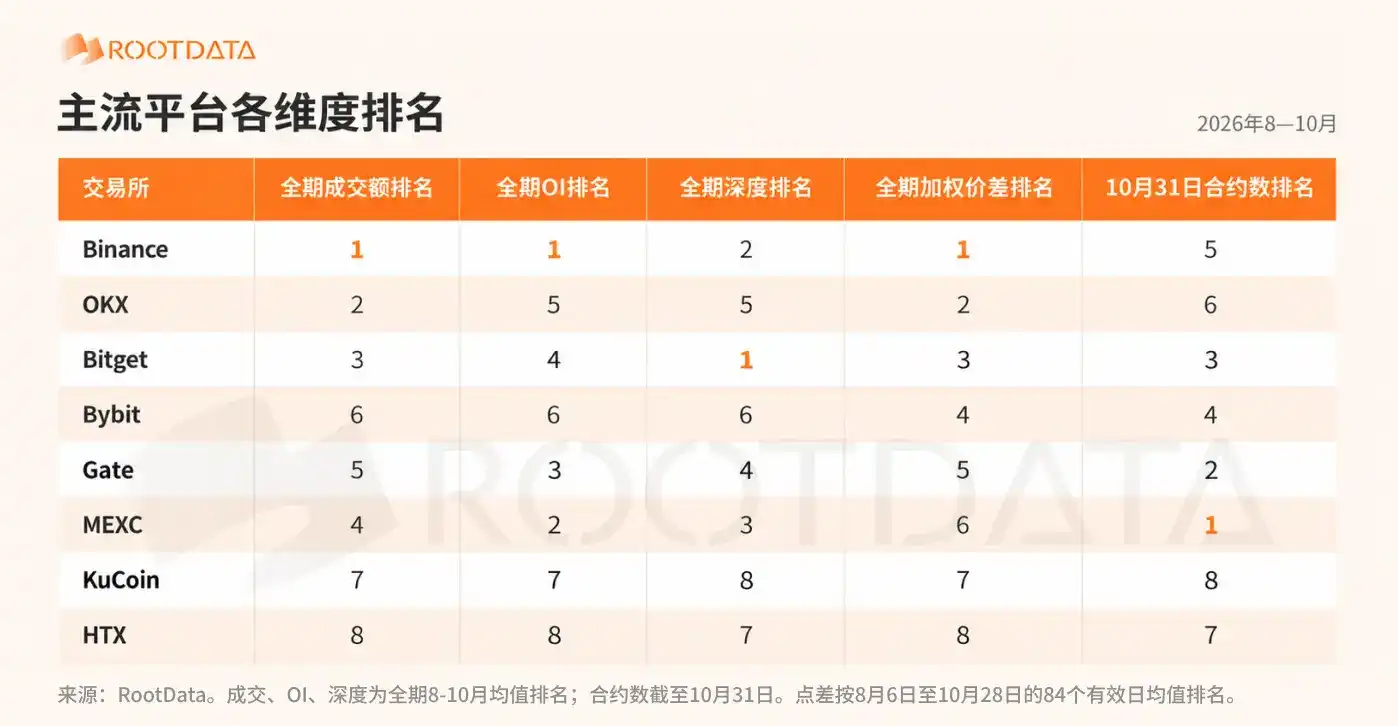
The platforms occupied different leading positions across the report’s measures. Binance ranked first for average daily volume and average open interest. Bitget ranked first for average ±2% depth. OKX ranked second in both trading volume and weighted spread. MEXC ranked second in open interest and listed the largest number of stock derivative contracts.
Binance led volume and open interest
Binance recorded average daily stock derivatives volume of $13.128 billion from August through October, giving it a 65.27% market share. OKX and Bitget ranked second and third at $2.377 billion and $1.388 billion, respectively. MEXC, Gate and Bybit ranked fourth through sixth, while KuCoin and HTX together accounted for less than 1% of volume.
The October recovery was uneven across platforms. Bitget posted the largest month-over-month increase in volume, at 54.85%. MEXC and Bybit also recorded recoveries. Binance retained the largest volume while increasing its market share.
Binance also dominated open interest. Its average open interest was $4.157 billion during the period, accounting for more than half of the total. Bitget, Gate and MEXC had similar open-interest shares, each in the 11%-12% range. OKX held a 7.61% share, placing it in the middle of the group. Bybit, KuCoin and HTX had lower shares, ranging from 0.1% to 3%.
Bitget ranked first for displayed depth
Bitget ranked first for ±2% order-book depth even though its trading volume and open interest were below Binance’s. Its average depth was $418 million from August through October, compared with $407 million for Binance. Bitget’s share of total depth was 23.90%. The report said the platform had a larger visible order supply within the ±2% range, giving it a strong position in displayed liquidity.
Binance and OKX led on weighted spreads. Both recorded an average daily weighted spread of 0.0115% during the period. Bitget ranked third at 0.018%, followed by Bybit.
In October, Bitget’s and Bybit’s spreads narrowed by 16.59% and 18.58%, respectively. Binance and OKX widened from September but still recorded the smallest spreads. HTX posted the largest narrowing, although its absolute spread remained materially higher than those of the other platforms.
Five tokenized stock issuers followed different product strategies
The report compared Ondo, bStocks, xStocks, Reality and Robinhood Stock Tokens across product coverage, assets under management, execution mechanisms, dividend treatment, reserve disclosures and trading hours. AUM was used to reflect the scale of issued assets, while the number of products reflected coverage.
Based on the figures listed in the report, Ondo, bStocks and xStocks had AUM of $1.3 billion, $1.2 billion and $1 billion, respectively, putting them ahead by asset scale. Reality and Robinhood followed with AUM of $161 million and $157 million.
Reality covered more than 3,200 assets, substantially more than the other four issuers. Robinhood primarily distributed its products through its own platform and user base.
Execution ranged from traditional-market access to on-chain pools
Reality offered three execution methods: direct market access, or DMA; request for quote, or RFQ; and on-chain liquidity pools. DMA sends orders directly to traditional financial venues for matching. Under RFQ, a trader requests a quote from a market maker before executing. Reality’s liquidity sources covered traditional financial venues, Bitget’s centralized exchange and on-chain channels.
Ondo and xStocks distributed products through multiple centralized exchanges and on-chain channels. bStocks and Robinhood relied on Binance, the Robinhood platform and on-chain channels, respectively, as described in the report. The five issuers therefore ranged from a combination of traditional venues, centralized exchanges and on-chain liquidity to a single-platform model. That channel structure determines the pool of capital that can be reached.
Dividend and reserve disclosures also differed
The five products used two approaches to dividends. Reality paid dividends directly to holders in stablecoins, leaving investors with cash that they could use at their discretion. The other four automatically reinvested dividends after tax. That removes a manual step but does not provide holders with a direct cash distribution.
For disclosures, Reality listed a reserve attestation issued by an independent third-party CPA, giving its reserve transparency an external verification component. Ondo, xStocks and bStocks relied mainly on self-disclosure. Robinhood did not list a reserve attestation arrangement.
Trading hours were not uniform. All assets offered by xStocks, bStocks and Robinhood supported around-the-clock trading. Most Reality and Ondo assets supported 24/7 trading, while the remaining assets traded 24 hours a day, five days a week. The applicable trading hours depended on the specific asset.
The report did not identify one issuer as the overall leader across every measure. Ondo, bStocks and xStocks emphasized asset scale and used multiple centralized exchanges or channels such as Binance to deepen existing distribution. Reality took a different route, emphasizing breadth and product mechanics. It covered more than 3,200 assets, combined DMA and RFQ execution, paid dividends in stablecoin cash and listed an independent third-party CPA attestation.
Reality had accumulated an initial share through the Bitget exchange channel and had product mechanics that more closely resembled trading in U.S. stocks, according to the report. Whether its broad coverage can become sustained volume and open interest requires more data.
Q4 focus turns to policy events and quoting during market stress
The report identified the U.S. midterm elections as an important point for monitoring policy expectations. It said the follow-up issues include how tax, trade and technology regulation develop after the election, and whether companies adjust their investment and earnings guidance in response.
For crypto stock platforms, the ability to keep quoting and maintain reasonable spreads during an event may distinguish them more clearly than liquidity rankings recorded in quiet periods.
The stock derivatives market now has several distinct competitive positions. Binance led volume and open interest. OKX ranked second in both volume and spread. Bitget ranked first in order-book depth and placed in the top three across most of the measures used in the comparison.
Platforms expanding their product lists also face separate questions about trading quality. MEXC had the largest number of contracts and ranked second in open interest, but ranked sixth in spread. Gate ranked second in contract count and third in open interest, while its October volume declined. Bybit recorded the largest increase in contract count during the period, but ranked sixth in volume, open interest and depth. KuCoin and HTX had relatively small volume shares and relatively wide spreads.
The report said competition in the next stage may shift from the number of new listings toward whether new assets can generate sustained trading and whether platforms can quote effectively during volatile events. For MEXC, Gate and Bybit, the question is whether product expansion can lift volume and open interest. For Bitget, the question is whether its depth advantage can turn into a larger volume share. Binance and OKX will need to be watched for their ability to preserve scale and quoting advantages in popular stocks and during non-U.S. trading hours.
The report lists trading in newly added assets, open-interest retention, and changes in depth and spreads during events as key items for follow-up.
Macro setting and methodology
The report said global equity markets moved between earnings growth and tighter macro conditions during the third quarter of 2026. The Federal Reserve raised rates by 25 basis points in September to 3.75%-4.00% and left rates unchanged in October. Expectations for another hike in December remained, making the rate path a central variable for the fourth quarter.
At the sector level, demand for AI memory and higher product prices supported stocks such as SNDK and MU. After October, concerns about the returns on AI capital spending increased and technology-stock volatility rose. The report also said the U.S. midterm elections, an Anthropic IPO and expectations that OpenAI’s listing would be delayed until 2027 could continue to affect technology-stock valuations and trading themes.
The data covers August 1 through October 31, 2026, and comes from RootData contract and spot rankings and historical snapshots. Monthly and full-period averages were calculated by dividing the sum of each platform’s valid daily observations by the number of valid days. Missing dates were not filled with zero. Cross-platform market and individual-stock averages were calculated as the sum of platform averages.
Volume uses a daily rolling 24-hour measure. October figures are the in-month averages through October 31. Rounding may create small differences in totals. The report’s reference materials included Ondo Stocks’ product operation and reserve verification materials, xStocks’ official FAQ and corporate-action materials, Binance’s bStocks FAQ, Bitget’s rToken FAQ and materials on trading hours and corporate actions, Bitget’s Reality product and developer documentation, Robinhood’s Chain Stock Tokens documentation and Classic product materials, and the FEC’s 2026 U.S. federal election dates.
The report was authored by RootData Research and is for research reference only. It does not constitute investment advice.



