
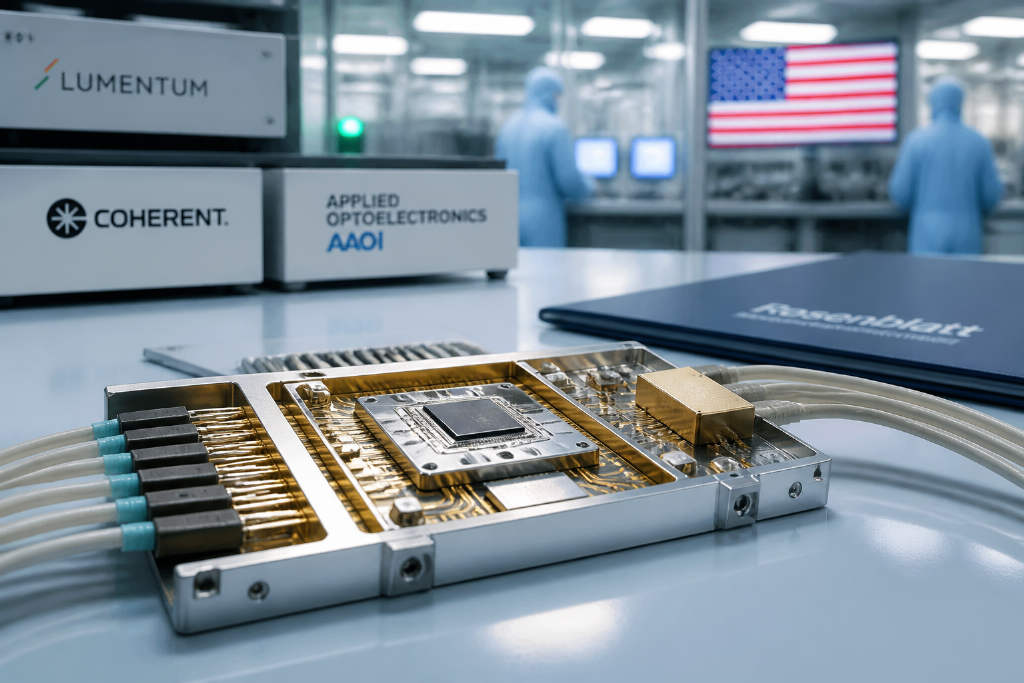
Rosenblatt said in an August 19 optical industry report that the sector’s current bottleneck is on the supply side rather than the demand side, with order visibility extending to 2028. The note was based on first-hand interviews from the firm’s Age of AI Technology Summit and centered on Lumentum (LITE), Coherent (COHR) and Applied Optoelectronics (AAOI), while reiterating Buy ratings on the three companies.
The report said optical components are entering another major growth phase as AI server architecture moves from scale-out to scale-up. Rosenblatt also argued that although Chinese laser makers continue to add capacity, they are still unlikely in the near term to dislodge the U.S. supply chain’s technology moat in high-end CPO and NPO lasers.
Scale-up optics moves to the center
Rosenblatt described scale-up optics as the most important growth variable to watch. Executives cited in the report said the scale-up ramp began in the middle of this year and is expected to continue through 2027.
Based on Rosenblatt’s market sizing, each GPU in a scale-up architecture requires nine times the transmission bandwidth of scale-out. Even so, scale-out networks use multi-layer switches and require more optical connection endpoints, which offsets part of that gap. Over the long run, the report estimated that the addressable market for scale-up optics is about three times the size of scale-out.
Rosenblatt said customer demand has not cooled and that no supplier had reported any delay to CPO or NPO deployment schedules.
On pricing, the report said spot price increases for 100G and 200G EML and CW lasers have recently moved from high-single-digit gains to low-double-digit percentage increases. As long-term agreements, or LTAs, account for a larger share of orders, Rosenblatt expects the pace of price gains to moderate to 15% to 20% year over year. That would still compare favorably with the period before the AI wave, when annual declines of 10% to 20% were common, and would support both revenue and gross margin for optical communications suppliers.
Chinese laser suppliers still trail in high-end segments
Rosenblatt’s conclusion on U.S.-China laser supply chain competition was that there is no need for excessive concern for now. The firm said Chinese laser manufacturers can scale output quickly, but remain about two generations behind market leaders technologically, especially in the advanced laser products needed for CPO and NPO.
The report said current Chinese designs top out at around 70mW. Moving to 150mW or even 400mW would require a disruptive laser architecture rather than incremental process improvement, and analysts estimated that such a breakthrough would take at least two years.
Analysts also said that several industry leaders still control most of the sector’s ASP and profitability, making it difficult for Chinese capacity expansion alone to force broad price declines in the near term.
The report did flag one area to watch: lasers used in China-made 1.6T silicon photonics transceivers could become competitive within the next 18 months. Still, in ultra-high-power laser products and long-reach CPO lasers, where the technical barrier is highest, Rosenblatt expects the gap between U.S. and Chinese suppliers to remain in place.
Lumentum outlook
Lumentum executives described the current period during a fireside chat as “an industrial revolution rather than evolution” and said InP cannot be replaced. According to the report, management said silicon has reached its physical limits and InP laser chips are gradually being integrated into silicon photonics platforms.
Rosenblatt said Lumentum is pursuing a three-stage expansion plan for ultra-high-power pump lasers. Capacity for pump lasers is expected to increase fourfold over the next 12 to 18 months, and management said even more capacity may be needed after that.
The company’s move to 6-inch wafers is planned for 2028. Lumentum has signed a seven-year LTA with a Japanese substrate supplier and is also working with AXT to diversify geopolitical risk. Management said it expects no meaningful threat from Chinese competition for at least the next two years and is expanding output quickly enough to reduce customers’ incentive to shift orders.
On operations, Rosenblatt said revenue from OCS, or optical circuit switches, could double quarter over quarter for several consecutive quarters. Lumentum has already shipped 1.6T transceivers to two hyperscale cloud customers, giving the company an early-mover position. Management wants transceivers to remain about 25% of the revenue mix so that higher-margin components can grow faster.
The report also said Lumentum is targeting $2 billion in quarterly revenue within the next three to four quarters, versus current-quarter guidance of $1.25 billion. Revenue and gross margin could expand alongside scale-up business in the second half of 2027.
Coherent outlook
Coherent executives said plainly that capacity, not demand, is the limiting factor. The company has doubled InP capacity over the past 12 months and expects to double it again in the next 12 months. Revenue from its data center unit rose 66% year over year last quarter, and current-quarter guidance calls for growth of more than 80%.
Coherent said 6-inch InP lines accounted for 50% of shipments last year and should rise to 75% by the end of next year. Management sees the cost and yield advantages of 6-inch production as a competitive moat that can last three to five years, with no industry rival currently entering that area.
On the U.S. transceiver import ban, Coherent management said the measure is “helpful but not necessary.” The report said hyperscalers, along with Nvidia and AMD, have already taken steps to reduce reliance on Chinese suppliers, while substrate sourcing has been diversified across suppliers on multiple continents.
Gross margin is moving toward a target above 42%, with improvement in eight of the past nine quarters. Coherent is set to introduce its PhotonLink CPO/NPO platform at next month’s ECOC conference. The scale-out version has already shipped this quarter, while the scale-up version is expected to ramp in about five quarters.
AAOI outlook
Applied Optoelectronics executives said the company’s owned InP laser wafer fab and highly automated U.S.-based manufacturing lines give it a differentiated way to deal with current geopolitical uncertainty.
The report said U.S.-made products command a clear pricing premium in 800G and 1.6T orders. Even though the transceiver ban is still under discussion, customers have already shifted toward U.S. supply chains as a hedge. Coherent, Lumentum and Nokia were also cited as beneficiaries.
AAOI expects Q3 shipments of 800G products to rise about fivefold from the prior quarter. Current output capacity is slightly above 200,000 units a month, and the year-end goal is 650,000 units a month. Existing capacity is fully loaded through the second half of 2027, and the company is turning away new inquiries from additional cloud operators.
For 1.6T orders, AAOI said about $70 million to $80 million of a $200 million contract will be recognized in Q4, with the rest deferred into the first half of 2027. More customer qualifications are also under way.
AAOI expects gross margin to reach 32% to 33% by the end of 2026, below an earlier 35% target, while keeping its end-2027 gross margin goal of 40% unchanged. Management attributed the pressure mainly to higher substrate and other material costs.
The company also said its CPO lasers are ready, but wafer shortages across the industry remain a constraint. AAOI currently has five customers in discussions around CPO and NPO cooperation.
What Rosenblatt says to watch next
Across the three companies, Rosenblatt’s central view is that AI-driven optical demand has not slowed and that the key competitive question is which supplier can expand InP laser and 6-inch wafer capacity faster.
The report highlighted several milestones for the coming quarters: Coherent’s PhotonLink launch at next month’s ECOC conference, Lumentum’s 2028 yield ramp for 6-inch production, AAOI’s pace of gross margin recovery after its new plant starts operating by year-end, and the long-term financial model guidance the three companies may provide at 2027 OFC or at investor day events.
Rosenblatt said the eventual leaders in the emerging scale-up optics market remain to be seen.