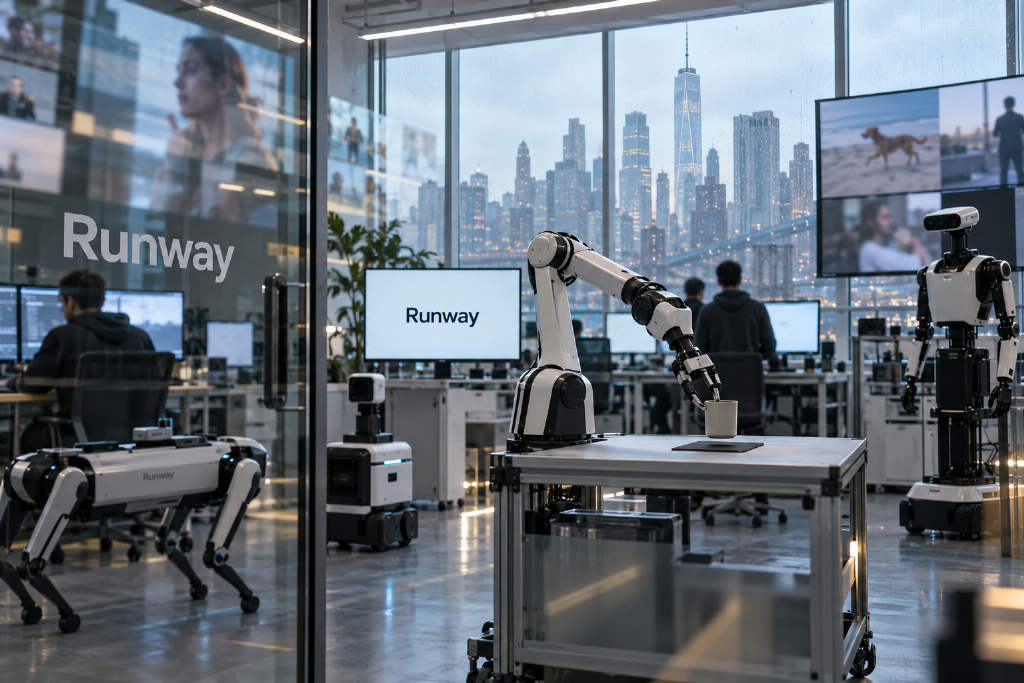
Runway has introduced Praxis-1, a robotics model that applies techniques developed for AI video training to real-world robots. The system learns from large volumes of ordinary internet video, using those clips to model how objects move and how people complete tasks, then converts that knowledge into robot actions.
In an object placement test, Runway said robots pretrained on internet video posted an average error of 16.1 centimeters. When trained instead on specially collected robot teleoperation video, the average error was 16.0 centimeters. The company said the benchmark covered 93 evaluations, with the two training approaches finishing nearly even.
Runway argued that if this approach scales, the amount of usable training data for robotics could expand by orders of magnitude, since teleoperated robot data requires hardware, physical space, and human labor, while ordinary video is already abundant online. Praxis-1 has been tested on multiple robots from Noble Machines, Standard Bots, and Ultra, including robotic arms, dual-arm systems, and mobile robots. The company also showed the same policy continuing a task after moving from a studio setting to a kitchen. Praxis-1 is currently available only through an early access application, while model weights are planned for release in the coming months. Parameter count and fuller independent evaluations have not yet been disclosed.
Runway has released Praxis-1, a robotics model that takes capabilities originally built for AI video models and applies them to physical robots. The model first learns from large volumes of ordinary video, studying how objects move and how people carry out tasks, then turns those patterns into robot actions.
Internet video pretraining came close to specialist robot data
Runway said it ran an object placement test. With pretraining on internet video, the robot recorded an average error of 16.1 centimeters. Using specially collected robot teleoperation video instead, the average error was 16.0 centimeters. The company said the test included 93 evaluations, and the two training methods finished nearly tied.
Runway said that if the approach continues to scale, the biggest bottleneck in robot training data could expand by several orders of magnitude. Collecting data through human teleoperation requires equipment, space, and labor. Ordinary video, by contrast, is already widely available across the internet.
Tested across several robot types
According to Runway, Praxis-1 has already been tested on multiple robots from Noble Machines, Standard Bots, and Ultra, including robotic arms, dual-arm robots, and mobile robots. The company also showed the same policy continuing to perform tasks after moving from a studio environment to a kitchen.
Praxis-1 is currently open only for early access applications. Runway said model weights are planned for release in the coming months, while parameter count and more complete independent evaluations have not been disclosed.
This article was originally published by Bit.Fan. For more cryptocurrency news and market insights, visit www.bit.fan. Disclaimer:
The market information, project data, and third-party content displayed on this platform are for industry information sharing only and do not constitute any form of investment advice or return commitment.
Cryptocurrency trading carries high risks. Users should fully assess their risk tolerance and make independent decisions. All profits, losses, and legal responsibilities are borne by the users themselves.