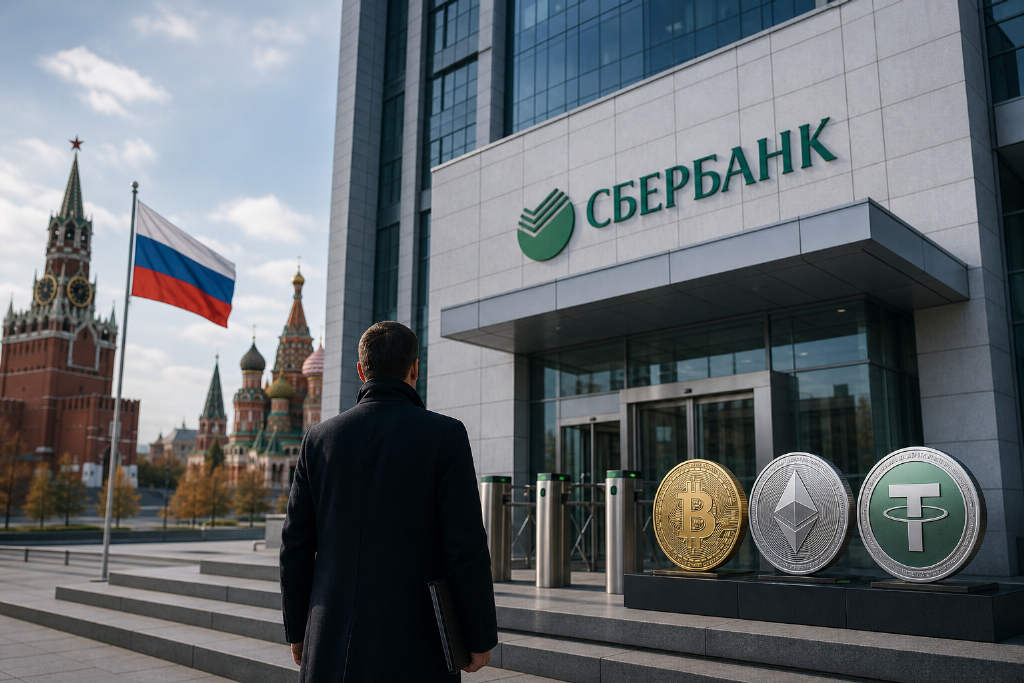
In a forecast from Russia's largest bank, first-year volume in the country's compliant crypto market is expected to reach at least 4 trillion rubles, or roughly $46.43 billion. Anatoly Popov, deputy chairman of the executive board at Sberbank, said the figure could climb to around 7.5 trillion rubles (about $87.06 billion) by 2029 as investors shift toward official trading channels. Still, most activity is projected to stay outside the regulated exchange system; only around 20% of first-year volume, equivalent to 3.5 trillion to 4 trillion rubles per year, is expected to flow through exchanges. A new framework takes effect September 1, letting investors buy crypto legally through brokers. Non-qualified investors face an annual cap of 300,000 rubles per licensed intermediary and must pass a risk-awareness test, while qualified investors have a 3 million ruble ceiling. For now, official exchanges can only list Bitcoin, Ether, and USDT; other altcoins are excluded. Exchanges have until July 1, 2027, to complete registration.
Russia's first-year compliant crypto trading volume is expected to reach at least 4 trillion rubles, or about $46.43 billion, according to Anatoly Popov, deputy chairman of the executive board at Sberbank, the country's largest bank. Bitcoin.com News reported the remarks.
Popov said that figure could grow to around 7.5 trillion rubles, roughly $87.06 billion, by 2029 as investors migrate to the official trading system. But most crypto volume is still projected to stay outside the regulated exchange system. In the first year, only about 20% of trading volume — equivalent to 3.5 trillion to 4 trillion rubles per year — would go through exchanges.
The new legal framework takes effect on September 1. From that date, investors will be allowed to buy crypto assets through brokers. Non-qualified investors can purchase up to 300,000 rubles per year through a single licensed intermediary, and must pass a risk-awareness test first. Qualified investors face a higher cap: 3 million rubles per year.
For the time being, official exchanges can trade only Bitcoin, Ethereum, and USDT. Other altcoins are excluded entirely. Exchanges must complete their registration by July 1, 2027.
This article was originally published by Bit.Fan. For more cryptocurrency news and market insights, visit www.bit.fan. Disclaimer:
The market information, project data, and third-party content displayed on this platform are for industry information sharing only and do not constitute any form of investment advice or return commitment.
Cryptocurrency trading carries high risks. Users should fully assess their risk tolerance and make independent decisions. All profits, losses, and legal responsibilities are borne by the users themselves.