

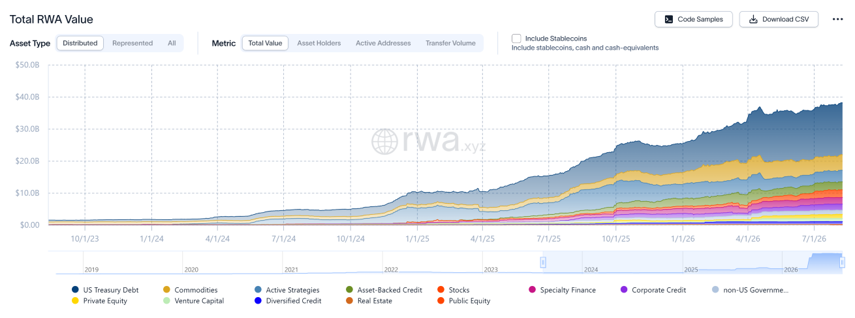
Real-world assets have kept growing even as trading in native DeFi assets has weakened and some older crypto narratives have lost momentum. Citing RWA.xyz data, Foresight reported that the publicly distributed RWA market, excluding stablecoins, reached $38.17 billion as of Aug. 10, 2026. That leaves the segment $1.83 billion short of the $40 billion threshold, while the total number of asset holders rose 56.18% over the past month to 1.7 million.
The article says this wave is not being driven by a fresh crypto narrative. Instead, demand for assets such as U.S. Treasurys and equities is being absorbed on-chain. Its main point is that the real test for RWA is not whether assets can be tokenized, but whether custody, legal claims, liquidation routes and redemption arrangements still hold after they move on-chain.
Market value and holder count both moved sharply higher
As of June 30, 2026, the RWA market stood at $32.65 billion with 947,000 holders. A little more than a month later, those figures had climbed to $38.17 billion and 1.7 million, representing monthly growth of 16.9% and 79.5%.
Over a longer stretch, the article says RWA has been in a high-growth phase since 2025. What changed in the second half of 2026 is the source of incremental growth. New issuance is no longer the only driver. The surge in holder count suggests demand is now opening up on the user side as well.
That growth is also highly concentrated. A joint report from BeInCrypto and RWA.xyz tracked more than 7,000 tokenized products, but only 62 assets accounted for 88% of market value. Under another classification approach, roughly $32 billion belongs to assets that can move freely on public blockchains, while another roughly $27 billion is closer to an on-chain representation of off-chain holdings, with limited practical on-chain usability. The article describes the market as shifting away from a broad rise toward structural divergence.
The market data in this section is sourced from RWA.xyz and is current as of Aug. 10, 2026.
Growth is concentrated in Treasurys, equities and commodities
The expansion in RWA is not spread evenly across asset classes. The article identifies three main growth lines: U.S. Treasurys, equities and commodities.
Tokenized U.S. Treasurys remain the base layer
As of Aug. 10, tokenized U.S. Treasury products were worth $16.21 billion across 87 separate products. This category alone grew from $380 million in the first quarter of 2023 to more than $16 billion. Circle’s USYC led the field at $3 billion, followed by BlackRock’s BUIDL at $2.68 billion.
Tokenized equities became the biggest user-acquisition channel
Holder count for tokenized equities reached 1.09 million as of Aug. 10, with weekly growth of 117.93% and allocated value of $2.37 billion. Data from Jupiter showed monthly tokenized equity trading volume on the platform had grown 360% this year, with more than 65% of trading taking place outside regular U.S. stock market hours.
Commodities continued to expand at a steadier pace
Tokenized commodities reached $4.88 billion in allocated value, while active addresses rose 124.42% on a monthly basis. Tether Gold was identified as the leading product in this category. The article argues this points to a two-track market structure, where institutional allocation now sits alongside a growing retail entry point.
These category figures also came from RWA.xyz, with the same Aug. 10, 2026 cutoff.
Traditional financial firms are a major force behind this cycle
According to the article, the most notable feature of the current RWA expansion is that it is being driven less by crypto-native invention and more by the collective arrival of traditional financial institutions.
BlackRock is presented as the clearest example. Its BUIDL fund has about $2.68 billion on-chain and is deployed on Ethereum, Avalanche and Solana. The fund mainly invests in U.S. Treasurys, repurchase agreements and cash equivalents, offering an annualized yield of about 3% to 5%. The article also highlights BlackRock’s recent move through Securitize and Uniswap Labs to bring BUIDL onto UniswapX, allowing qualified institutional investors to exchange USDC for the on-chain money market fund around the clock. BlackRock CEO Larry Fink, in the company’s 2026 shareholder letter, also stressed the importance of digital asset-related business in the firm’s broader strategy.
Franklin Templeton’s tokenized assets expanded from $768 million in June 2025 to more than $2.5 billion in June 2026. Its Benji platform moved $1.5 billion in assets to BNB Chain in July. Ondo Finance followed a different route, packaging yield-bearing underlying assets into yield-oriented dollar products and building a sizable on-chain base of users and assets.
RWA is also moving into practical DeFi use
The article says the story is no longer just about putting assets on-chain. It is increasingly about how those assets are used inside on-chain finance. In the second quarter of 2026, RWA deposits on DeFi platforms rose to $7.4 billion, about triple the level from the same period a year earlier, according to CoinShares and Token Terminal’s report The Growth of Hybrid Finance. Over the same period, total DeFi deposits fell about 15%.
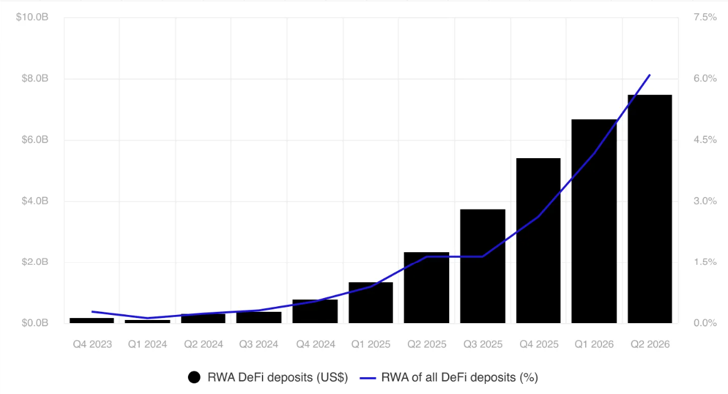
RWA spot trading volume increased about 220% year over year, while overall DEX trading volume fell about 70%. On Ethereum, the share of RWA collateral used in DeFi lending was close to 70%. Taken together, those figures suggest that RWA has started to take part in trading, deposits and collateral structures rather than staying as a simple issuance story.
Strong growth has not removed the core constraints
The article argues that RWA is still some distance away from true scale, despite the headline numbers. It points to three main bottlenecks.
The first is concentration. Sixty-two assets account for 88% of total market value, and about half of all assets do not see weekly fund transfers. In other words, a large number of tokenized assets exist on-chain without developing an active trading market.
The second is the legal and custody structure. In many cases, what users buy is not the underlying asset itself, but an on-chain representation of a real-world holding. The article cites Robinhood’s tokenized products, which explicitly state that the tokens provide economic exposure to the underlying securities but do not grant direct legal or beneficial ownership. It says the ability of such structures to protect investor rights in an extreme scenario remains unresolved.
The third issue is regulation. Progress in the United States on digital asset market structure legislation has strengthened expectations that the regulatory perimeter around RWA may gradually become clearer, but the timetable and implementation path remain uncertain.
A comparison with the early stablecoin market
The article draws a parallel between today’s RWA market and stablecoins around 2019. At that time, total stablecoin market capitalization was only about $5 billion. It has now surpassed $300 billion. The argument is straightforward: demand is already visible and growth has already started, but the institutional framework needed to absorb that growth is still being built.
Whether RWA can turn current momentum into lasting, institutionalized financial capacity will depend on whether custody structures, legal rights and regulatory frameworks are fully put in place.