RWA tokenization is moving beyond issuance. As custody, compliance, issuance and blockchain infrastructure become easier to access, the market is shifting its focus to what happens after an asset goes onchain: whether the underlying asset is suitable as a reserve asset and whether the issuer can run the operation consistently over time. The piece argues that long-term records, not launch speed, are becoming the harder-to-copy advantage. Matrixdock’s XAUm is presented as a case study, with semiannual independent reserve audits and more than 20 new ecosystem integrations in the first half of 2026. The article also compares short-term U.S. Treasuries, gold, silver and money market instruments with private credit, and outlines why reserve quality and operating discipline both matter for RWA durability.
RWA tokenization is moving into a new stage. The issuance stack is getting easier to assemble: custody, compliance, issuance and blockchain infrastructure now have service providers around them, which means teams with enough capital and expertise can bring tokenized assets to market faster than before.
That progress, however, changes the basis of competition. Launching an asset is no longer the main hurdle. The harder question is what happens after issuance. Ten years from now, which RWA businesses will still be trusted, integrated into financial rails and operating steadily?
The answer depends on two things: whether the underlying asset is fit to serve as a reserve asset, and whether the issuer can sustain the operating discipline around it.
On the asset side, short-term U.S. Treasuries, physical gold and silver, and money market instruments tend to have the right profile. They come with mature markets, widely accepted standards, observable prices and institutional custody and settlement processes. That makes verification, liquidity management and ecosystem integration easier to standardize and repeat.
Private credit is more complicated. It can carry standard features such as NAV, agreed yield and structured wrappers, but the exposures are still heterogeneous and often require asset-by-asset underwriting. Value may need to be assessed rather than simply observed in the market, and liquidity and credit performance can differ widely across loans.
But asset quality is only the starting point. Once an asset is tokenized and brought onchain, the issuer still has to prove that the surrounding infrastructure works as intended. Reserves must be managed continuously, custody must remain secure, verification must keep running, redemptions must execute smoothly, liquidity must hold up and integrations with protocols and ecosystems must stay reliable.
Many of those components can be replicated with third-party services. What is much harder to copy is the operating record that accumulates when the full system works over time: years of reserve management, repeated independent audits, successful redemptions, continuous market presence, a growing liquidity network, protocol integrations and real performance across different market conditions.
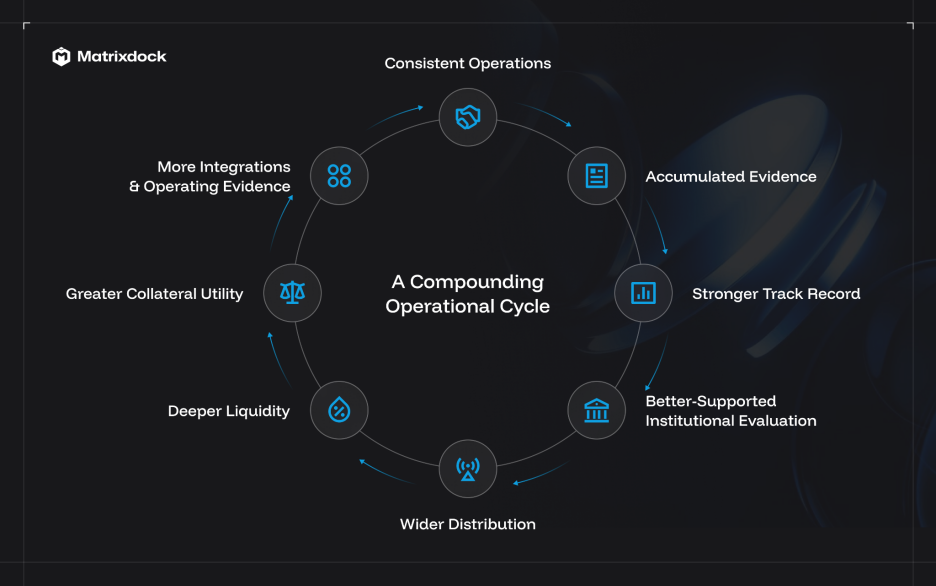
That record builds one proof at a time. Each audit adds another checkpoint. Each successful redemption shows the exit path works. Each stretch of uninterrupted market activity adds pricing and liquidity history. Each new integration expands the asset’s use across the broader financial system.
Over time, those proofs become a compounding cycle: ongoing operations create evidence, evidence strengthens the operating record, a stronger record supports institutional diligence, broader distribution deepens liquidity, liquidity improves collateral utility, and that in turn attracts more integrations and more evidence.
Matrixdock’s tokenized gold product, XAUm, is a live example. It has built a consistent verification record through semiannual independent reserve audits, and in the first half of 2026 alone it added more than 20 ecosystem integrations.
Neither of those achievements, on its own, is enough to create a durable edge. The edge comes from long-term, scaled execution and the evidence that execution leaves behind.
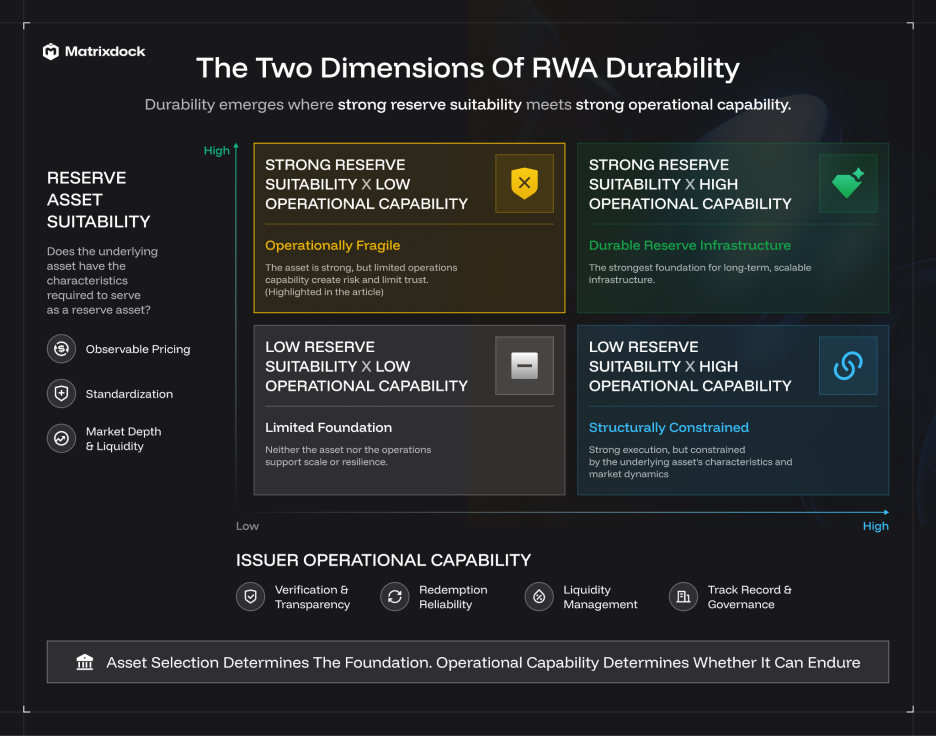
Seen through that lens, RWA longevity comes down to two dimensions: reserve-asset suitability and issuer operating capability. Low on both leaves little room for durability. High operating capability cannot fully overcome a weak underlying asset. The strongest setup is high reserve suitability plus strong execution, where growing evidence, broader market confidence and deeper institutional use reinforce one another.
The most overlooked case is the fourth one: strong reserve suitability with only limited issuer operating history. Gold and U.S. Treasuries already carry deep market recognition and long financial histories, which can make their tokenized versions feel safe even before the issuer has built a comparable track record.
That is exactly why the distinction matters. The quality of the reserve asset is not the same thing as the quality of the infrastructure representing it. The real test shows up in the details: Can the audit schedule be maintained when audits become harder to conduct? Has the redemption mechanism actually been stress-tested at scale, or only assumed to work? Can insurance and vault custody arrangements be renewed on schedule? Can compliance keep pace when rules change across jurisdictions?
Those gaps are easy to miss in normal markets. They become much more important during volatile periods, heavy redemptions, liquidity stress or operational disruptions, when the infrastructure around the asset is tested directly.
That is why tokenization alone is not enough. It creates an onchain representation of an asset. The asset itself provides the foundation. Ongoing operations collect the evidence that eventually turns that foundation into real infrastructure.
For Matrixdock, that is the logic behind Reserve Layer: using long-term, consistent execution to turn high-quality real-world assets into infrastructure for onchain finance.
This article was originally published by Bit.Fan. For more cryptocurrency news and market insights, visit www.bit.fan. Disclaimer:
The market information, project data, and third-party content displayed on this platform are for industry information sharing only and do not constitute any form of investment advice or return commitment.
Cryptocurrency trading carries high risks. Users should fully assess their risk tolerance and make independent decisions. All profits, losses, and legal responsibilities are borne by the users themselves.