
MarsBit’s latest RWA weekly, covering Oct. 23 to Oct. 30, 2026, showed on-chain real-world assets regaining ground while tokenized equities and stablecoin rules drew fresh attention from regulators and market infrastructure providers.
RWA and stablecoin market data
According to the latest figures from RWA.xyz, total on-chain RWA market capitalization reached $39.56 billion as of Oct. 30, up 2% from the same point a month earlier. The number of asset holders rose to 5.457 million, an increase of 8.49% over the same comparison period.
The stablecoin sector posted a split set of readings. Total market capitalization stood at $287.47 billion, down 2.16% month over month. Monthly transfer volume climbed 38.53% to $10.09 trillion. Monthly active addresses fell 4.69% to 58.49 million, while the total number of holders increased 3.13% to 304 million.
The three largest stablecoins remained USDT, USDC and USDS. USDT market capitalization fell 1.87% from a month earlier, USDC declined 3.72%, and USDS dropped 2.6%.
Policy and regulatory developments
SEC adds tokenization to fiscal 2027 clearing agency risk reviews
According to Unchained, the U.S. Securities and Exchange Commission included tokenization for the first time in its list of high-risk review areas for clearing agencies in fiscal 2027. Tokenization was not mentioned in the comparable documents for fiscal 2025 or 2026.
Canada releases draft stablecoin rules
CoinDesk reported that the Canadian government published draft Stablecoin Regulations and opened a 60-day public consultation that runs through Dec. 23. The draft would prohibit issuers from paying interest or yield to holders, whether directly or through a third party, while allowing rewards tied to usage.
It would also require non-bank issuers to hold reserves at least equal to circulating supply and keep those reserves with qualified Canadian custodians. Issuers would need to complete redemptions within three business days, could not impose a minimum redemption amount, and would face a 1% cap on redemption fees. The draft is intended to implement the Stablecoin Act passed this year and is scheduled to take effect in the fall of 2027.
Singapore, Malaysia and Thailand advance BLOOM
The Monetary Authority of Singapore said Bank Negara Malaysia and the Bank of Thailand have joined BLOOM as policymaking members. The three central banks will work with industry participants in their jurisdictions to build a common framework for the use of digital currencies across borders, covering receipt, exchange and settlement across institutions, networks and jurisdictions.
BLOOM, short for Borderless, Liquid, Open, Online, Multi-currency, is a public-private initiative focused on cross-border financial use cases involving tokenized deposits, regulated stablecoins and settlement across payment networks. New participants include Airwallex, Mastercard, Maybank, Monee, Nium, Ripple, ShopeePay, Visa and the World Bank Group.
South Korea and Latvia study tokenization frameworks
EDaily reported that South Korea’s Financial Services Commission will study a framework that could allow crypto exchanges to participate in the security token offering market. The review will cover market conditions, investor protection, licensing integration and permissions for combined operations. FSC Chairman Lee Eok-won said he agrees with proposals to use existing exchange technology and trading infrastructure to develop the STO market.
CoinDesk separately reported that Latvian Economy Minister Viktors Valainis said the country plans to introduce an RWA tokenization regulatory framework in the first half of 2027. Commercial real estate could be among the first use cases, and government bonds are also under consideration. The ministry is working with the central bank, the finance ministry and industry representatives, while an assessment of legal changes that had been expected by Oct. 1 is still underway.
Hong Kong and mainland China developments
LME explores tokenizing metal inventory in Hong Kong warehouses
Reuters reported that the London Metal Exchange, owned by Hong Kong Exchanges and Clearing, plans to turn metal stored in its Hong Kong warehouses into digital assets that can be used for financing. Three people familiar with the matter said the effort is tied to Hong Kong’s five-year plan to expand its role as a commodities trading hub. LME said it is in the early stages of exploring tokenization of off-warrant metal inventory to support corporate financing and plans to hold an invitation-only industry roundtable in early November.
Hong Kong is also testing the conversion of carbon credits into digital tokens for faster settlement.
Anchorpoint targets a retail stablecoin
The South China Morning Post reported that Anchorpoint, the stablecoin joint venture led by Standard Chartered, plans to issue a retail-focused stablecoin on a public blockchain and said it will take a “prudent” approach.
Hong Kong-regulated gold token XAUa goes live on Sui
XAUa, a Hong Kong-regulated tokenized gold product, has launched on Sui. The token is minted under Sui’s Permissioned Asset Standard, or PAS, issued by AlphaToken and distributed on-chain by TBook. Each XAUa token is backed by physical gold stored in Hong Kong, and holding or purchasing it is subject to eligibility requirements.
Under PAS rules, compliance requirements are written into a Policy. Every transfer must pass Policy checks before settlement. If a transfer fails, it is rejected and balances do not change. TBook said it has rebuilt and migrated its vault issuance platform onto PAS, allowing future RWA issuers to launch vault products on Sui with similar compliance controls.
Jiangsu universities to pay salaries through e-CNY wallets
According to notices from the finance offices of Nantong University and Yangzhou University, and following a notice from the Jiangsu Provincial Department of Finance, salaries for staff on establishment and personnel agency staff at the two universities will be paid through digital yuan wallets starting in November 2026.
Nantong University asked relevant staff to complete wallet opening and upgrades by Oct. 30. Salary and performance pay will be issued to two separate cards, and both cards require wallets. Yangzhou University required staff to complete wallet opening and upgrades by Oct. 23 and said wallet account information from four banks would be collected on Oct. 24 for payroll disbursement testing.
Project developments
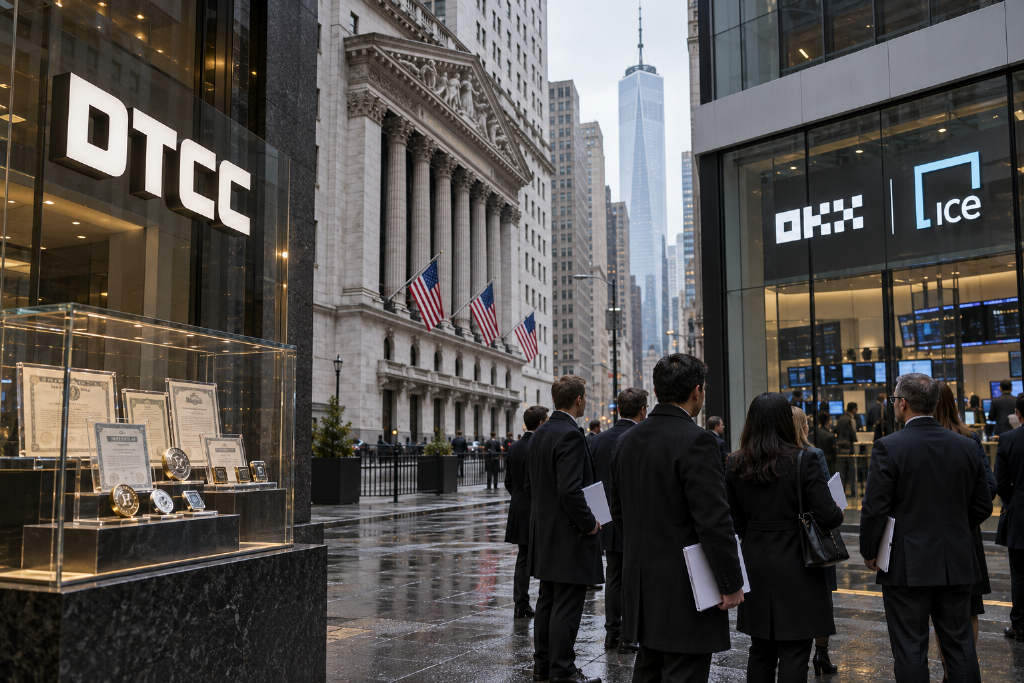
DTCC tokenization service goes live with 34 securities
According to DTCC’s website, the Depository Trust & Clearing Corporation has launched the DTCC Tokenization Service with an initial set of 34 eligible securities. The tokens are backed 1:1 by securities held in custody at The Depository Trust Company. Holders receive the same legal rights and economic interests as they do in the underlying securities.
The same CUSIP is used in traditional markets and on-chain. Registered DTC wallets can transfer the assets peer to peer on a 24/7 basis. DTCC said the service includes built-in compliance controls and near real-time ownership tracking. Initial wallet and application partners include BitGo, Blockdaemon, Fireblocks, HashKey, Kaleido, Prometheum, Talos, Temple and Tradeweb. DTC holds roughly $30 trillion in assets under custody.
Janus Henderson launches JQQQ on Stellar
According to unfolded, Janus Henderson launched JQQQ, a tokenized fund described as the first tokenized fund licensed to use the Nasdaq-100 Index. JQQQ is issued on Stellar using Centrifuge technology and is available only to eligible non-U.S. professional investors, with a minimum investment of $100,000. Assets under management and trading volume have not been disclosed.
TSV may begin trading tokenized CNTN shares on Nov. 2
CoinDesk reported that TSV LLC, a tokenized stock trading platform built on Canton Network, plans to begin trading tokenized shares of Canton Strategic Holdings, ticker CNTN, as early as Nov. 2. The company is using an issuer-led tokenization model and has appointed SEC-registered on-chain transfer agent Fairmint to issue the tokens and maintain the official record of ownership.
That structure allows TSV to avoid the 30-day issuer objection period required for third-party tokenization. CoinDesk said the move could let TSV complete the first tokenized U.S. stock trade under the SEC’s “innovation exemption” framework before the OKX-ICE joint platform does.
Mirae Asset Securities works with Grvt on tokenized financing notes
Chainwire reported that the Hong Kong subsidiary of Mirae Asset Securities arranged the issuance of tokenized financing notes under a structured note program of an affiliate, with on-chain trading platform Grvt subscribing to the issuance. Grvt plans to use the exposure in its yield product, Grvt Earn, subject to applicable requirements.
The two sides said they may explore tokenized government bonds, corporate bonds and ETFs later, without making commitments and subject to regulatory approval. As of September 2026, Mirae Asset Financial Group managed more than $1 trillion in global client assets. Grvt launched in 2024, has served more than 198,000 wallets, and recorded a peak total value locked of $109 million.
Soneium outlines token and entertainment IP plans
According to an official announcement, the Ethereum Layer 2 network Soneium plans to issue a native ecosystem token called SONEIUM to connect creators, intellectual property holders, developers, fans and investors. Token details and the token generation event schedule will be announced later. The token has not yet been issued.
Soneium also laid out an on-chain entertainment economy plan. Soneium Portal will serve as a discovery and participation platform for IP tokenization projects. The first IP token project will be the Japanese character Moriusa. The network also plans an IP Vault for royalty assets, tokenized IP bonds backed by entertainment businesses, and a partnership with DayOneDream to bring K-pop concert business royalties on-chain. Soneium said it also plans to adjust base gas fees to support network resilience and sustainable operations.
SBI, BlackRock and Ripple-related partnerships expand
According to an announcement on Cross River’s website, SBI Holdings signed a strategic memorandum of understanding with CRB Group, the parent of Cross River Bank, to form a joint venture in Japan. The companies plan to explore tokenized products tied to real-world assets such as loan receivables, cross-border payments and payment infrastructure for AI agent trading. SBI also plans a strategic investment in CRB Group and will explore connecting the yen stablecoin JPYSC to the Cross River platform for institutional cross-border and tokenized asset settlement. Final agreements and regulatory approvals are still required.
The Block reported that BlackRock Financial Management and BlackRock Japan signed a memorandum of understanding with SBI Holdings and Startale Group to explore linking tokenized money market funds with SBI’s yen stablecoin JPYSC. The parties will assess feasibility across technology infrastructure, business and distribution, and regulation and market development, and plan to open cooperation to Japanese and international financial institutions and corporations.
Ripple said in an official announcement that BNY now supports custody for XRP and the U.S. dollar stablecoin RLUSD on its digital asset custody platform. Eligible institutional clients can custody, hold and transfer those assets through the platform. The two companies also plan to expand support for tokenized assets and investment products on the XRP Ledger and are exploring a setup that would allow clients to mint and redeem RLUSD directly through BNY in the future.
Ripple added that it and BNY are working with working capital platform C2FO on a supply chain finance model on XRPL that would tokenize trade finance assets such as receivables.
Business Wire reported that Ripple and Robinhood entered into a strategic partnership. RLUSD is already live on Robinhood Chain and Bitstamp by Robinhood and is expected to reach the Robinhood app later this year. Robinhood will use RLUSD on XRPL for institutional settlement and will integrate Ripple Treasury for cash and liquidity management, payments and risk management. Ripple Prime is providing lending and margin financing for about 20 digital assets to Bitstamp and will support perpetual futures trading on Bitstamp later this year. RLUSD’s market capitalization has exceeded $2.5 billion since its launch in December 2024.
OKX-ICE tokenized stock plan faces objections from 38 companies
CoinDesk reported that Walmart, Eli Lilly, Carnival, Arcos Dorados and Cigna have joined the list of companies objecting to the tokenized stock trading plan involving OKX and Intercontinental Exchange. Of the 62 companies originally identified, 38 have now publicly expressed opposition.
Under a five-year exemption granted by the SEC, companies have 30 days to object to stock tokenization initiated by third parties, meaning non-affiliated parties. If they remain silent during that period, the activity is treated as permitted, and there is no mechanism to withdraw that permission later.
MSX lists four U.S. stock tokens
U.S. stock token trading platform Maitong MSX has listed spot and derivatives trading for tokenized shares tied to cybersecurity company TENB, SaaS platform NOW, beverage company KO and payments brand V.
Fundraising and issuance
Aviva Investors launches tokenized sterling liquidity fund shares on XRPL
According to Ripple, Aviva Investors has launched a tokenized share class for a sterling liquidity fund on the XRP Ledger, with Aviva investing £50 million, or about $66 million. The fund’s overall assets under management are about £22 billion, though that figure does not represent the amount brought on-chain in this issuance.
After launching a tokenized U.S. dollar liquidity fund share class in July, Aviva Investors’ combined investment across the two tokenized share classes has now exceeded £86 million, or about $116 million. The new share class uses a digital twin model that represents holdings on-chain while preserving the existing off-chain fund structure, investment objectives, risk profile, liquidity and regulatory protections. Eligible investors with digital wallets can participate. Fund assets remain in custody at BNY, while Komainu and Licuido provide digital asset custody and tokenization infrastructure, respectively.
Industry observations
Two tokenized U.S. equity models are moving in opposite directions
A PANews summary said OKX-ICE plans to launch third-party tokenized U.S. equities under the SEC’s five-year innovation exemption, and 33 listed companies had already exercised their 30-day objection rights, representing about $17 trillion in combined market value. The summary said those objections apply to that specific platform rather than tokenization as a whole. It also said issuers are concerned about price volatility and the risk that investors may confuse the nature of the product.
The same summary said DTC, under DTCC, has rolled out a 1:1 securities tokenization service that preserves traditional securities rights and has already attracted a range of institutions, setting up a direct contrast with the OKX-ICE third-party model. It also said Nasdaq does not recognize the trading mechanism under that exemption. Conservative nonprofit CSLF placed a full-page advertisement in The Wall Street Journal urging listed companies to exercise their opt-out rights, and its ties to industry association SIFMA have fueled market speculation.
Securitize Stocks and the next phase of tokenized equity competition
Another PANews summary said Securitize launched Securitize Stocks with 12 tokenized U.S. equities on Solana using a UCC Article 8 securities entitlement structure. That legal design differs from Binance bStocks and Robinhood stock tokens. Once conditions are met, Securitize’s structure can be converted into shares recorded on the issuer’s shareholder register, while the other two provide economic exposure only and limit conversion to brokerage accounts.
The summary added that Binance and Robinhood account for most on-chain tokenized stock trading volume, while Securitize has less retail traffic. Its goal, according to the summary, is not limited to trading. It is trying to build a neutral asset base layer for exchanges and brokerages, offering issuance, registration and custody infrastructure that could support issuer-led tokenization in the future. Whether that model scales will depend on issuer participation and the size of the trading network.


