
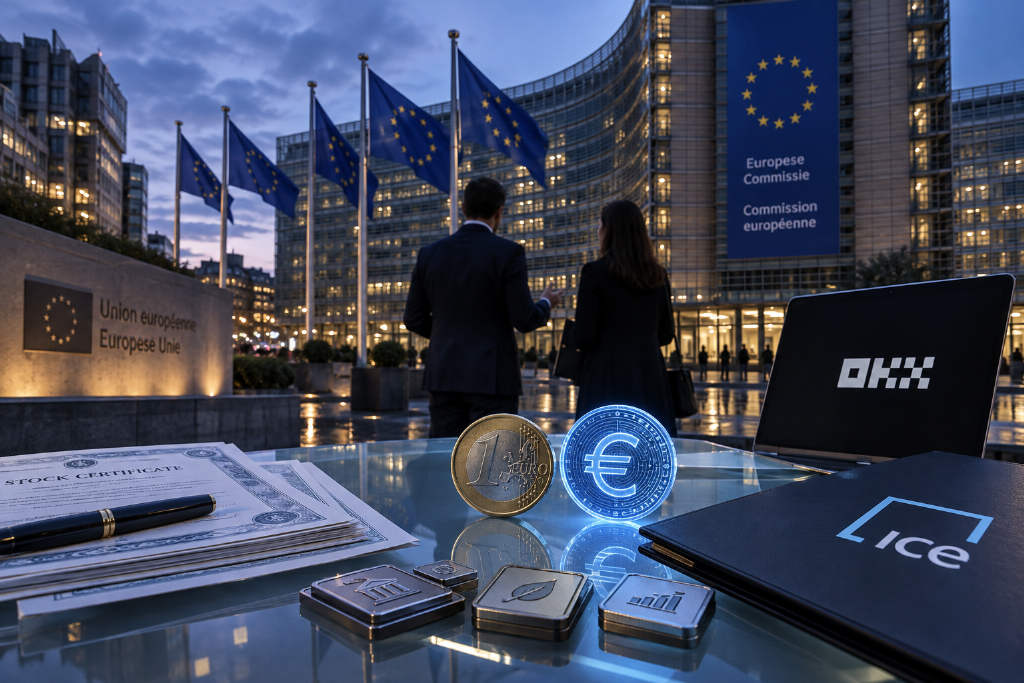
PANews’ latest RWA weekly covered the period from Oct. 2 to Oct. 9, 2026, and showed a market that kept moving on several fronts at once: on-chain RWA value slipped, user counts kept rising, stablecoin capitalization edged higher, and regulators and issuers pushed ahead with new plans.
RWA market cap fell to $38.88 billion while holder count kept rising
According to the latest figures from RWA.xyz, total on-chain RWA market capitalization stood at $38.88 billion as of Oct. 9, 2026, down 0.99% from the same point a month earlier. The total number of asset holders rose to 5.1764 million, up 37.21% over the same period.
The combination left the sector with a clear split: asset values softened, but user penetration continued to expand.
Stablecoin capitalization rose, but transfer activity cooled sharply
Total stablecoin market capitalization reached $295.09 billion, up 0.51% from a month earlier. Monthly transfer volume came in at $6.82 trillion, down 21.87%. Monthly active addresses reached 60.73 million, up 5.13%, and the total number of holders climbed to 295 million, up 2.82%.
The leading stablecoins remained USDT, USDC and USDS. USDT market capitalization rose 0.58% from a month earlier, USDC was flat, and USDS slipped 0.01%.
The data pointed to a market where capitalization and user base kept growing, while on-chain transfer and settlement activity lost momentum over the month.
ECB sets 2029 target for digital euro, ESMA orders non-MiCA stablecoin wind-down
According to JRJ, European Central Bank executive Piero Cipollone said the digital euro would help European banks improve their competitiveness. Speaking on Tuesday, he said the project was “not only” about fixing current weaknesses in Europe’s payments system. “This is also an opportunity to think about the future and provide a platform for innovation. New opportunities are constantly emerging, and we want to make sure European payment service providers are fully able to seize them and build a strong competitive advantage,” he said.
The ECB plans to formally launch the digital euro in 2029 and start a pilot phase next year. The project is intended to safeguard Europe’s monetary sovereignty. The report said European policymakers remain concerned by the region’s dependence on U.S. payment companies such as Visa and Mastercard, as well as the continued growth of dollar-linked stablecoins.
On Oct. 8, the European Securities and Markets Authority issued an opinion requiring crypto-asset service providers in the EU to stop offering services involving non-MiCA-compliant stablecoins to EU clients. The scope covers trading, exchange, custody, transfers and investment advice, and providers must also block clients from buying or increasing positions. Existing exposure must be cleared within three months, and no later than Jan. 8, 2027. During the transition period, only limited exit services such as selling, exchanging and withdrawing may be offered.
In France, according to Journal du Coin, the finance committee of the National Assembly has been reviewing 10 crypto-related amendments in the 2027 budget bill since Oct. 7. Three have passed and one has been rejected. Measures approved by the committee include taxation of stablecoin exchange transactions, an exit tax on crypto assets, and a 10-year carryforward for crypto losses. A proposal to extend the wealth tax to crypto assets was rejected, while reporting requirements for some self-custody wallets and platform penalty measures remain under review. None of the measures has become law yet.
According to Cointelegraph, Russia’s Finance Ministry said some employees had received salaries in digital rubles for the first time. The ministry did not disclose how many employees were paid that way or the total amount distributed. It said that after successfully disbursing about 16 million digital rubles, or roughly $192,245, during a 2025 federal budget spending pilot, it had now applied that payment channel to its own payroll process. Russia’s central bank is working with the ministry to integrate the digital ruble into budget payments.
According to NADA NEWS, Japan’s Finance Ministry held the first meeting of its study group on putting government bonds on-chain and outlined three categories. Type 1 would circulate beneficiary rights in funds investing in government bonds, including MMFs, on blockchain. Type 2 would place transfer ledgers on-chain within the current transfer and settlement framework, with three forms: a single account management institution, coordination among multiple institutions, and linkage to the Bank of Japan ledger. Type 3 would issue a new form of government bond on blockchain outside the current system. The ministry said on-chain issuance could improve collateral and liquidity management efficiency and broaden the investor base, especially for overseas investors, while also raising issues such as market fragmentation, transmission of sharp price swings and system upgrade costs. The framework remains provisional, and the ministry plans to compile a report by January 2027.
According to Bits media, the Kyrgyz government decided to terminate operations of the national stablecoin Gold Dollar, or USDKG, and ordered the Finance Ministry to liquidate its issuer EVA and the country’s first state-owned crypto exchange, Coin Nomad Exchange. USDKG was launched in November 2025 and was initially described as the world’s first state-issued stablecoin backed by physical gold and pegged 1:1 to the U.S. dollar. More than 50 million tokens were registered for issuance, and the token ran on Tron. Authorities had planned to operate it until at least 2034. Holders can now redeem USDKG for fiat currency or USDT.
OKX and ICE file for tokenized stock venue as Securitize and Ondo expand offerings
According to The Block, Standard Chartered’s Singapore branch plans to offer institutional investors custody services for selected crypto assets, stablecoins and tokenized real-world assets. The bank said the service would expand an existing digital asset custody footprint that already covers the UAE, Luxembourg and Hong Kong.
Bloomberg reported that OKX has filed with the U.S. Securities and Exchange Commission to launch a tokenized stock trading platform, making it one of the first major exchanges seeking to use new U.S. rules to trade digital versions of publicly listed company shares on a crypto platform. The applicant, OKXICE LLC, is a joint venture between OKX and Intercontinental Exchange, the parent company of the New York Stock Exchange. It plans to list tokenized shares of 63 NYSE-listed companies in its first batch. Issuers would have a 30-day opt-out period before trading could begin.
The filing relies on the SEC’s five-year “Innovation Exemption,” introduced on Sept. 17. The joint venture is co-chaired by former New York Governor Andrew Cuomo. Under the new rules, tokenized securities must include full shareholder rights, including dividends and voting rights. PANews also noted that ICE took a stake in OKX in March this year at a $25 billion valuation.
According to Cointelegraph, tokenization platform Securitize has entered a strategic partnership with South Korean technology giant LG CNS. The two companies signed a memorandum of understanding to jointly develop tokenized asset and digital asset infrastructure for Korean financial institutions. Under the agreement, they will focus on tokenized funds, stocks and stablecoins, while also exploring broader opportunities across the Asia-Pacific region. The move comes as South Korea prepares to implement new rules for tokenized securities, with regulations proposed by the Financial Services Commission expected to take effect in February 2027.
CoinDesk separately reported that Securitize launched Securitize Stocks, a tokenized U.S. equities product covering 12 companies in its first batch, including Apple, Nvidia and Tesla. The tokens are issued on Solana, backed 1:1 by underlying shares, and carry dividend and voting rights. Settlement is in USDC. Qualified investors in the U.S., Europe and other regions can trade the product. The company plans to add 24/7 trading later and expand to the NYSE digital platform and OKXICE.
Ondo Finance said it launched Ondo Private Markets, a platform designed to bring the economic exposure of leading private companies on-chain through tokenized notes. The product offers investment exposure through Tokenized Notes, with each token’s payoff linked to the per-share value of the relevant company’s common stock in a qualifying liquidity event such as an IPO or another exit. The tokens are freely transferable and can be combined with on-chain DeFi applications.
Injective, according to an official announcement, released a new white paper, its first full rewrite since the original version published in December 2018. The project said it has evolved from an Ethereum-based anti-front-running trading protocol into a Layer 1 blockchain focused on institutional finance and asset tokenization.
The new white paper covers native RWA issuance, iAssets, an on-chain central limit order book, roughly 600-millisecond block times with deterministic finality, native EVM and WASM support, perpetual futures mechanisms, and financial functions for AI agents. Injective said AI agents can use USDC for machine payments through MCP servers, strategy-constrained signing and the x402 protocol. It also said on-chain protocol revenue will flow to recurring INJ community buybacks.
Plume said it launched nBND, a tokenized vault based primarily on the Fidelity Total Bond ETF, or FBND. The product is designed to give on-chain allocators broader fixed-income exposure beyond short-term Treasuries and money market assets, extending Plume’s tokenized asset lineup into longer-duration and actively managed bond exposure.
CoinDesk reported that the Cardano Foundation has spun out its digital identity project Veridian into an independent Swiss company and tokenized most of its 1 million shares on-chain using Cardano’s newly introduced programmable token standard CIP-0113. Veridian became the first company to use the standard for equity tokenization, though the tokenized shares were not offered to the public.
Foundation CEO Frederik Gregaard, who also serves as Veridian’s chairman, said the company plans to seek strategic investors in 2027. Veridian is led by blockchain engineer Thomas A. Mayfield and builds digital credentials on the open KERI and ACDC standards to help individuals, businesses and AI agents verify identity and permissions without a central database. Its mobile wallet is already live on iOS and Android and has integrated with Utah’s digital identity rules in the United States.
Dominion, a tokenized silver project on Solana, said it is shutting down. The team said a September security breach led to the theft and sale of a large amount of SILV, triggering a collapse in liquidity, losses in operating funds and damage to market structure that the project could not sustainably recover from.
Dominion said it used most of its remaining liquid funds after the attack for a reimbursement plan for holders from before the hack. Eligible participants can exit at $63 per SILV. The team said the capital required to rebuild liquidity, restore the market and continue operations exceeded remaining resources.
Tokenized U.S. stock trading platform MSX said it has distributed dividends for 11 tokenized underlying assets, including Salesforce (CRM), Merck (MRK) and the Nasdaq-100 ETF QQQ, covering execution dates from Oct. 3 to Oct. 11.
Spiko raises $90 million, while First Digital and OpenPayd move toward Nasdaq
The Block reported that tokenized cash fund issuer Spiko raised $90 million in a Series B round led by New Enterprise Associates, bringing total funding to $120 million.
Spiko said its tokenized cash fund business now spans more than 25 jurisdictions and has reached $2.7 billion in assets under management. The company plans to use the new capital to launch more fund products, enter new markets and expand its team.
According to GlobeNewswire, stablecoin payments infrastructure company Noah raised $38 million in seed funding, with participation from Endeit Capital, FJ Labs, LocalGlobe, Felix Capital and several angel investors. The company said the funds will be used to expand international remittance operations and regulatory coverage for stablecoin-based cross-border payments serving businesses and individuals.
Techinasia reported that Hong Kong-based digital asset company First Digital Group Limited, the issuer behind the FDUSD stablecoin, signed a definitive business combination agreement with Nasdaq-listed SPAC CSLM Digital Asset Acquisition Corp III, ticker KOYN. The transaction values First Digital at $250 million before the deal. After closing, First Digital will become a wholly owned subsidiary of a new Cayman holding company, and existing shareholders will receive Class A ordinary shares. The combined company is expected to list on Nasdaq in the first half of 2027.
CoinDesk reported that London-based stablecoin payments infrastructure company OpenPayd plans to go public on Nasdaq by the end of 2026 through a merger with Titan Acquisition Corp. under the ticker OP, at an implied valuation of about $1.1 billion. CEO Iana Dimitrova said the proceeds would be used for U.S. expansion and acquisitions, with a goal of launching services for U.S. clients by April 2027. The company has acquired and integrated money transmitter licenses in 43 states. For its latest fiscal year ended April 30, 2026, OpenPayd reported revenue of $73 million, up about 28%. Its clients include Kraken and OKX.
The Defiant reported that Anchorage Digital, the first federally chartered digital asset bank in the U.S., acquired B2B payments platform Routable. Financial terms were not disclosed. Routable uses developer-first APIs to help businesses onboard and verify payees, automate tax and compliance processes, and send mass payouts in fiat and stablecoins to creators, contractors and sellers in more than 220 countries.
Anchorage Digital said the acquisition would broaden its customer base from crypto-native firms to traditional financial institutions entering digital assets, as well as large technology companies and Fortune 500 firms with significant payout needs. Routable will operate under a new brand, and stablecoin and tokenized deposit products are expected to launch over the coming quarters.
PANews highlights debate over DeFi, RWA and tokenized stock compliance
In its insights section, PANews summarized views from TOKEN2049 that framed RWA as a core question for DeFi. The argument was that if DeFi relies only on crypto-native assets, total value locked and yields will continue to swing with token prices and struggle to compete with risk-free rates in traditional markets. Hyperliquid and Solana have already shown incremental gains tied to RWA, but most tokenized stocks and funds are still only on-chain in form and have not yet been put to work inside DeFi.
The same discussion pointed to several bottlenecks: T+1-style liquidity limits on RWA redemptions, insufficient depth in on-chain fixed-rate markets, and a preference among institutions for permissioned KYC access rather than direct deposits. Metrics worth tracking next include acceptance of RWA as collateral, development of fixed-rate markets, compliant institutional access, the share of tokenized stocks embedded in DeFi, the scale of RWA-backed collateral and growth in RWA holder addresses.
PANews also summarized ArkStream Capital’s view that the market’s pricing logic is changing. It said macro factors including higher oil prices linked to the U.S.-Iran conflict and Federal Reserve rate hikes helped drive Bitcoin up 42% in the third quarter of 2026. Bitcoin traded more in line with the Nasdaq and decoupled from gold, while capital mainly entered through spot Bitcoin ETFs and the broad altcoin rally faded. Robinhood Chain and Arc posted strong data, but most activity there remained concentrated in meme tokens and launchpad assets, leaving RWA still in an early stage.
That view also said the main increase in crypto trading volume this quarter came from RWA perpetual contracts, while on-chain RWA scale grew sharply. Tokens with real protocol revenue and active buyback programs outperformed most altcoins, making revenue sustainability a more important filter for projects.
On OKX’s filing, PANews said the exchange has applied to launch a tokenized stock trading platform in the U.S. Its offshore market currently offers more than 70 synthetic tokenized stocks, but those products are restricted under Regulation S, unavailable to U.S. and European users, and give holders only price exposure rather than real shareholder rights such as dividends and voting.
In September, the SEC introduced a five-year Innovation Exemption that allows compliant venues to trade on-chain U.S. equities, but only if the tokens carry full shareholder rights. Existing offshore synthetic products do not meet that standard. PANews said OKX and ICE have already formed the OKXICE joint venture and are still waiting for broker-dealer and FCM license approvals, leaving the public filing details, product structure and licensing progress as the next points to watch.