

Key developments this week
This edition covers the period from July 17 to July 24, 2026.
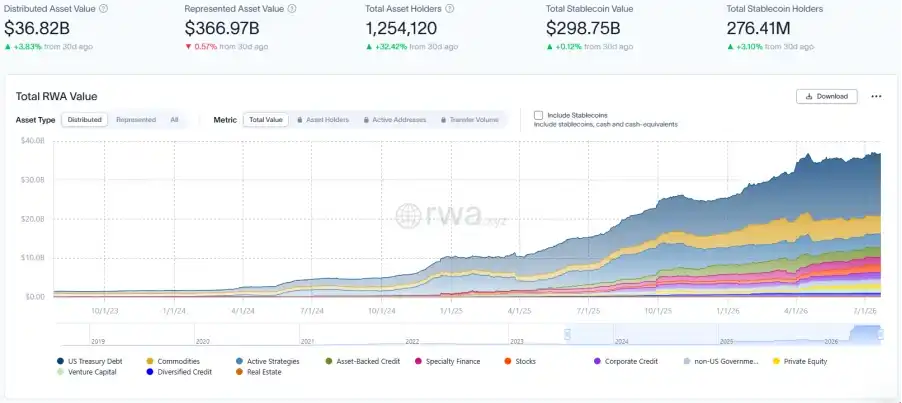
As of July 24, 2026, on-chain RWA market capitalization reached $36.82 billion, up 3.83% from the same point a month earlier. The number of asset holders climbed to 1.2541 million, a 32.42% increase from a month ago and a net monthly gain of more than 300,000, the largest increase on record.
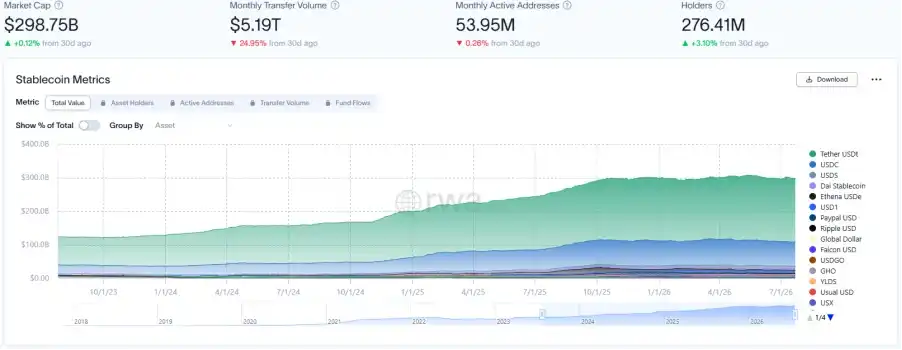
The stablecoin market moved differently. Total market capitalization edged to $298.75 billion, up 0.12% month over month, while monthly transfer volume dropped to $5.19 trillion, down 24.95% from the same period a month earlier.
On regulation, the U.K. is targeting 2027 for its first on-chain gilt issuance, though a shortage of compliant GBP stablecoins remains a constraint. South Korea moved on several fronts at once, including stablecoin legislation, won internationalization, and broader payment use cases tied to its CBDC work.
At the project level, HSBC, BNY Mellon and Abu Dhabi sovereign wealth capital expanded their involvement in tokenized bonds and private equity. Ondo gained authorization tied to regulated tokenized securities in the U.S. Kraken’s xStocks and other firms widened tokenized equity access. Stablecoin use cases also kept spreading into enterprise settlement, wallet-native support and clearing-bank infrastructure.
On financing, stablecoin clearing bank startup Augustus raised $180 million at a $1 billion valuation in a round led by Tiger Global.
Data snapshot
RWA market overview
RWA.xyz data showed that, as of July 24, 2026, total on-chain RWA market capitalization stood at $36.82 billion, up 3.83% from the same time a month earlier. Total holders rose to 1.2541 million, up 32.42% over the same period, with a net monthly increase of more than 300,000.
The figures point to faster investor inflows into the RWA segment and a clear increase in market participation.
Stablecoins
Total stablecoin market capitalization was $298.75 billion, up 0.12% from a month earlier, with liquidity pools broadly unchanged. Monthly transfer volume, however, fell to $5.19 trillion, a 24.95% drop from the same point a month earlier.
Monthly active addresses slipped to 53.95 million, down 0.26%, while total holders rose to 276 million, up 3.1%. That divergence suggests retail allocation demand is still growing even as on-chain transaction participation has eased.
The leading stablecoins remained USDT, USDC and USDS. USDT market capitalization rose 1.21% month over month, USDC fell 0.2%, and USDS dropped 13.2%.
Regulation
U.K. targets 2027 for first on-chain gilt, but GBP stablecoin gap remains
According to CoinDesk, the U.K. plans to issue its first blockchain-based government bond, the Digital Gilt Instrument Token, or DIGIT, as early as 2027 through HSBC and London Stock Exchange Group. A central issue is still on-chain cash settlement.
Industry participants said putting gilts on-chain could allow instant settlement and the movement of collateral across platforms, potentially freeing up tens of billions in idle liquidity. Daily trading volume in U.K. gilts currently exceeds £45 billion. But the market still lacks standardized on-chain payment tools and compliant GBP stablecoins. The largest TGBP has a market capitalization of only about $34.2 million, and the U.K.’s crypto regulatory framework will not take effect until October 2027.
The report said analysis indicates that, if supporting rules and stablecoin infrastructure are put in place, on-chain gilts could become high-quality collateral for a broader tokenized asset market.
South Korea publishes won internationalization roadmap
According to ETNews, the South Korean government released a “won internationalization roadmap” on July 19. The plan aims to move the won from a regulated currency model toward freer convertibility and to build an offshore won settlement network.
South Korea’s central bank is expected to launch an offshore won settlement network, a provisional name, with a pilot run in September this year and a formal launch in January next year. The country also plans to build digital-asset payment infrastructure to support issuance, distribution and trading of won-denominated stablecoins, and to begin a pilot next year for government bond tokenization linked to the Bank of Korea’s institutional CBDC.
South Korea is also set to formally join Agora, the cross-border digital payment project led by the Bank for International Settlements and involving eight central banks.
South Korea accelerates stablecoin legislation
Edaily reported that Kim Seong-jin, head of the virtual asset division at the Financial Services Commission, told a National Assembly meeting that the government is moving ahead with both stablecoin-related legislation, described as the second phase of the Digital Asset Basic Act, and measures to allow institutional investors into the market. The FSC said it would complete digital asset legislation within the year.
If institutional entry proceeds, a ban that has prevented financial companies from holding equity stakes in crypto businesses for nine years, enforced through administrative guidance since 2017, could be lifted this year. Banks and securities firms would then be able to participate in virtual-asset investment.
Kim also said authorities are studying mechanisms similar to institutional brokerage and over-the-counter intermediation in the stock market, while looking to European rules to simplify market entry requirements for financial institutions moving into comparable crypto-related business lines.
Deposit-token payment infrastructure project extends CBDC testing into private payments
Digital Today reported that the Korea Internet & Security Agency and the Ministry of Science and ICT have launched a project to expand deposit-token payment infrastructure, extending outcomes from South Korea’s “Project Hangang” CBDC pilot into civilian payment scenarios.
The project is overseen by the Korea Financial Telecommunications and Clearings Institute, with participation from nine banks, eight payment gateways and two large demand-side entities. Its total budget is KRW 9.6 billion, and the stated aim is to reduce payment fees for small merchants.
The system uses existing payment rails rather than building a new network. Users would pay through bank deposit-token wallets, and merchants would not need to replace terminals. The government also plans to test deposit-token use for official travel expenses and explore links with dBrain for treasury fund management. Of the total budget, about KRW 3 billion will go to development, operations and promotion for SMEs, startups and IT companies, while participating banks are expected to separately pursue about KRW 4.5 billion in related business spending.
Hong Kong watch
Anchorpoint may announce HKD stablecoin HKDAP by month-end
Hong Kong’s HKEJ, citing people familiar with the matter, reported that Anchorpoint, the fintech venture led by Standard Chartered Bank (Hong Kong), may announce a stablecoin launch as early as the end of this month.
Anchorpoint plans to issue HKDAP, a Hong Kong dollar-pegged stablecoin. Virtual-asset trading platforms including OSL Group and HashKey Exchange are expected to act as distributors.
An Anchorpoint spokesperson told HKEJ that the company is proceeding as planned with preparations for the phased issuance of the regulated HKD-linked stablecoin HKDAP and will disclose updates in due course.
Project developments
HSBC joins the U.K. Digital Securities Sandbox
HSBC said it has become the first institution approved by the Bank of England to go live in the U.K.’s Digital Securities Sandbox. Its digital asset platform, HSBC Orion, will act as a digital securities depository in the sandbox and support issuance, custody and settlement for native digital bonds, including DIGIT and corporate debt.
The sandbox is jointly run by the Bank of England and the Financial Conduct Authority to provide a regulated environment for testing and deploying distributed ledger technology in the issuance, trading and settlement of securities in the U.K. The U.K. chancellor recently said the first DIGIT is expected to be issued early next year. HSBC Orion has so far supported more than $5 billion in digital bond issuance.
BNY Mellon prepares for 24/7 U.S. Treasury settlement by 2027
Bloomberg reported that BNY Mellon is preparing to support round-the-clock settlement for U.S. Treasuries as digital-asset growth puts pressure on traditional market infrastructure. In a client letter, the bank said it had earlier this year facilitated after-hours Treasury transactions involving stablecoin issuers, and plans to launch tokenized U.S. Treasuries by the end of 2026 for pilot trading on its private blockchain. The target is 24/7 settlement for both traditional and tokenized Treasuries in 2027.
The bank said those after-hours transactions took place after the Federal Reserve’s Fedwire Securities Service had closed and involved Ripple, issuer of RLUSD, and OpenEden, issuer of USDO. Both stablecoins are backed by short-term U.S. Treasuries. BNY Mellon said the transaction “demonstrated that Treasury market activity related to the digital asset ecosystem can continue after traditional cut-off times.”
Mubadala Capital teams up with Coinbase on tokenized private equity
Fortune reported that Abu Dhabi sovereign wealth fund affiliate Mubadala Capital will work with Coinbase and infrastructure provider KAIO to launch a blockchain-native version of its long-term private equity fund, issued to qualified investors in compliant token form.
Coinbase will use its Base blockchain as one of the token networks and will also buy the token itself for inclusion on its balance sheet. The report described the move as the first time a U.S.-listed company’s equity balance sheet has adopted a regulated tokenized asset for native on-chain treasury management.
Kraken parent Payward expands xStocks beyond U.S. equities
According to CoinDesk, Payward, Kraken’s parent company, is expanding tokenized equities on its xStocks platform beyond U.S. shares into Hong Kong, the U.K., Europe and South Korea. It has partnered with investment infrastructure provider GTN to launch Hong Kong stocks, while expansion into other markets still depends on regulatory approval.
Payward said xStocks now supports more than 500 tokenized securities, with cumulative trading volume above $35 billion and close to 200,000 holders. It plans to widen coverage into more asset classes through GTN’s connectivity to more than 90 markets. xStocks remains unavailable to U.S. investors.
Ondo adds tokenized stocks as collateral and expands regulated U.S. access
The Defiant reported that Ondo Finance has deployed its tokenized equities as collateral on perpetuals platform OndoPerps, initially supporting SPYon and QQQon, tokenized ETF products tracking the S&P 500 and Nasdaq-100 respectively.
Users can post Ondo Stocks directly as margin without converting to stablecoins or selling other holdings. The initial notional cap is $100,000 per asset, with the collateral universe expected to widen over time.
Ondo also said Oasis Pro Markets, its SEC-registered broker-dealer subsidiary, has received authorization from U.S. regulators to offer a regulated tokenized securities marketplace and related services under SEC and FINRA supervision.
The authorization allows Oasis Pro Markets to conduct tokenized securities trading in the U.S. and to engage in over-the-counter activity, underwriting for primary issuance, private placements and other businesses. The company will also operate a compliant platform for primary issuance by U.S. issuers and secondary trading by both institutional and retail investors in the U.S.
Within that framework, Oasis Pro Markets can provide U.S. investors with access to NMS stocks, ETFs, mutual funds, index funds and securities issued through IPOs and traded in secondary markets. Settlement may take place in fiat currency or supported stablecoins, including direct settlement between blockchain wallets.
LayerZero and Keeta plan tokenized commercial bank money connectivity
The Block reported that LayerZero and Keeta have entered into a partnership aimed at enabling interoperability for tokenized commercial bank funds across Ethereum, Solana, Base and the Keeta network.
According to the statement, the issuance centers on the Keeta stablecoin, a new form of tokenized commercial bank money funded by commercial bank deposits and traded through Bivo, a licensed U.S. fintech platform with access to U.S. payment systems and a partner bank network.
Unlike traditional stablecoins backed by mixed reserves, the Keeta stablecoin represents actual commercial bank deposits. It also allows issuers to retain full contract control at each step through LayerZero’s Omnichain Fungible Token standard. LayerZero said the Keeta stablecoin will launch in U.S. dollars later this month, followed by euro, yen, yuan, pound sterling, Canadian dollar, Mexican peso, UAE dirham and Hong Kong dollar versions.
The statement also said Keeta is a Visa Direct network partner building blockchain infrastructure for regulated financial institutions, and that a public stress test conducted with Google Spanner engineers recorded 11.2 million verified transactions per second.
Hana Financial and Dunamu broaden digital finance cooperation
Token Post reported that Hana Financial Group and Dunamu are expanding their work on digital finance architecture to cover won-based stablecoins, security tokens and RWA tokenization.
Hana Bank had previously acquired a 6.6% stake in Dunamu in May for about KRW 1 trillion. The report said the relationship has moved beyond simple won deposit and withdrawal account cooperation into a deeper phase combining capital and technology.
The two sides plan to integrate bank deposits, securities and virtual-asset accounts into a unified portfolio structure and develop comprehensive wealth-management services. In cross-border remittance and settlement, Hana Financial’s foreign-exchange and overseas network capabilities are expected to combine with Dunamu’s Web3 infrastructure, with ambitions extending into trade settlement and business-to-business fund transfers. The report added that actual launch timing still depends on institutional progress, including questions around issuer eligibility, reserve management and business boundaries.
AZ-COM Maruwa plans JPYC payments for 2,300 business partners
Cointelegraph reported that Japanese logistics company AZ-COM Maruwa Holdings plans to use the JPYC stablecoin to make payments to roughly 2,300 business partners, a move that could become Japan’s first large-scale enterprise case for yen stablecoin usage.
The stablecoin will be used to pay transport contractors, including truck drivers. Because JPYC does not charge transfer fees, the company said stablecoin use could support faster and more frequent payments. AZ-COM Maruwa is also considering a partnership with JPYC and plans to invest more than JPY 1 billion, or about $6.2 million. Its major customers include Amazon Japan.
Samsung Wallet to add stablecoin support
Digital Today reported that Samsung Electronics said at Galaxy Unpacked 2026 that Samsung Wallet plans to add stablecoin support, combining payments, rewards and digital assets in a unified service.
Samsung said the move would make it one of the first major handset brands to support stablecoins as a native feature. Samsung Wallet has already expanded beyond payments into a broader digital hub for keys, IDs and boarding passes. The event also introduced Samsung Galaxy Card, the first financial service built on Samsung Wallet, launched in the U.S. with Barclays and Visa. Samsung said its Knox security platform protects sensitive information with end-to-end encryption.
Ramp launches stablecoin accounts for businesses on Solana
SolanaFloor reported that Ramp, a financial platform serving more than 70,000 businesses, has launched stablecoin accounts on Solana. The product allows companies to hold USDC or USDT and make 24/7 cross-border payments through their existing approval and accounting workflows.
Ripple launches Ripple Mint for RLUSD management
Cointelegraph reported that Ripple has launched Ripple Mint, a platform that lets institutions mint, redeem and manage the RLUSD stablecoin through either a user interface or an API.
Falcon Finance rolls out USDf payment card
Bitcoin.com News reported that Falcon Finance has launched a USDf payment card for eligible users in more than 90 jurisdictions, allowing online, in-store and mobile-wallet spending with the USDf stablecoin.
Users can mint USDf by depositing eligible collateral or acquire it in the secondary market and then load it onto the card. The card has no annual fee and no added transaction fees other than foreign-exchange related charges. Funds loaded onto the card are used for payments and do not earn yield, while users can separately stake USDf to access the yield-bearing sUSDf product.
MSX lists two more tokenized U.S. stock products
Tokenized U.S. equities trading platform MSX has listed spot exposure to AI data center power supplier $VICR.M and contract trading for analog chip maker $TXN.M.
Funding
Augustus raises $180 million at $1 billion valuation
Stablecoin clearing bank startup Augustus has completed a $180 million funding round at a post-money valuation of $1 billion. Tiger Global led the round, with participation from Hummingbird, QED and founders from Nubank, Ramp, Circle and Deel.
The company has received conditional approval for a national bank charter from the U.S. Office of the Comptroller of the Currency and plans to expand dollar clearing while adding customers across Latin America, Southeast Asia, the Middle East and Africa.
Augustus does not issue its own stablecoin. Instead, it is building what it describes as “AI-native” clearing infrastructure linking traditional payment systems with blockchain networks to support programmable, 24/7 stablecoin settlement. It already provides euro clearing through a licensed entity in Finland, processes tens of billions of euros annually, and serves institutional clients including Kraken.
Selected insights
Russia to launch controlled compliant crypto trading framework in 2026
PANews said Russia’s State Duma has passed the Digital Currency and Digital Rights bill, which will establish a controlled, compliant crypto trading framework from Sept. 1, 2026. The framework is designed for cross-border settlement and investment management rather than free circulation.
The bill adopts tiered supervision. Retail investors would need to pass a risk test and face an annual limit of RUB 300,000 per intermediary, roughly $3,800, with access restricted to a small number of leading assets such as Bitcoin and Ether. Qualified investors would face no investment cap and could buy assets other than privacy coins.
Foreign stablecoins would be tightly restricted for ordinary investment use but fully available to enterprises for foreign trade settlement. Transfers from personal wallets above RUB 100,000 would trigger a 48-hour cooling-off period. Operating an unlicensed crypto business would carry criminal liability, while the legal boundary for personal peer-to-peer trading still needs further clarification.
William Quigley on Tether, Europe and the stablecoin market
PANews summarized comments from Tether and WAX co-founder William Quigley, who said Tether’s exit from the European Union was mainly driven by MiCA rules requiring 60% of reserves to be held at local banks, a structure he said conflicted with Tether’s model. Circle, by contrast, has used compliance to gain ground in Europe.
Quigley said major banks and technology companies are likely to dominate enterprise stablecoin issuance and settlement in the future, though private issuers would still retain an innovation edge. He also said privacy concerns around CBDCs are overstated relative to the reality of the existing financial system, while tokenized fiat offers clear efficiency advantages.
On investment themes, he said he is positive on RWA tokenization that can solve inefficiencies in traditional asset trading, as well as blockchain gaming with entertainment value. He was skeptical on the return outlook for AI and space businesses because of high capital expenditure and limited defensibility.
Tiger Research looks at where stablecoin profits may shift
PANews summarized a Tiger Research report arguing that the stablecoin business is moving beyond a concentrated issuance layer, where returns mainly come from reserve income, into a fuller value chain that includes on-ramps, transfers, payments and yield generation. As lower rates weaken the appeal of reserve income, value is shifting toward settlement infrastructure and integration with traditional finance.
The report said on-ramp services are moving toward recurring revenue through embedded models; transfer businesses are competing on licenses and low-cost cross-border rails; payment providers are focusing on card-network vertical integration and instant settlement; and yield generation has opened room for on-chain lending and asset-management products, an area traditional finance finds harder to penetrate.
Its broader conclusion was that the industry’s dominant strategy is not to replace traditional finance outright, but to attach the efficiency advantages of stablecoins to existing financial infrastructure.