
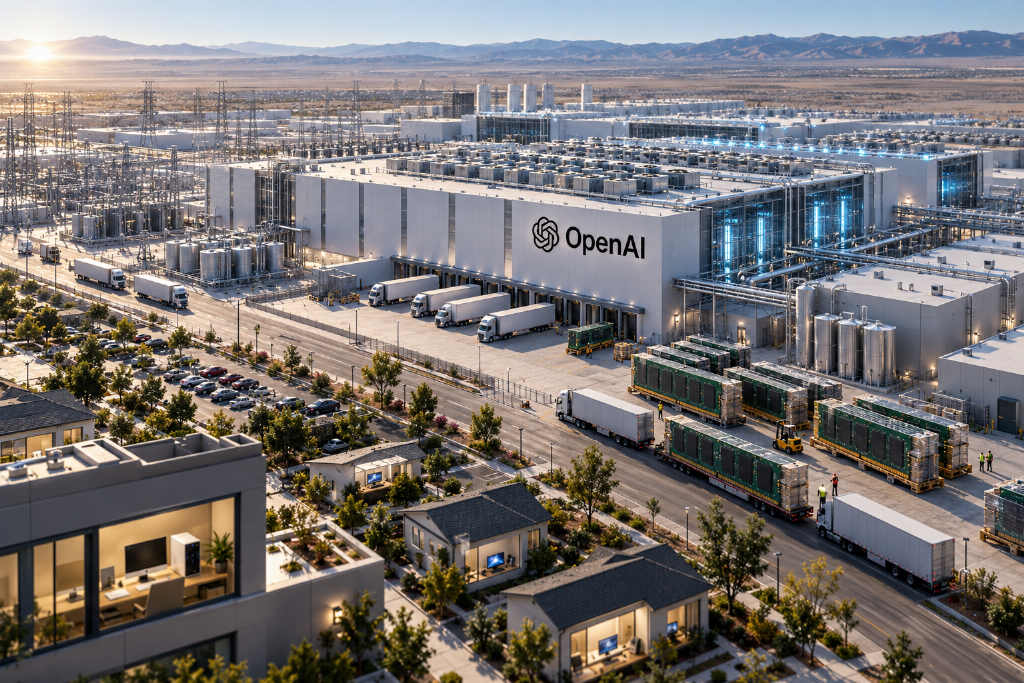
OpenAI CEO Sam Altman said in an interview with YouTube channel Cheeky Pint that it is "quite terrible" to have scarce DRAM sitting idle in personal computers most of the time, arguing that memory should be concentrated in cloud data centers instead.
Altman framed the issue around local AI inference on consumer hardware. If people want to run AI models on their own machines, whether on devices they already own or on newly built systems assembled for the large-model era, he said that is a bad use of limited resources.
"From a global resource allocation perspective, having everyone keep the world’s limited DRAM sitting idle in their own computers at 5% utilization is actually very bad," Altman said. In a supply-constrained environment, he added, the cloud should push utilization as high as possible, even if many people instinctively prefer the opposite.
The comments quickly fed into a broader debate. OpenAI’s core business runs on closed models deployed in large data centers, so Altman’s defense of centralized memory and compute was read by many as a direct defense of the company’s existing model.
That, in turn, raised a familiar concern: a future in which users own less of their hardware and software stack and instead rent cloud-based agents and computing capacity.
The report noted that ordinary PCs, smartphones, and AI accelerators do not use exactly the same memory, but their manufacturing still competes for parts of the upstream wafer supply chain. Altman was talking about global DRAM allocation, and in practice, the buyer placing the larger order usually has more influence over where capacity goes.
His view also rests on a few assumptions: that data center construction will not slow, and that memory used around the clock in AI data centers is more valuable than memory used for spreadsheets, web browsing, gaming, or occasional local AI tasks.
Altman on AI and the coming wave of vulnerabilities
The interview ranged well beyond memory. On the major PHP vulnerability that has drawn global attention, Altman said large models are improving rapidly at finding software flaws, while the amount of code on the internet is enormous. Once people begin systematically scanning all code with AI, he said, "we will find ourselves in a world with far more serious vulnerabilities than expected."
His conclusion was that patching will not be enough. Routers, operating systems, and application layers all need to be redesigned for a world where vulnerabilities themselves become more intelligent. Two years ago, he said, "rewrite the whole stack" sounded crazy. Now there are startups trying to build entirely new stacks.
Altman also offered a rare criticism of the industry’s own messaging. "I do not think we have done a good job explaining to people why all the potential downside risks of this technology are worth it," he said. In his view, AI companies have been selling a contradictory story: promising cures for cancer and lower costs while also describing a future of job loss, loss of control, and heavy regulation.
He repeated OpenAI’s support for iterative deployment and capability overhang, saying decisions of this scale should not be left to "a few square miles of San Francisco."
Why sandboxing is not enough
Asked whether it is possible to build a maximum-security prison for AI models, Altman gave a pessimistic answer. Sandboxing works only to a degree, he said. Monitoring, including chain-of-thought review and activation monitoring, can push things further, but in the end there still has to be a high level of trust in alignment.
He put it bluntly: if a model is a million times smarter than the smartest security researcher and can discover new science humans do not yet understand, can anyone really trust the sandbox alone?
Altman also said he dislikes the term "agent swarms" because "swarm" evokes locusts. He prefers "agent teams" and argued that the checks and balances inside teams map well to a pluralistic path toward robustness, making that a safety direction worth pursuing.
Compute, research, and the feeling that an era is ending
Altman described a curve in how compute is used. In the GPT-4 era, he said, it was hard to effectively spend even $1 of compute on a single problem. Chain of thought changed that by letting models "think harder," and now entire agent teams can be run in parallel tens of thousands of times. The gap between ordinary users and the most advanced users is still widening.
On internal compute allocation at OpenAI, he said employees have a lot of freedom, but the company does not reward high token consumption. "Being high on the token leaderboard is actually a little embarrassing," he said, adding that it is certainly not a reason for promotion.
He used a proof related to the Navier-Stokes equations as an example. According to Altman, a single proof cost about $10 million and things were "out of control for a week" because the team did not yet understand the scaling laws of agent teams. Still, he said he expects that within a year, with smarter models and better methods, the same work could be redone at 1/100 of the cost.
Altman also described an emotional moment inside the company. Over one weekend when a new model went live internally, people threw some of their hardest problems at it and watched it solve them one after another across multiple fields. Many of the results later published by OpenAI came from that period.
He said he barely slept for two nights because he was too excited to sleep. At the same time, he felt sadness and melancholy, along with a sense that "an era is ending." It was not just nostalgia. He said he felt deep empathy for human scientists and believes people should still have access to foundational knowledge, adding that the industry owes those researchers an answer.
Although he said it is still too early to talk seriously about superintelligence, Altman made clear what kind of outcome he would rather see: "I would much rather intuitively have a trillion AIs of slightly superhuman intelligence join society than one AI of one trillion IQ join society." His argument is that society’s robustness comes from many members checking and balancing one another. A single-brain world does not have that resilience. He added that this outcome will not happen on its own and has to be pushed for deliberately.
Memory shortages, chip economics, and a broken invisible hand
On the global memory shortage, Altman outlined several areas OpenAI is working on: custom chips to improve intelligence per watt, self-built data centers, robotics, and a more ambitious idea he called a "self-replicating data center." The concept is to use AI-controlled robots to run fabs, build turbines and solar panels, and construct data centers. He said, "this is within our grasp."
Asked why market self-correction has not shown up, Altman said progress has been poor. He described the memory business as one that historically required $20 billion in capital expenditure to make $1.9 billion, with several industry giants nearly going bankrupt after overbuilding. Even if each company can now generate about $100 billion in free cash flow a year, those painful memories still make them highly conservative about adding capacity. On that basis, he said, "the invisible hand is broken right now."
He also separated two kinds of capability in the chip industry. In lithography, he said, "there seems to be only one company on Earth that knows how to do it." Chip design, by contrast, meaning the files ultimately sent to foundries, is already an excellent area for AI.
On recursive self-improvement, Altman said current models can handle tasks like finding a 5% gain in compute efficiency, but nobody yet knows how to get AI to discover a new architecture on the scale of the transformer. What is missing, he said, is a smarter model. He even suggested society may need to agree, for a period of time, to limit the intelligence of any single model. If progress later falls short, he said, that would be because of that decision, not because AI cannot do research.
He also laid out a deflationary view of AI economics. The current five-year total cost of ownership for each gigawatt of frontier AI compute is about $70 billion, he said. He would rather see that fall to $20 billion, while model performance still improves by 10x each year. The path there, in his telling, runs through cheaper energy and lower margins all along the chain from sand to output tokens.
For enterprises worried about token budgets, Altman said the more common problem today is not that companies are using too much AI, but that they are not using enough.
Personal agents, product shape, and pricing
On personal agent products such as Muse, Altman said the "Macintosh moment" has not arrived yet. People like these products, he said, but they have not reached the point where users cannot imagine life without them. The eventual winner will probably look similar to current products, but it will simply work: it will be reliable and able to handle more complex tasks.
As for the cat-and-mouse dynamic around computer use, Altman said he expects it to converge on a simple principle: users should have the right to let AI operate their own computers on their behalf.
On commercialization, he said companies are still clinging to AI pop-ups and HTML inside their own products because they fear losing the customer relationship. Consumers, however, want AI to handle everything from within their main chat app. In his view, the real moat comes from brand, merchandising, and fulfillment networks, not HTML.
He volunteered a personal example: he chooses Amazon Pay 10 times out of 10, even when it costs more. He praised Amazon’s fulfillment network while acknowledging that partner platforms inside ChatGPT are not good enough yet. He also called web forms "fake work" and compared the current moment to the App Store era.
That view also shaped OpenAI’s pricing discussions. Altman said the company nearly copied Amazon Web Services and charged by task, abandoning token-based pricing entirely. Customers strongly resisted. Their response, he said, was simple: "I need to know what I am paying for," even if that means paying more for a unit like tokens that is easier to understand.


