
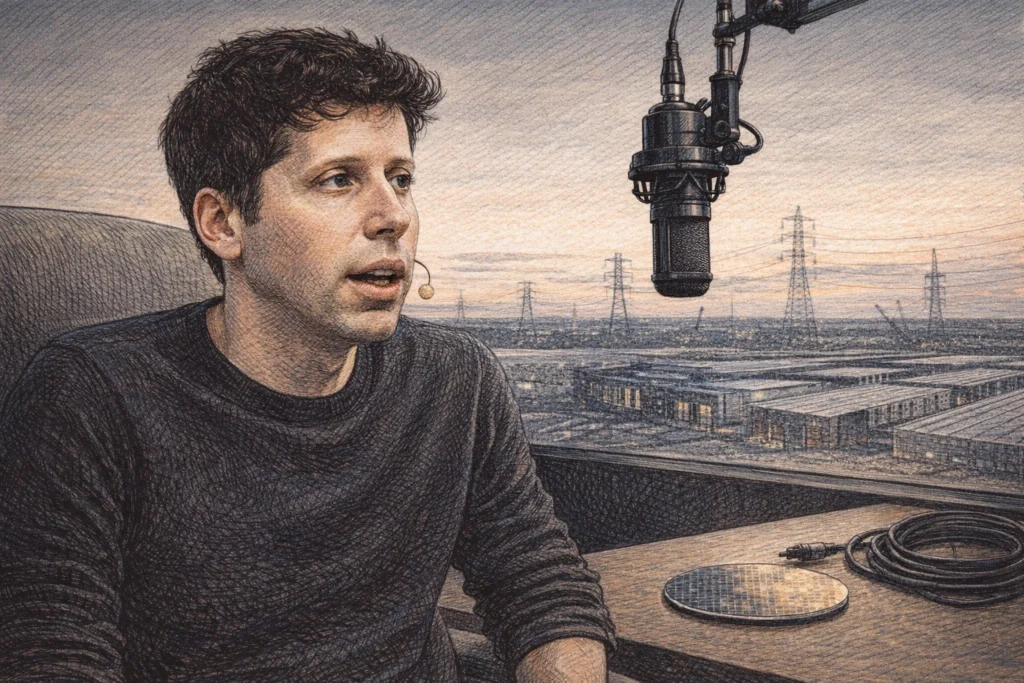
OpenAI CEO Sam Altman said the company’s biggest constraints come down to two things: chips, and then electricity. In a recent interview on the Relentless podcast with host Ti Morse, he also said one of his biggest mistakes was underinvesting in compute.
Chips first, electricity next
The interview ran for about 70 minutes, with Altman discussing startups, ambition, and the strain of handling work while becoming a father. When he boiled OpenAI’s main bottleneck down to essentials, he named chips first and electricity second.
He also offered a rare look at internal trade-offs inside the company. According to Altman, once GPT-3 began producing meaningful results, OpenAI shut down the robotics project it had been pushing hard. More recently, as coding agents started gaining traction, the projects that were pushed aside were Sora and the browser effort.
Altman said Sora was not a failure. “It would have been very successful,” he said, adding that compute and attention were simply more important on coding agents. He described that as the kind of choice a resource-constrained company has to make: a product may have users, momentum, major spending behind it, and a full year of work invested, and still get stopped.
He added that these decisions are not made in a single meeting. Instead, teams gradually come to see that the same compute and the same people have a more important use elsewhere, and then make what he called a painful decision.
Altman says he underbet on compute
One of the clearest moments of self-criticism came when Morse asked him when he last realized he was not being ambitious enough. Altman’s answer was compute investment.
“I dramatically underbet on compute,” he said.
Asked whether he could have known that at the time, Altman said yes. He added that he had been scared by “financial markets and things like that,” and said that was obviously a mistake.
He also argued that the industry has focused too heavily on getting algorithms to produce better algorithms, while paying too little attention to getting data centers to produce more data centers. In his framing, one data center’s compute should be used to direct a robot workforce to build the next data center.
Altman said that if current expectations about what compute can ultimately unlock are right, then the return on using compute to expand compute infrastructure would be higher than using that same capacity elsewhere.
OpenAI’s next form points to large-scale infrastructure
Altman also gave a glimpse of what he sees as OpenAI’s next form. After moving from a research lab into a product company, he said, OpenAI is now heading toward large-scale infrastructure, where much of the value will sit in lower-margin infrastructure layers.
He did not provide operational details, saying it was not yet time to talk about that. What he did say was that he has already figured out how to line up the work he is good at and passionate about with the company’s next 10x or 100x phase of growth.
Three waves: chatbots, coding agents, then persistent agents
Altman divided AI product growth so far into two waves. The first was chatbots. The second is coding agents, which he said are now “totally crazy.”
He expects a third wave to arrive soon: persistent agents that stay with users over time and operate more like a chief of staff or a coworker.
On coding agents, Altman said OpenAI was not the early leader. He said Codex had been far behind Claude Code and that internally the effort was viewed as close to a kamikaze-level mission, because the prevailing belief was that once another company had real momentum in a product category, direct competition was almost impossible to win.
Still, he said the team got there. In his account, most of the top engineers he knows are now using Codex.
AI governance: authoritarian control or freedom
As for where all this is heading, Altman said the real battlefield at this stage is whether the world moves toward “AI authoritarianism” or toward freedom.
He said he worries that some will argue, in the name of safety and economic disruption, for a single model to remain as a machine god, or for one company to control it.
“Every time humanity trades freedom for safety, it’s a net long-term loss,” Altman said. He also said he had been waiting for this moment his whole life and that “we are in the singularity now.”
Why he does not expect AGI to bring a four-hour workweek
Altman also rejected the idea that superintelligence, or AGI, will push people into a life of working only four hours a week.
His reasoning was about human behavior rather than the technology itself. Expectations keep rising, he said. People always want more, keep inventing new things for one another to do, and care deeply about how they compare with everyone else.
That leads him to a simple conclusion: after superintelligence arrives, people will probably be busier than they expect. In his words, they will still complain out loud, but inwardly they will be happy.