Altman's Vast Investment Empire: 400 Companies and Deep Ties to OpenAI
The debate surrounding OpenAI CEO Sam Altman has never ceased. Some view him as the pioneer of AGI, while others accuse him of leveraging his position to build a personal wealth ecosystem. According to a Wall Street Journal report, Altman's personal fortune is spread across a massive network of tech companies, including nuclear fusion startup Helion and even a venture aiming to build a new city on the Mediterranean coast. He previously stated at a 2023 event that he had invested in about 400 startups that were still active, many with roots dating back to his tenure at Y Combinator.

Notably, Altman does not directly hold OpenAI equity—the company is currently valued at $852 billion—meaning there is no direct link between his personal interests and the company he leads. However, at least 10 of his invested companies have established commercial relationships with OpenAI or are currently negotiating such deals. This pattern has drawn scrutiny from regulators. In May 2026, the U.S. House Oversight Committee opened an investigation into Altman's potential conflicts of interest, and several state attorneys general have urged the SEC to intervene.

Key Case Studies: Helion, Cerebras, and Retro Biosciences
Altman's most prominent investment is Helion, a nuclear fusion startup. In 2015, Altman invested in Helion and became its board chairman; later that year, he co-founded OpenAI. In 2021, he made an additional $375 million investment, his largest personal bet on a single startup at the time. In 2024, OpenAI signed a non-binding agreement to purchase power from Helion in the future—a deal that former OpenAI board member Shivon Zilis called "surprising" during court testimony, given fusion's speculative nature. In 2025, after SoftBank invested in OpenAI, Altman lobbied SoftBank to invest in Helion, successfully. In March 2026, Altman stepped down as Helion board chairman, and OpenAI signed a revised agreement. By June 2026, Helion raised $4.1 billion at a $15.5 billion valuation from Thrive Capital, OpenAI's strategic investor, doubling Altman's stake to at least $4.1 billion.

Another example is chipmaker Cerebras, in which Altman invested nearly a decade ago. Cerebras went public with the tagline "the next Nvidia," partly driven by a chip procurement deal with OpenAI. After the IPO, Altman's Cerebras shares increased more than sixfold in value from December 2025. Meanwhile, Altman's stake in anti-aging startup Retro Biosciences was valued at $258 million as of last December, after OpenAI formed a research partnership with the company. These cases illustrate how Altman uses his OpenAI CEO role to create business opportunities for his personal holdings, raising serious conflict-of-interest concerns.

Internal Controversies and External Regulatory Pressure
Altman's web of interests has stirred unease within OpenAI. In 2025, he urged OpenAI to invest about $500 million in Helion, a proposal that was ultimately rejected by the company—a move that some employees found "disturbing." OpenAI board chair Bret Taylor has defended Altman, stating that he has been transparent about his external involvement and that the company manages conflicts responsibly. Meanwhile, Tools for Humanity, the iris-scanning firm behind Worldcoin co-founded by Altman, is facing two external investigations into executive fund misuse and alleged violations in Thailand. The company was once valued at $2.5 billion.

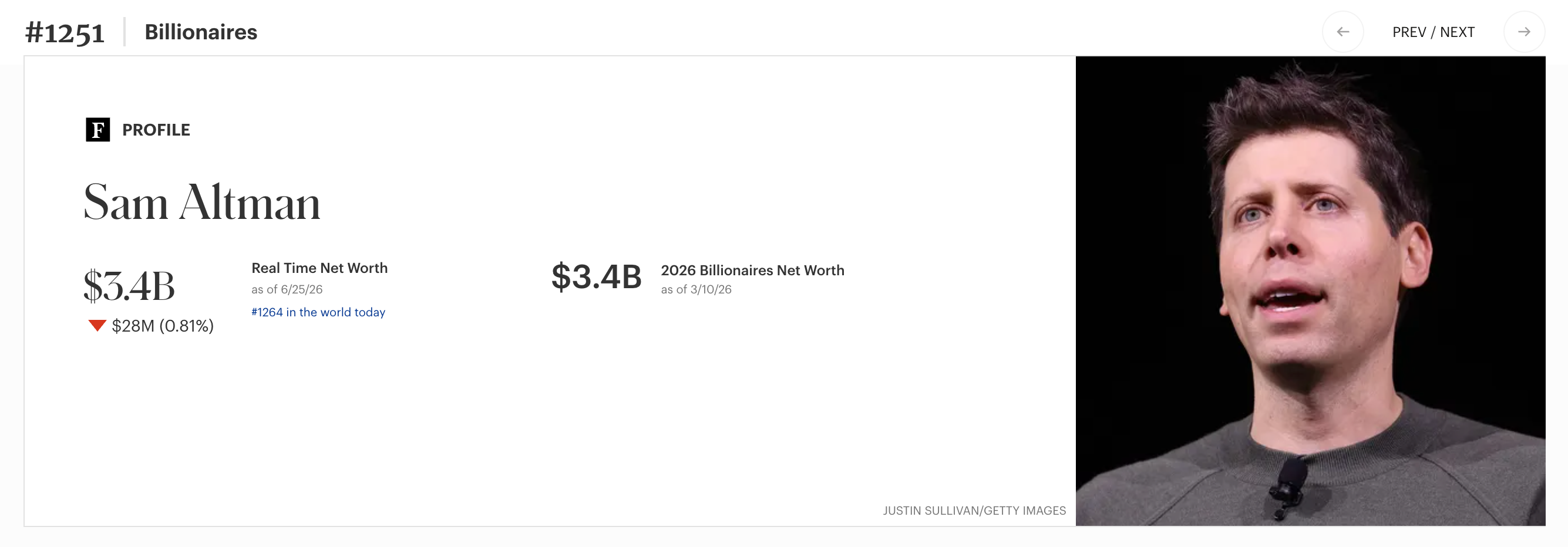
Separately, OpenAI itself has drawn criticism for its massive deals with chip and cloud vendors, including $500 billion with Nvidia, $300 billion with AMD, $300 billion with Oracle, and over $22 billion with CoreWeave. While these are not personal investments, they amplify Altman's sphere of influence. According to Forbes, Sam Altman now ranks #1,251 on the global billionaires list, with a net worth of approximately $3.4 billion—up from #2,692 in April 2024, a climb of over 1,400 positions in two years, against the backdrop of more than 8 billion people worldwide.