
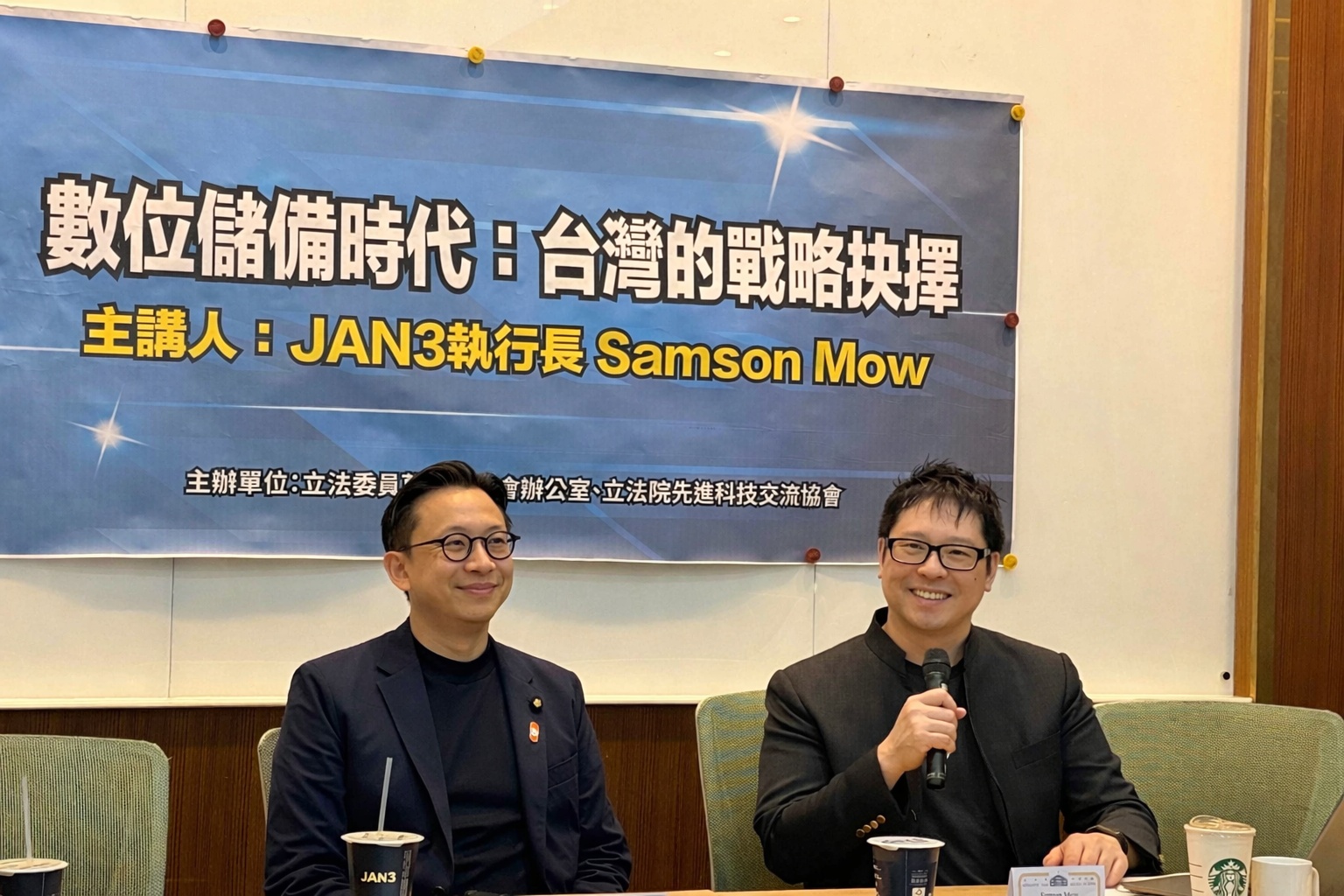
On March 31, Jan3 CEO Samson Mow entered Taiwan's Legislative Yuan for the first time at the invitation of Legislator Ko Ju-chun, presenting a briefing on "How Taiwan Can Build a Bitcoin Reserve." Mow recommended buying 83,000 Bitcoin for a cost of less than 1% of Taiwan's GDP. Ko revealed the government has completed its first Bitcoin inventory, confirming 210 BTC from judicial seizures, and that the central bank governor has softened from calling Bitcoin a scam to saying "maybe."
Bitcoin: A New Form of Energy and Information Money
Mow compared fiat, gold, and Bitcoin against the seven properties of sound money: durable, divisible, fungible, portable, verifiable, scarce, and non-counterfeitable. He argued Bitcoin meets all criteria, noting that while gold is scarce, more exists in the solar system — Bitcoin's 21 million cap can be verified by anyone on a personal computer. His key thesis: Bitcoin is both energy and information money. Any form of energy can be converted to electricity for mining, and transactions can be sent via internet, radio, satellite, or even written on paper as a private key. Mow stressed that legislators should not treat Bitcoin as fiat or a security, because its essence is information, and restricting information is a losing battle.
Reserve Sizing: 83,000 BTC Based on Gold Holdings
Using Taiwan's official gold reserve of 422 tonnes as a baseline, Mow compared with the UK's 310 tonnes of gold and roughly 60,000 Bitcoin. Since Taiwan holds 30% more gold than the UK, its Bitcoin reserve should be 30% larger — 83,000 BTC. At Bitcoin's current price of ~$67,000-68,000 and Taiwan's GDP of ~$900 billion, the purchase cost would be under 1% of GDP. Mow noted Taiwan spends 2% of GDP on defense, so investing 1% in Bitcoin could yield massive returns over the next century. He proposed issuing "Bitcoin bonds" with interest paid from mining, offering an implied yield of 6.5% by year five and 90% by year ten.
ETFs as the First Step
In response to a question from a local media outlet, Mow said a national Bitcoin reserve requires "friendly society, friendly legislation, and friendly government." He sees Bitcoin ETFs as the best way for Taiwan's 23 million people to gain exposure, and suggested pension funds could use ETFs to address underfunding. Legislator Ko confirmed Taiwan has allowed qualified investors to buy overseas Bitcoin ETFs through sub-brokerage, and major financial groups are planning local Bitcoin ETFs. Crypto lawyer Henry Lin said his association has completed a legal paper on converting seized virtual assets into strategic reserves and is in talks with investment trust companies to launch a homegrown Bitcoin ETF. Financial expert Jeff Wen urged consideration of dollar stablecoins, given Taiwan's life insurance industry has over $600 billion exposure to U.S. assets, and proposed a "silicon chip bond" modeled on El Salvador's volcano bonds. Blockchain enthusiast Mike Lin said Taiwan is signing MOUs with Bitcoin communities in Seoul, Tokyo, and other cities to position itself as an Asian Bitcoin hub.
Mow closed with: "Bitcoin is digital gold, better than gold — it is everything gold wants to be. Move fast because other countries are watching, companies are buying, ETFs are accumulating. Buy Bitcoin as soon as possible."