

Samsung Electronics is pulling back again in China, and this time the pressure is showing up in its smartphone retail network.
A recent Sina Tech report said Samsung has begun shrinking its market footprint in China. People familiar with the matter said stores with monthly sales below RMB 300,000 will be phased out, and Samsung outlets in Shenzhen, Fuzhou, Zhengzhou and Xi’an have already closed.
The move comes only three months after Samsung Electronics announced its exit from China’s home appliance market. In May, the company said it was leaving that business in response to a “rapidly changing market environment.” At the same time, Samsung had said its semiconductor business in China, specifically memory, along with its mobile terminal and medical device operations, would continue as normal. So far, the company has not publicly commented on the latest adjustment to its smartphone business.
The broader picture is hard to miss. From appliances to phones, Samsung’s position in China has kept narrowing, a sharp contrast with the brand’s earlier standing in the market.
Smartphone operations in China keep losing ground
When Samsung’s home appliance business said it would leave China three months ago, outside observers had already begun drawing a grim conclusion: once appliances were gone, it would be difficult for Samsung smartphones to preserve the same level of brand visibility and channel support on their own.
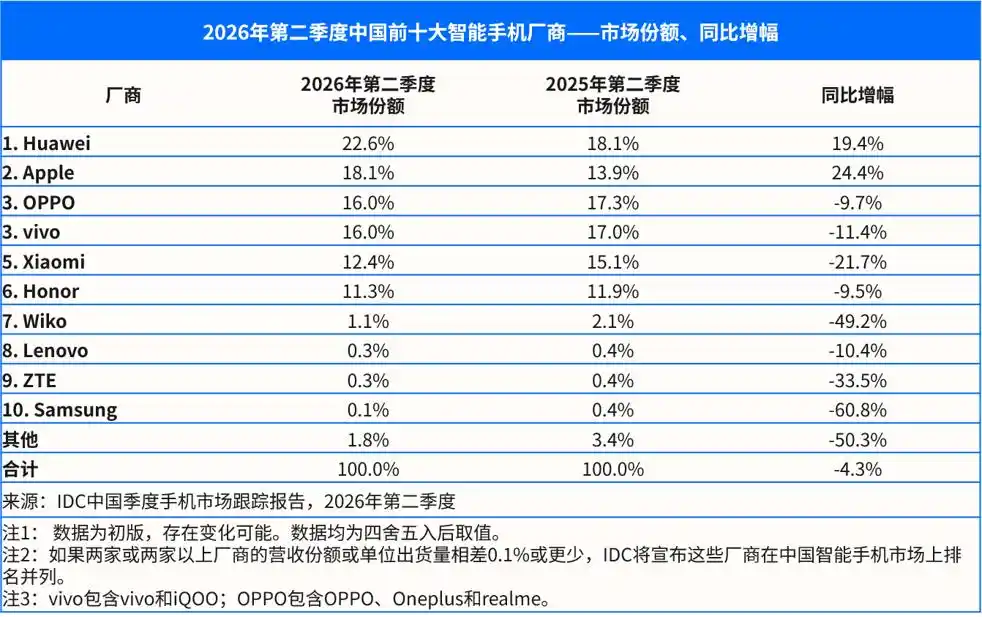
Market data cited in the article points in the same direction. Samsung’s share of China’s home appliance market was just 1.5% in 2025. Its phone business was in even worse shape. IDC data showed Samsung’s share of China’s smartphone market fell to 0.1% in the second quarter of 2026, while shipments dropped 60.8% from a year earlier.
China’s smartphone market shipped about 66.01 million units in the same quarter. Huawei, Apple, OPPO, vivo and other leading vendors accounted for roughly 96% of the market combined, leaving Samsung pushed into the “Others” category.
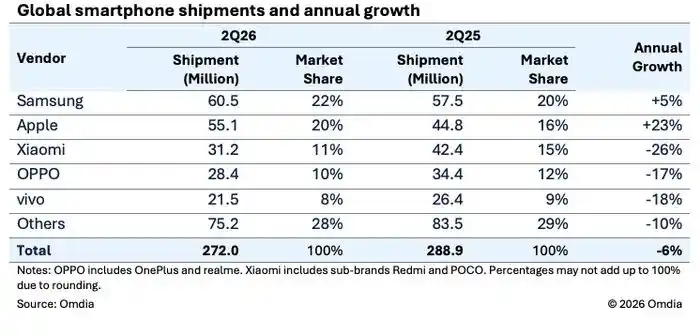
Yet Samsung’s collapse in China has not been matched overseas. Omdia data showed the company shipped 60.5 million smartphones globally in the second quarter of 2026, up 5% year over year, and kept the No. 1 spot worldwide with a 22% market share.
The same brand is producing two very different outcomes depending on geography. As the article argues, that gap suggests Samsung’s weak performance in China cannot be reduced to a simple product problem.
Price pressure, user experience and local fit
Samsung was once one of the dominant phone brands in China. The Galaxy flagship line had long been associated with premium positioning and durability, and at its peak the company’s domestic market share was close to 20%.
That market changed as Chinese brands accelerated product iteration and gave buyers more options across specifications, camera performance and feature sets. Consumers became more price-sensitive, and the comparison point moved quickly.
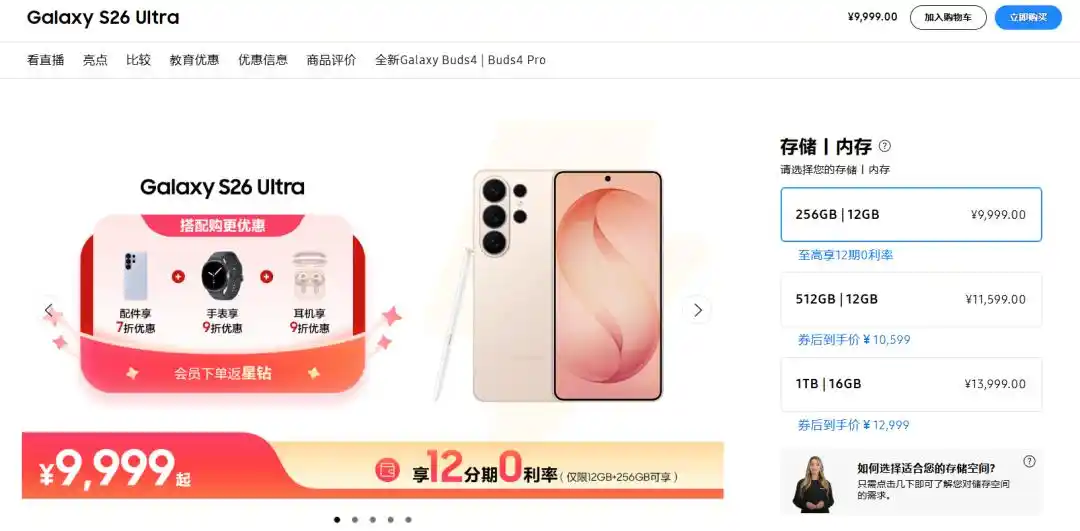
The article uses the Galaxy S26 Ultra as one example. Samsung launched the phone in February this year, and the 12GB+256GB version is listed on its official website at RMB 9,999. Honor’s Magic8 Pro, in the same 12GB+256GB configuration and using the fifth-generation Snapdragon 8 Elite chip, is priced at RMB 5,699.
It also says Samsung has lost ground to domestic brands in imaging, AI and battery-related user experience. Galaxy S26 Ultra supports 80W fast charging, while Chinese flagship phones have already moved to 90W and 100W charging in many cases.
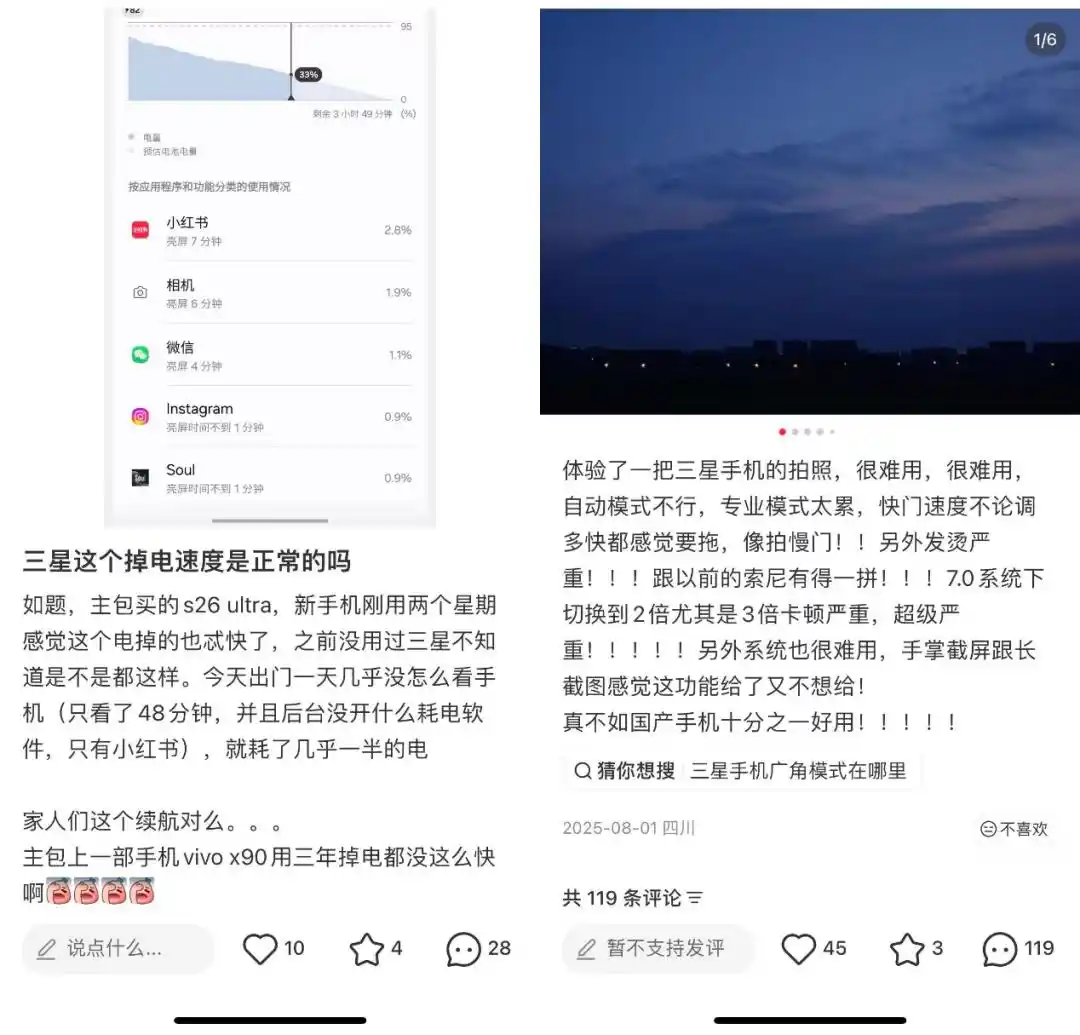
Some users on social platforms have complained that Samsung phone photos look “grayish,” and that battery life can fall short of four hours, making a power bank necessary for daily use. In that setting, the brand premium Samsung once commanded in China no longer carries the same weight it did in earlier years.
The article also points to a local ecosystem mismatch. Samsung’s ONE UI is described as closer to a global template than a system deeply adapted to Chinese user habits. Its functions, service layer and interaction logic, in this telling, have not fully merged with everyday local scenarios.
Examples include NFC transit card support in only a limited number of cities, and Samsung Pay’s slower integration with WeChat and Alipay. The article also notes the lack of a shortcut similar to HarmonyOS’s one-step payment code access. For users already used to domestic phone systems, those differences can become a practical drawback.
Another factor raised in the piece is the shifting mood around Korean brands in China. It says changes in China-South Korea relations have affected the popularity of Korean products, and that as Korean celebrities and entertainment have become less prominent in the domestic market, Korean consumer brands have also lost heat.
Its conclusion on this part is direct: Samsung’s decline in China has been a long slide playing out over more than a decade, not a single-cycle stumble.
Chips are booming while mobile and appliances come under strain
At the group level, Samsung’s latest results look exceptionally strong. The company recently reported second-quarter 2026 revenue of KRW 171.5 trillion, about RMB 804.975 billion, up 130% year over year. Operating profit came in at KRW 89.5 trillion, about RMB 420.1 billion, up more than 1,800%, marking a third straight quarter of record single-quarter profit.
The driver was semiconductors. According to the earnings figures cited in the article, the Device Solutions, or DS, division accounted for 99.7% of Samsung’s operating profit, with AI-led demand acting as the main engine behind the surge.
The article adds another comparison to underline the scale: Samsung earned KRW 89.4 trillion in the second quarter alone, more than double the KRW 43.6 trillion it made in all of last year, and more than the combined profit of 2023 through 2025.
But that concentration of profit also exposes an awkward reality inside Samsung’s structure. As memory gets stronger, consumer electronics come under more pressure.
In the second quarter, the Device Experience, or DX, division, which includes Samsung’s phones and home appliances, posted KRW 48 trillion in revenue, down 9% from the prior quarter. It also recorded an operating loss of KRW 0.8 trillion. The article describes that as the first loss since Samsung’s phone business was established.
Because global smartphone sales still rose 5% year over year in the same period, the article argues the pressure did not come from volumes. It came from costs.
It points to Korean media reports from late last year saying Samsung’s DS division, which handles semiconductors, refused to sign DRAM supply agreements longer than 12 months with the MX division, which oversees smartphones and other mobile devices. That, according to the article, pushed up costs for phones and other smart hardware.
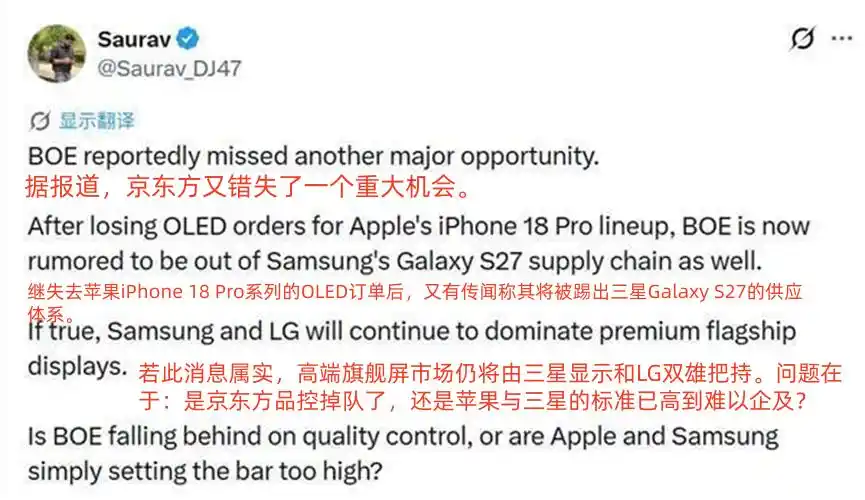
It also cites a January media report saying Samsung had considered bringing in BOE as a second OLED panel supplier for the Galaxy S27 to lower display procurement costs through supplier competition. That plan later fell apart. Foreign media reports, as cited in the article, said the core resistance came from Samsung Display, which had been the exclusive screen supplier for Samsung smartphones and was unwilling to accept a rival’s panel in a flagship model.
The article frames Samsung’s history as a balancing act between two cycles. When memory is booming, handsets tend to come under strain. When semiconductors are weak, the phone business has often helped carry the company through the downturn. In the AI cycle now lifting chips, that internal relationship is starting to look less stable.
Samsung still holds more cards than most of its competitors in chips and displays. But the article argues that internal coordination can become a burden when separate business units are each trying to maximize their own interests. In that setup, one part of the company can constrain another, and the group as a whole ends up paying the price.
Channel cuts in China fit a move toward the ultra-premium segment
The cost pressure on mobile is presented as one of the immediate triggers behind Samsung’s retail pullback in China.
Sina Finance reported that Samsung phone stores in multiple Chinese cities have recently been hit by a wave of closures. Store staff said the group had set a hard internal target: stores and employees tied to outlets with monthly sales below RMB 300,000 would face gradual elimination.
Samsung has not commented on that report. Still, when read alongside its exit from China’s appliance market and the current shape of its profit structure, the adjustment is consistent with a narrower allocation of resources.
The article says Samsung is actively tightening its product lineup and shifting group resources toward premium products. Its departure from China’s crowded appliance market, together with the move to outsource entry-level appliances, is presented as part of that strategy. The phone business, it says, is likely following the same path.
Last month, Samsung launched the Galaxy Z Fold8 series, described in the article as a wide foldable phone similar to Huawei’s Pura X Max, with a starting price of RMB 12,999.
The pricing is high, but reported demand was strong. Media reports cited in the article said pre-orders for the Galaxy Z Fold8 series in South Korea reached 1.44 million units, setting a record for the Galaxy line. In India, pre-orders topped 271,000 units within 72 hours.
Under the original plan, Samsung’s initial flexible-screen production capacity for the Z Fold8 was about 2.8 million finished units. The article says Samsung has since placed additional orders with suppliers of displays, hinges and batteries, adding several hundred thousand units of extra capacity.
It also notes that the wide foldable category was pioneered by Huawei and already has a strong consumer identity in China. With Samsung entering and Apple also expected to join, the market is becoming more contested. The article says Apple is expected to release its first wide foldable product in September.
Counterpoint forecasts that in the global wide foldable phone market in 2026, Samsung, Apple and Huawei will hold shares of 32%, 25% and 24%, respectively.
Even with only a 0.1% share in China’s smartphone market, Samsung remains the global leader overall. On that basis, the article argues that a tighter, more selective strategy may offer Samsung a better chance of defending its position, both inside China and abroad.
That would also mean the company’s retail retreat in China may not be over. If ultra-premium phones are aimed at middle- and upper-income buyers, Samsung may only need a limited number of stores in core cities to keep reaching its target customer base while spending less on channels.
The other side of the strategy
The article ends with a warning about what this concentration could cost. As Samsung runs harder toward semiconductors, the resilience once provided by appliances and mobile devices may keep eroding.
If the memory chip cycle turns down, the company would have fewer buffers to absorb the shock. The more the business is concentrated in one basket, the more the weight of that basket becomes a risk in itself.
In that reading, Samsung’s current focus on premium products is a practical choice. But shrinking in a market also means giving up ground, and serving a smaller group of high-end buyers means walking away from some of the scale effects and brand reach that once helped define the company.
The article was originally published by the WeChat public account Luoxuan Laboratory, and the author is listed as Wuqing.