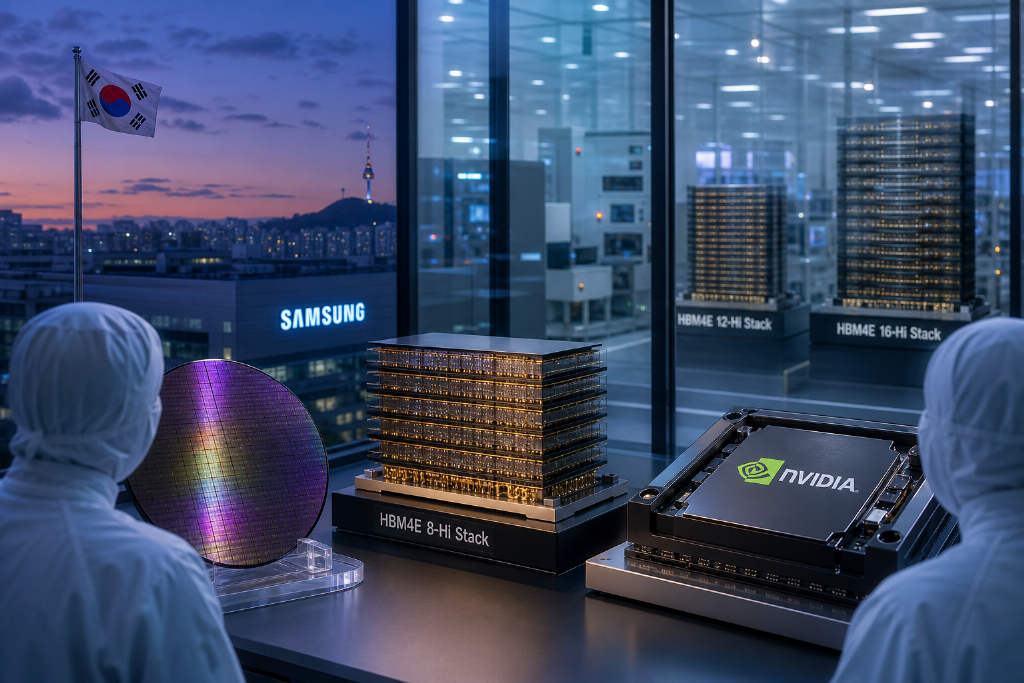
Samsung Electronics is developing an 8-layer HBM4E product at Nvidia's request, according to Korea's Seoul Economic Daily. The chip is intended for Nvidia's custom high-bandwidth memory (NVHBM), and it uses fewer stacked layers than the 12- and 16-layer options Samsung initially prepared. Nvidia's target speed for the memory is 17–18 Gbps, about 20% faster than the 14.4 Gbps seen in Samsung's early HBM4E samples. The simplified layering is expected to reduce manufacturing difficulty in wafer thinning, precision stacking, and packaging, improving yield and supply potential. NVHBM could first appear on Nvidia's upcoming Rubin Ultra AI GPU, which is slated for next year; the platform plans to scale GPU interconnect from 72 to up to 576 units to offset lower per-GPU memory capacity. Samsung, which designs and produces DRAM, logic chips, and base dies, says it can provide one-stop custom HBM services. Industry observers note that Samsung has already shown strong transfer speeds with HBM4, and its capabilities may gain more attention as Nvidia shifts its focus from high stacking to high-speed transmission.
Samsung Electronics is developing an 8-layer HBM4E product at Nvidia's request, according to Seoul Economic Daily, as reported by BlockBeats on Aug. 28. The chip will be used for Nvidia's custom high-bandwidth memory, called NVHBM, and it reduces stack layers compared with the 12-layer and 16-layer versions Samsung originally planned.
Nvidia has set a target speed of 17 to 18 Gbps for the memory, roughly 20% higher than the 14.4 Gbps in Samsung's early HBM4E samples. The fewer layers are expected to lower the difficulty of wafer thinning, precision stacking, and backend packaging, easing yield pressure and helping improve supply capacity.
NVHBM may debut on the Rubin Ultra AI GPU, which Nvidia is expected to release next year. The Rubin Ultra platform will expand GPU interconnect scale from the current 72 units to as many as 576, allowing more high-speed GPUs to work together to offset lower memory capacity per GPU.
Samsung also designs and produces DRAM, logic chips, and base dies, offering one-stop custom HBM services. Industry insiders say Samsung has already shown strong transfer speeds with HBM4; as Nvidia shifts its competitive focus from high stacking to high-speed transmission, Samsung's capabilities may attract more attention.
This article was originally published by Bit.Fan. For more cryptocurrency news and market insights, visit www.bit.fan. Disclaimer:
The market information, project data, and third-party content displayed on this platform are for industry information sharing only and do not constitute any form of investment advice or return commitment.
Cryptocurrency trading carries high risks. Users should fully assess their risk tolerance and make independent decisions. All profits, losses, and legal responsibilities are borne by the users themselves.