
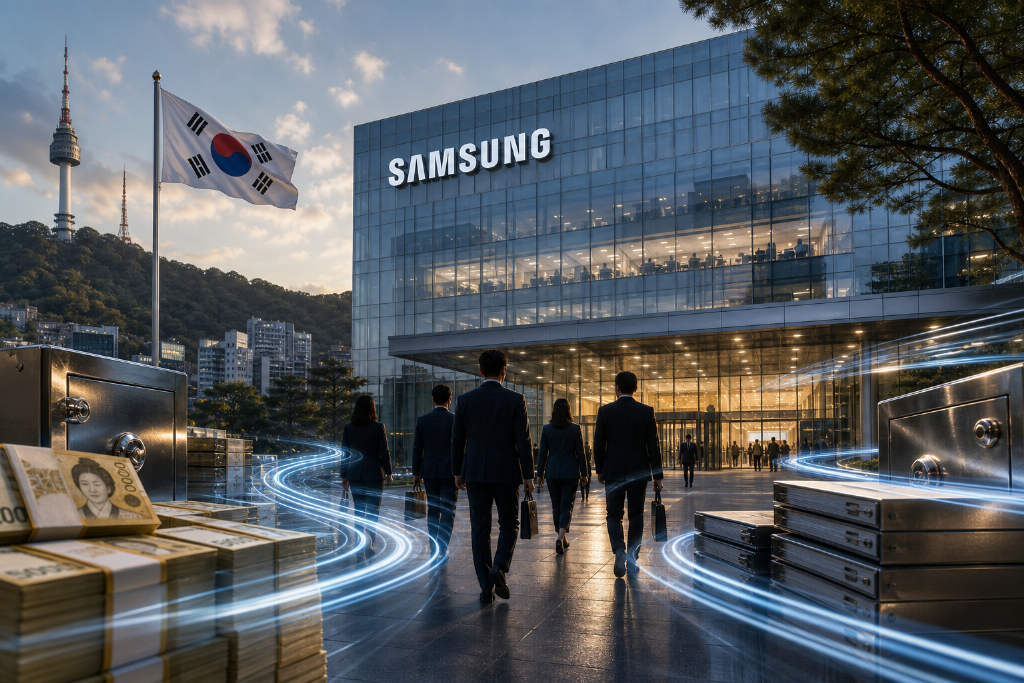
Samsung Electronics is reportedly set to review a shareholder return package in August that could total 150 trillion to 160 trillion won, or about $107.5 billion to $114.7 billion. If approved, it would rank as the biggest shareholder return move ever undertaken by a listed company in South Korea.
The reports surfaced a day after SK hynix unveiled a 40 trillion won share buyback plan on Aug. 19, pushing fresh attention onto whether Samsung will follow with an even larger program.
Board decision expected by late August
According to industry talk in South Korea, Samsung Electronics plans to hold a board meeting before the end of August to discuss major shareholder return options, including treasury share buybacks and cancellations as well as a special cash dividend. Korean media, however, have reported different figures.
MoneyToday reported earlier in the day that the program could reach 100 trillion won. Later, The Korea Economic Daily raised that estimate and said the final number could come in at 150 trillion to 160 trillion won.
Samsung has not endorsed either figure. The company said only that it is "discussing shareholder return options from multiple angles," without confirming a final amount.
50% of free cash flow is the baseline policy
The reports said Samsung’s current shareholder return framework is built around returning 50% of free cash flow, or FCF, to shareholders.
Brokerage estimates cited in the coverage put Samsung’s full-year FCF at as much as 263 trillion won. On that basis, cumulative FCF for the 2024-2026 shareholder return cycle would be around 319 trillion won, implying a total return pool of roughly 160 trillion won. After subtracting the 39.1 trillion won that has already been executed or scheduled during the three-year period, about 120 trillion won would remain available.
At one point, the market circulated an even bigger figure of 200 trillion won. Both reports said that level was unrealistic. Their reasoning was that Samsung spent more than 55 trillion won on research and development plus facility investment in the first half of this year, limiting the cash that could realistically be returned.
Special dividend or treasury stock cancellation?
The Korea Economic Daily said Samsung is expected to pay more than 30 trillion won in performance bonuses this year following labor-management negotiations. That has fueled concern that a higher number of shares in circulation could dilute the stock, making treasury share buybacks and cancellations more likely to proceed alongside a special dividend as a way to offset the effect.
MoneyToday took a different view. It said Samsung is more likely to center the program on cash dividends, with treasury stock cancellation carrying less weight. The report tied that stance to group governance rules. Under South Korea’s Financial Industry Structure Improvement Act, a large-scale cancellation of Samsung Electronics treasury shares could lift the ownership ratios of affiliates such as Samsung Life in Samsung Electronics, creating a governance burden for the group.
SK hynix faces a different setup. According to the report, its affiliate SK Square must maintain a certain ownership ratio under the Fair Trade Act, so cancelling treasury stock can actually help lift that stake. That is one reason SK hynix favors buybacks followed by cancellation, while Samsung is seen as leaning toward cash dividends.
SK hynix moved first as Samsung’s retail base watches closely
SK hynix announced its 40 trillion won treasury share buyback and cancellation plan just one day earlier, also marking the largest such move in that company’s history. Shares of both Samsung Electronics and SK hynix rose on the news that day.
Samsung has about 8 million retail shareholders. Its stock has long been viewed as relatively undervalued against earnings performance, and how the company makes ordinary investors in this widely held name feel the benefit of any payout is seen as a central issue in the structure of the plan.
At its earnings call last month, Samsung said the board and management were actively discussing concrete measures, including a special dividend, in an effort to balance reinvestment for growth with shareholder returns.
No official announcement yet
For now, both the 100 trillion won figure and the 150 trillion to 160 trillion won range remain media reports and industry speculation. Samsung has not formally announced its final plan, and the eventual size and mix of tools will only be known after the August board decision.