
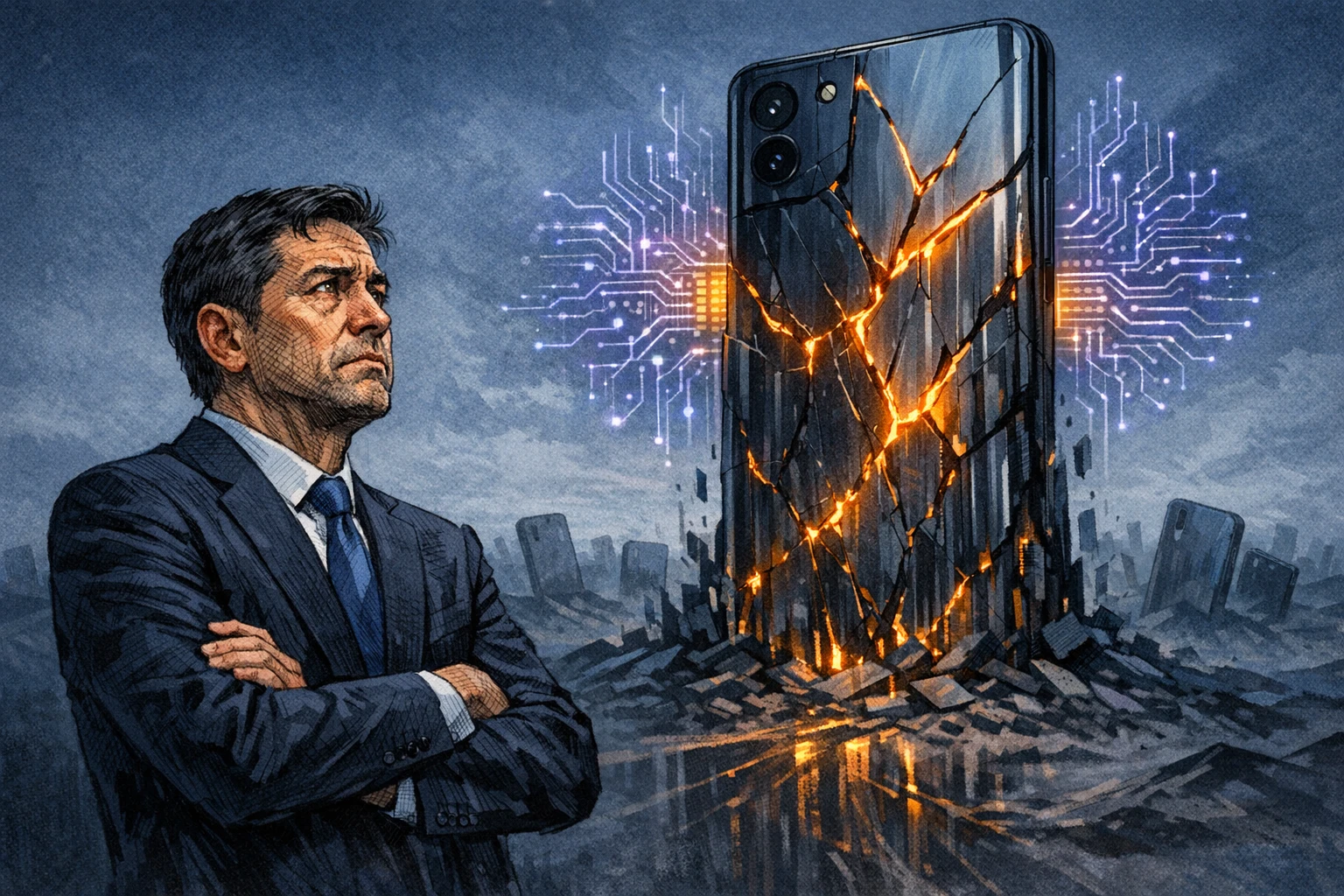
Samsung's MX (Mobile eXperience) division chief TM Roh has warned top management that the mobile business could face its first-ever annual net loss. The warning is unusual because Galaxy S26 sales are not collapsing—Samsung remained profitable during the 2008 financial crisis and the 2020 pandemic supply chain disruption. This time, it's a cost problem, not a demand problem.
In 2025, the MX division posted an operating margin of roughly 11%, translating to about 12.9 trillion won ($8.7 billion) in annual operating profit. Analysts estimate 2026 profit could plunge to 5 trillion won ($3.3 billion), compressing margins to around 3%, with some bearish forecasts seeing even 1% gross margin as difficult to sustain. Meanwhile, Samsung's global smartphone market share dropped from 24.6% at end-2023 to 19% as of September 2025, a 10-year low. In Q4 2025, Samsung lost the top spot in global smartphone shipments to Apple, and failed to reclaim it in Q1 2026.
AI Rewrites Memory Supply-Demand Dynamics
The application processor (AP) used to be the most expensive component in a smartphone. The AI era has broken that formula. Counterpoint Research data shows that by mid-2026, memory and storage combined will account for over one-third of BOM cost in budget models, and for flagship models, memory alone will exceed 20% of total material costs. The root cause: AI servers are gobbling up LPDDR5x memory originally designed for phones. Nvidia's Vera AI processor can carry up to 1.5 TB of LPDDR5x per chip—128 times the memory of a flagship phone. A single rack-scale AI platform (36 Vera CPUs plus 72 Rubin GPUs) consumes as much LPDDR5x as 4,600 Galaxy S26 Ultra phones (each with 12 GB RAM). As AI data centers deploy at that scale, memory fab capacity is pulled upstream. Pricing for DRAM and NAND is no longer dictated by phone shipments but by Nvidia's shipment plans. Samsung's mobile division is losing this resource war not to Apple but to its own other business line.
Structural Crisis, Not Cyclical Blip
IDC forecasts global smartphone shipments will decline 0.9% in 2026, with rising memory costs a key factor. Samsung's DX division (which includes MX) has been ordered to cut operating costs by 30%. The problem is not something that will fix itself once memory prices fall. AI server buildout shows no sign of slowing, and the memory types AI demands—high bandwidth, large capacity, low latency—overlap heavily with phone needs, both competing for the same wafer capacity. Samsung's dilemma: the more phones it sells, the more memory it must buy, and pricing power is no longer in its hands. Samsung's own memory division (DS) is the world's largest DRAM and NAND maker; in theory it could allocate internally, but if internal transfer prices are below market, it simply moves the loss from one pocket to another. The cost structure that supported mobile profitability was built on cheap memory. That premise no longer holds.