
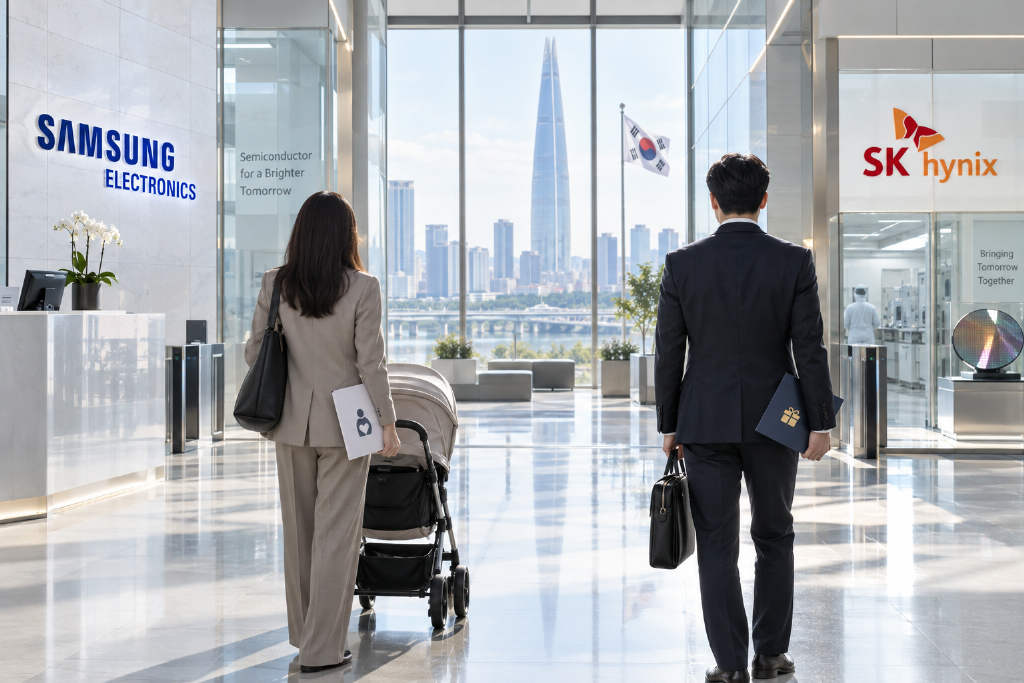
Samsung Electronics and SK hynix are back in the spotlight over employee benefits after outside media reports said both companies posted slightly lower childcare leave take-up rates in the first half of 2026 than in the same period of 2025. Samsung’s overall rate slipped from 36.2% to 35.5%, while SK hynix fell from 4.0% to 3.2%. Leave participation among both male and female employees also narrowed at the two companies.
Both companies have already reached agreements with labor unions to allocate 10.5% and 10% of operating profit, respectively, to uncapped performance bonuses. That has prompted discussion over whether the prospect of large bonus payouts is affecting how employees weigh the cost of taking long periods of unpaid leave. Even so, the current data does not support a clear conclusion that the bonus systems alone caused the decline in leave usage.
Uncapped bonus structures sharpen incentives to stay on the job
Samsung Electronics and SK hynix have in recent years put in place highly flexible compensation structures. Under labor-management agreements, Samsung sets aside 10.5% of operating profit and SK hynix 10% for performance-linked bonuses, with no payout ceiling at either company.
With the semiconductor cycle moving into an expansion phase, the earnings outlook for chipmakers has improved, raising expectations that distributable bonus pools could also increase. Because performance reviews and bonus payments at many companies are closely tied to actual attendance, the prospect of stronger compensation has become one factor employees may consider when deciding whether to take extended leave.
Official figures show modest declines
Officially disclosed data showed Samsung Electronics’ childcare leave take-up rate in the first half of 2026 fell 0.7 percentage points year over year to 35.5%. The rate for men declined from 12.4% to 11.2%, while the rate for women dropped from 94.3% to 88.2%.
SK hynix also recorded a 0.8 percentage point decline, to 3.2%. Among male employees, the rate fell from 1.3% to 0.7%. Among female employees, it moved down from 10.1% to 8.9%.
Some market observers said that when potential bonus payouts rise, the gap created by wage replacement during childcare leave can widen, creating a more tangible economic opportunity cost. That, in turn, could indirectly weaken the immediate willingness of employees to apply for long-term leave.
Causation remains difficult to establish
Even with bonus incentives drawing attention, the analysis said the change in leave rates cannot be fully attributed to the bonus mechanism. Decisions on childcare leave are also shaped by non-financial variables such as family caregiving arrangements, individual career planning, and team staffing conditions.
The report also noted that the two companies use different statistical standards. Samsung Electronics uses parents of newborns in the relevant year as the denominator. SK hynix, by contrast, uses all eligible employees, generally those with children aged 8 or younger or in the second grade of elementary school or below. Because the denominators differ, the two sets of figures are not directly comparable across companies.
On that basis, a slight decline in half-year data alone is not enough to establish a clear causal relationship between bonus systems and leave behavior.