
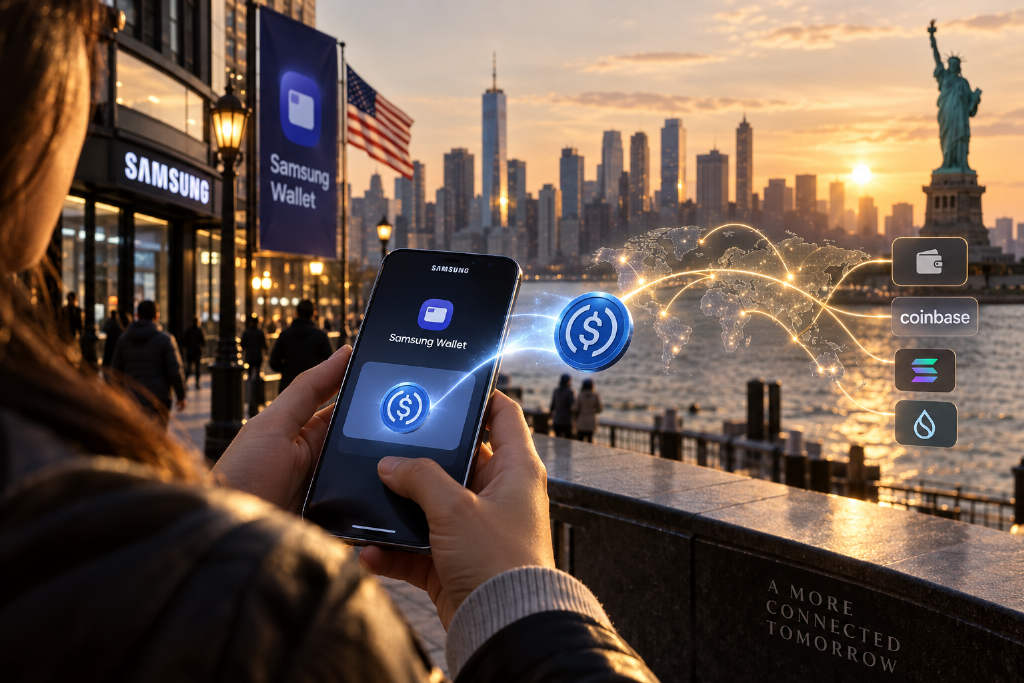
Samsung is moving stablecoin access into the phone wallet itself.
On Oct. 7, Samsung Electronics America, Inc. said it will introduce USDC support in Samsung Wallet through partnerships with Coinbase, Bastion, Solana and Sui. The rollout is planned for the last week of October for eligible Galaxy users in the United States. Samsung said the potential device footprint reaches 82 million Galaxy devices compatible with Samsung Wallet in the U.S.
The announcement pushes Samsung’s crypto work beyond wallet storage and key management into stablecoin transfers and cross-border remittances. For users, the shift is practical: instead of downloading a separate crypto app, they can reach the service from a wallet interface they already know.
What the 82 million figure actually refers to
With a self-custody crypto wallet, users usually have to manage private keys on their own and deal with network selection and address compatibility. Samsung’s planned stablecoin feature is designed to remove part of that friction. Users will not need to install another crypto app, and they will not have to manage private keys themselves.
The first supported stablecoin is USDC, the dollar-pegged token issued by Circle. Eligible Galaxy users in the U.S. will be able to buy and send USDC directly inside Samsung Wallet.
According to the announcement, the product starts with two transfer scenarios.
- The first is sending USDC to compatible external crypto wallets or exchange accounts. Samsung said it will not charge a fee for those transfers. The receiving platform may still charge fees, and transfer speed will depend on blockchain network conditions.
- The second is remittances to eligible bank accounts in more than 60 countries. Recipients will receive local currency and do not need a crypto wallet. This route will carry fees that vary by destination and remittance amount.
Samsung’s announcement also highlighted the 82 million number, but the footnote makes the scope narrower than it first appears. It refers to the number of Galaxy devices in the U.S. that are compatible with Samsung Wallet. Actual use still depends on service eligibility and identity verification requirements.
How the partners split the work
The service is being assembled across several companies, each handling a different layer.
Bastion will provide custody, compliance management and cross-border remittance functions. Coinbase will provide sub-custody for the USDC involved through Coinbase Prime Vault. Samsung supplies the user entry point and device-side security, and it does not hold customer funds.
Solana and Sui provide blockchain network support, though the two announcements stressed different technical angles.
The Solana Foundation said users will be able to make Solana-based USDC cross-border transfers through the familiar Samsung Wallet interface, with integrated fiat on- and off-ramps and local currency conversion.
Sui focused on fee-free stablecoin transfers. Under its description, users will be able to send USDC on the Sui network without first holding SUI to pay network fees. That is tied to Sui’s previously launched Gasless Stablecoin Transfers feature.
Based on what has been disclosed so far, Samsung is starting with stablecoin transfers and remittances. The change is less about introducing a new crypto asset than about placing those functions inside an existing wallet entry point.
Seven years of Samsung’s Web3 experiments
Samsung’s connection with the crypto sector goes back to 2019.
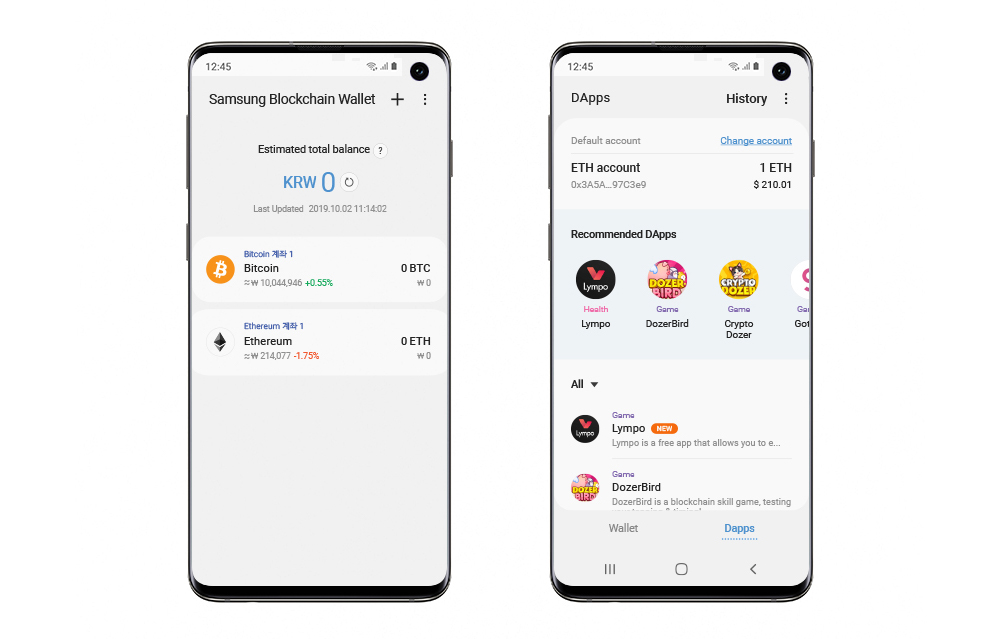
That year, the company introduced blockchain wallet and Keystore private key protection features around the Galaxy S10, along with the Blockchain Platform SDK for developers. Developers could integrate blockchain functions into mobile apps, while users could manage crypto assets and access decentralized applications from their phones.
In 2021, Samsung Blockchain Wallet added support for connecting external hardware wallets including Ledger Nano S and Nano X, allowing users to view and manage related crypto assets through Galaxy devices.
At that stage, the product focus was still on private key protection, asset management and developer tools. The target users were mainly people who already needed blockchain applications.
In 2022, Samsung launched Samsung Wallet, combining payment cards, membership cards, passwords and digital keys in one app. The announcement at the time also said its crypto-related functions included a consolidated view of holdings value across some exchanges.
That same year, Samsung explored NFTs across different consumer electronics settings, though the TV business and the Galaxy ecosystem need to be separated.
On the TV side, Samsung worked with Nifty Gateway, the NFT marketplace it had acquired, to offer NFT browsing, purchasing, trading and display functions on some television products. Nifty Gateway later formally announced its shutdown in February 2026.
Within the Galaxy ecosystem, Samsung signed a memorandum of understanding with partners including Theta Labs, with plans for Galaxy NFT holders to receive offline benefits such as discounts and points after verification. The emphasis there was on linking digital collectibles with consumer perks.
By 2025, Samsung’s work with Coinbase had moved deeper into payment access. In July, the two companies said Samsung Pay would be integrated into the Coinbase app, making it easier for eligible users to buy crypto assets or fund their accounts. In October, Samsung also offered Coinbase One membership benefits to eligible Samsung Wallet users.
Compared with those earlier efforts, the USDC feature announced in October 2026 points to a more direct product direction: stablecoin transfers and cross-border remittances inside Samsung Wallet itself.
That shows Samsung’s crypto experiments extending into more concrete money movement use cases, though they still sit across different products and different stages.
Samsung affiliates are also moving into digital asset infrastructure
Outside the consumer wallet business, Samsung-linked entities have entered digital asset infrastructure through equity investment.
According to an official statement from Samsung SDS, Samsung Securities, Samsung SDS and Samsung Card decided in May 2026 to acquire a combined 4% stake in Dunamu for 612.8 billion won, described in the article as currently worth $457 million. Samsung Securities took 2%, while Samsung SDS and Samsung Card each took 1%. Dunamu operates the South Korean crypto exchange Upbit.
Samsung SDS later described the investment in its second-quarter earnings presentation as an equity acquisition completed in May. It said it would combine its IT services, cloud computing and security capabilities with Dunamu’s blockchain technology to expand in the digital asset infrastructure market.
The same page also said Samsung SDS had built relevant technical capabilities through a tokenized securities platform project with Korea Securities Depository and through end-to-end verification work with South Korean financial institutions covering stablecoin issuance through settlement.
That indicates Samsung SDS has already been involved in technical work tied to stablecoin issuance and settlement. The article also draws a line between process verification and the separate question of issuing and operating a public-facing stablecoin.
The OUSD participant-list dispute and the later USDC rollout
Another issue the article separates from the new Samsung Wallet launch is the dispute this year around the participant list tied to Open USD, or OUSD.
In late June, stablecoin project Open Standard published information on the dollar stablecoin Open USD and a related list of companies. Names appearing in coverage included Samsung Electronics, Dunamu, Visa and Mastercard.
But according to a July 3 report by South Korean media outlet Chosun Biz, several Korean companies listed said they had not held formal partnership discussions with the OUSD issuer. Dunamu and others said they had only received inquiries about possible participation and had not formally confirmed joining.
Upbit also told Cointelegraph that it was not involved in the issuance of Open USD and had only expressed willingness to consider participating in future OpenStandard ecosystem expansion.
Three months later, Samsung Electronics formally announced USDC support in Samsung Wallet. Unlike the earlier controversy around the OUSD company list, this rollout was accompanied by official announcements from Samsung, Solana, Sui and other participants that spelled out the launch plan and each party’s role.
Stablecoin transfers are in; retail payments may come later
Over the past seven years, Samsung and its affiliates have stretched their digital asset efforts from mobile private key protection, asset management and NFTs into exchange partnerships and financial infrastructure.
Now USDC is entering Samsung Wallet, and stablecoin transfers and cross-border remittances are becoming the next business direction. Online shopping and in-store stablecoin payments, the article says, remain possible capabilities for a later stage.
What Samsung brings here is not a standalone blockchain advantage but a large device base and an existing wallet ecosystem. The next question is whether stablecoins can move from being a crypto feature to becoming a financial tool ordinary users are willing to use day to day.
