
SanDisk used its 2026 investor day to present one of the most aggressive long-term financial outlooks seen in the storage sector, arguing that rising demand tied to AI inference can support much stronger growth and profitability than the NAND industry has historically produced.
At the event on Thursday, Aug. 13 Eastern time, the company introduced a long-term model for fiscal 2028 through fiscal 2030. It said revenue is expected to grow at a mid- to high-double-digit rate over that span, in line with bit shipment growth. On a non-GAAP basis, SanDisk is targeting gross margin of about 80% and operating margin of about 75%.
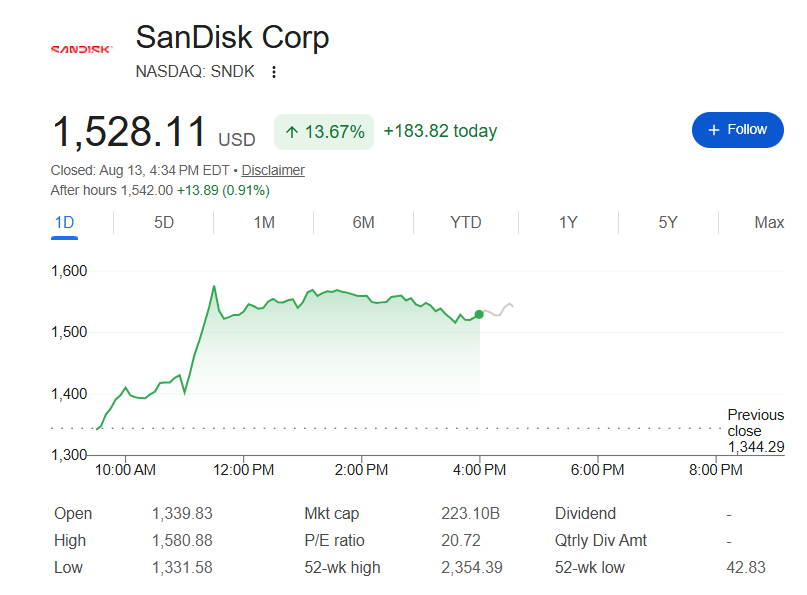
Investors responded immediately. SanDisk (SNDK) climbed as much as 17.6% during Thursday trading and closed up nearly 14%. The broader storage group also rallied: SK Hynix and Western Digital gained more than 7%, Seagate Technology rose nearly 5%, and Micron Technology added more than 4%.
Long-term model centers on fiscal 2028 to 2030
The biggest focus of the investor day was the long-range financial model itself. SanDisk said revenue growth in fiscal 2028 through fiscal 2030 should stay in the mid- to high-double-digit range, matching growth in bit shipments. At the same time, non-GAAP gross margin is expected to hold near 80%, while operating margin is projected at about 75%.
The fiscal calendar matters here. SanDisk’s fiscal year does not align with the calendar year. Its fiscal year ends on the Friday closest to June 30 and usually spans 52 weeks. Fiscal 2026 ended on July 3, 2026, which means the company had already entered fiscal 2027 by early July 2026. As a result, the fiscal 2028 to 2030 period discussed at the event does not refer to calendar years 2028 to 2030. It refers to a three-year stretch beginning around July 2027.
Under this framework, SanDisk expects operating expenses to account for about 5% of revenue, with no material impact from other income and expenses. Even after taxes, capital expenditure, and working capital needed to support growth, the company said adjusted free cash flow margin should still reach about 50%.
For a NAND business known for cyclicality, those targets stand out. SanDisk’s message was that AI-driven storage demand could keep revenue growth and profitability well above the averages associated with past memory cycles.
Bit output will be adjusted for profitability, not volume alone
Another key point from the event was SanDisk’s effort to address questions around bit growth. The company said it is not simply chasing shipment volume. Instead, it plans to adjust the amount of sellable bits according to profitability.
Investors had been watching SanDisk’s fiscal 2027 bit growth guidance. The company previously said input bit growth would be in the mid- to high-double-digit range, while growth in sellable output bits could come in below that level. At investor day, management said that should not be read as a sign of limited production capability.
According to Lynx Equity Strategies analyst KC Rajkumar’s interpretation of management’s comments, SanDisk Chief Executive Officer David Goeckeler said the long-term target for input bit growth remains mid- to high-double digits, but sellable bit output will be adjusted as needed to optimize profitability. In some periods, actual output bit growth could even run above the mid- to high-double-digit range.
That approach shifts attention from how many bits are sold to how much profit each bit can generate. SanDisk said that during NAND technology node transitions, it may selectively cut wafer output so that improvements in bit density do not push supply too far ahead of demand.
Rajkumar said each NAND node transition at SanDisk has historically generated about 54% bit growth on average. If the company were to release all of the incremental capacity created by a technology upgrade, it could quickly recreate an oversupply environment. By reducing wafer output during those transitions, SanDisk said it can better control the volume of bits entering the market and protect pricing, margins, and capital efficiency.
That logic also helps explain why the company felt comfortable putting forward a long-term gross margin target of about 80%. Higher bit density from process advances does not have to turn directly into higher supply if the company chooses to hold back some of that output and keep more of the benefit in profitability.
Company pledges to return 100% of excess cash
SanDisk also made its capital return policy unusually clear. Chief Financial Officer Luis Visoso said the company expects to return 100% of excess cash to shareholders after making the investments needed to support business growth.
That sets out a three-part capital allocation structure: invest first in the business and in technology that supports growth, preserve strong free cash flow generation, and then return remaining cash to shareholders.
With adjusted free cash flow margin projected at about 50%, SanDisk is effectively telling investors that, if the model holds, future cash generation could be substantial.
Eight customers have signed new business model agreements
SanDisk tied part of its confidence to a shift in how it sells NAND. The company said it has signed new business model, or NBM, agreements with eight customers.
Those agreements include committed purchase volumes, binding contractual structures, minimum financial protections, and structured pricing mechanisms. SanDisk said the goal is to better align customer demand with its capacity planning and reduce the impact of the traditional volatility seen in the storage industry.
The scale is already meaningful. According to the company, the signed NBM agreements cover about 50% of fiscal 2027 bit shipments and about two-thirds of fiscal 2028 bit shipments.
SanDisk said this model can deliver more predictable revenue, better visibility into cash flow, and more durable profit growth. In practical terms, the company is not only betting on AI-driven storage demand, but also trying to convert part of NAND’s traditional cyclicality into steadier revenue and cash generation through long-term agreements.
AI inference seen expanding the flash market
Another pillar behind SanDisk’s multi-year growth case is the shift in AI from training toward inference, which the company said is creating new requirements for storage infrastructure.
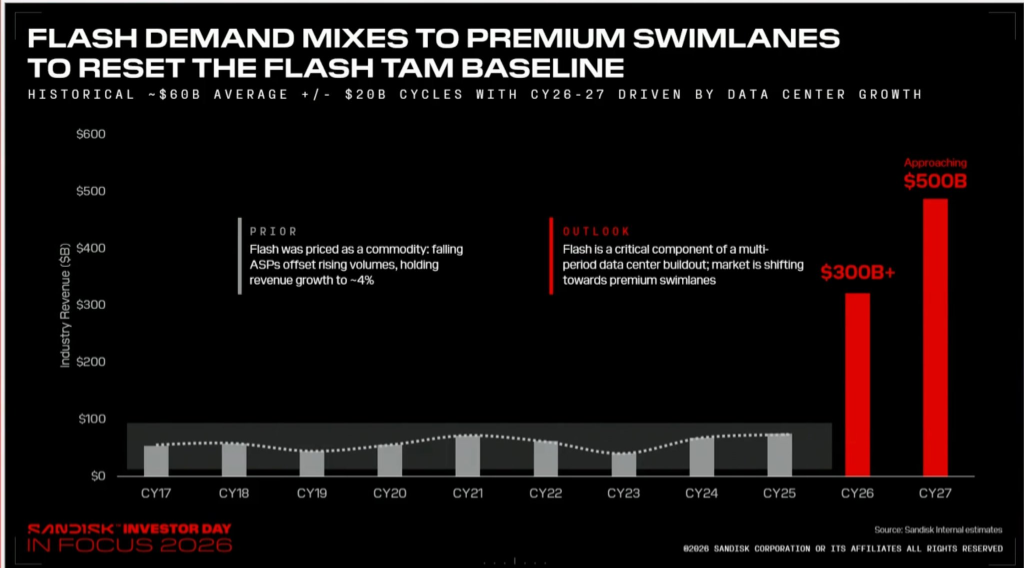
SanDisk estimates the flash market could grow from a historical annual revenue base of $60 billion to more than $300 billion in 2026, and then approach $500 billion in 2027.
The company said AI inference workloads are driving rapid growth in token usage, while KV Cache is reshaping the memory hierarchy in data centers. As inference scales up, AI data centers are expected to rely more heavily on storage. SanDisk projects enterprise data center flash total addressable market, or TAM, will reach 1.2 zettabytes by 2030.
On the technology side, SanDisk is advancing a 2D scaling strategy based on CMOS directly bonded array, or CBA, with the aim of building customized products for different markets more flexibly while improving capital efficiency.
The company’s latest BiCS9 QLC technology is the first case under that strategy. SanDisk said the product combines a BiCS8 array with a BiCS10-based CMOS wafer. It also said the new BiCS10 QLC node delivers 60% higher bit density than BiCS8.
HBF adds another AI inference angle
SanDisk is also pushing a new high-bandwidth flash, or HBF, technology aimed at AI inference. The company said HBF is becoming an important option for meeting storage requirements in the AI inference era, and that an ecosystem around the technology is taking shape.
For the market, that broadens the company’s AI storage story beyond the idea that AI data centers simply need more SSDs. It extends to storage demands inside inference architectures themselves, including higher performance, lower power use, and greater storage density.
That expectation fed through to the wider sector move. SanDisk’s own gain was the most dramatic, with the stock rising nearly 18% intraday after the long-term targets were released. The shares are up more than 530% year to date.
SanDisk also said the long-term financial targets are forward-looking measures based on a range of estimates and assumptions. Actual results may still be affected by demand, average selling prices, competition, technology transitions, supply chain conditions, and the cyclical nature of the storage industry.