
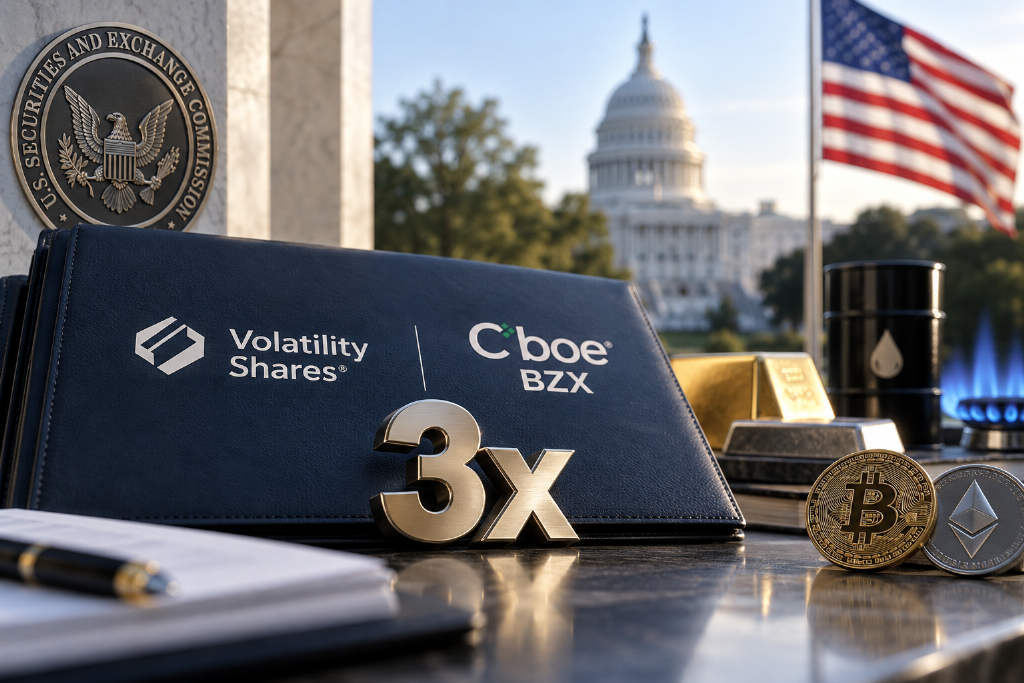
On Oct. 2, the U.S. Securities and Exchange Commission signed off on a rule change letting Volatility Shares list six 3x leveraged ETFs on Cboe BZX. The group spans Bitcoin, Ether, gold, silver, crude oil, and natural gas.
It’s the first time a U.S. crypto fund has been cleared to push past the 2x leverage ceiling. So yes, crypto-linked products now sit a lot closer to the derivatives menu long available for old-school commodities.
Each fund targets triple the daily move
All six ETFs are built to chase 3x the daily return of the underlying asset. If the reference asset gains 1% in a day, the fund is aiming for a 3% gain. If the asset drops 1%, the fund is aiming for a 3% loss.
But that target is for one trading day only. Hold longer, and returns can stray hard from what investors might assume, thanks to daily rebalancing and volatility decay.
Approval does not mean immediate trading
These products still are not ready to trade. Volatility Shares has to wait until the SEC declares its S-1 registration statement effective, and the agency’s approval order gave no deadline.
From rule approval to a real listing, the wait usually runs from several weeks to several months.
The funds also will not own spot Bitcoin or spot Ether. They will hold regulated futures linked to those assets instead, following the same route used by the first Bitcoin futures ETFs in 2021.
Daily rebalancing can amplify market swings
The engine that keeps these funds at 3x exposure is daily rebalancing. Before each market close, the fund must tweak its futures positions so leverage resets to 3x for the next session.
That means buying more futures after up days and selling more after down days. Mechanical stuff. And those flows often bunch up near the close. If the funds get big enough, they could worsen intraday volatility.
Bloomberg senior ETF analyst Eric Balchunas wrote on X: “Leveraged ETFs are for trading, not for investing.”
Volatility decay is a central risk in choppy markets
Blockstream CEO Adam Back made the same argument in blunter terms, saying automatic releveraging strategies steadily lose money in sideways markets, especially when the underlying asset is as volatile as Bitcoin.
This is the effect known as volatility decay. The report uses a simple example: if Bitcoin climbs 10% one day and drops 10% the next, the net loss is 1%. But if a 3x fund gains 30% on day one and loses 30% on day two, the net loss grows to 9%.
The more prices whip back and forth without a clear trend, the bigger the cumulative drag on leveraged products.
Volatility Shares said as much in its preliminary prospectus: “The more volatile the benchmark index, the greater the potential impact of volatility decay.”
Futures roll costs add another long-term drag
And volatility decay is not the only problem. The futures structure brings roll cost too. As contracts get close to expiration, the fund has to exit the old contract and buy a later-dated one. When longer-dated contracts trade above near-month contracts, that creates a contango structure, and it weighs on long-term returns.
That was also one of the main complaints about the first Bitcoin futures ETFs when they debuted in 2021.
The prospectus is direct about who should use them
Volatility Shares said in its S-1 filings that these products are not suitable for all investors, may be speculative in nature, and should be used only by people who can bear the risk of a total loss.
The SEC also told the firm to make those risks plain in its marketing materials.
Bitcoin implied volatility has stayed in a 35% to 40% range
According to Volmex’s BVIV, described in the report as a Bitcoin implied volatility index or “Bitcoin VIX,” volatility has stayed roughly in the 35% to 40% range since mid-September.
That points to traders pricing in an orderly consolidation, not violent swings. But the report adds a wrinkle: historically, long calm stretches in volatility often show up during trending markets, though they can also arrive before a larger move. For 3x leveraged funds, the worst setup is a directionless sideways market.
Three things to watch next
The report calls the SEC approval another milestone and says crypto assets are gradually getting access to the same product set available to traditional commodities.
It flags three variables from here: when the SEC declares Volatility Shares’ S-1 effective, the funds’ asset size and average daily trading volume in the first month after listing, and whether a sideways Bitcoin market produces visible volatility decay in these products.
The report also says investors in Taiwan currently cannot directly trade U.S. leveraged ETFs through local brokers, though indirect participation through overseas brokers or OTC channels remains something to watch.