
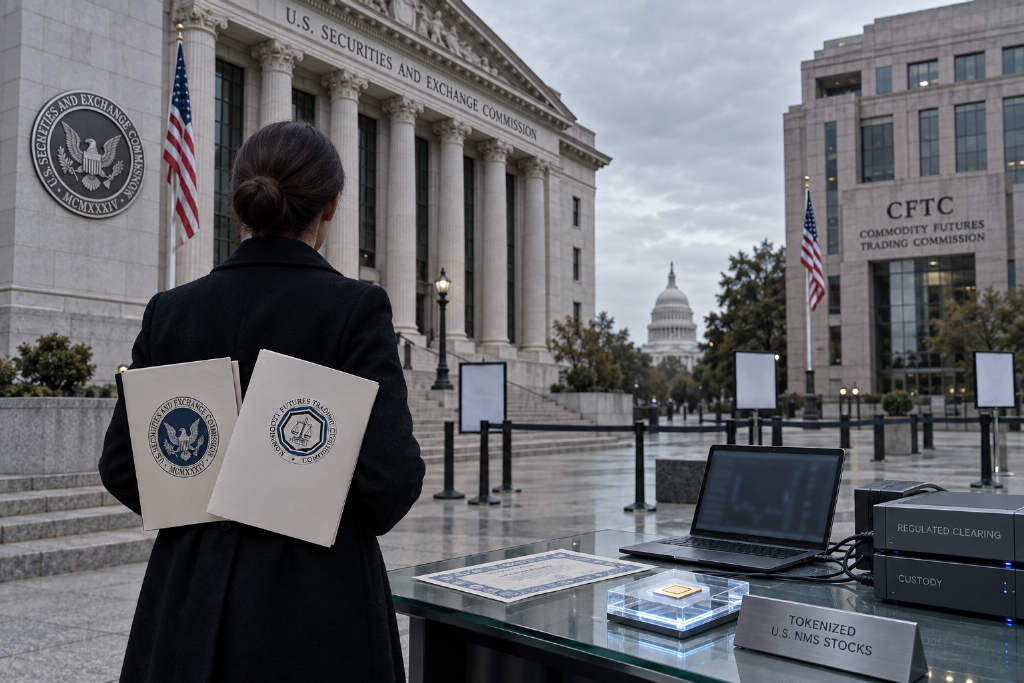
One day after the CLARITY Act failed to advance in the Senate on Sept. 16, the U.S. Securities and Exchange Commission and the Commodity Futures Trading Commission each released a separate document. Both have been described as regulatory easing, but the texts do not do the same thing, and both say plainly that they are temporary.
CFTC relief changes registration status, not the custody chain
The CFTC action, No-Action Letter 26-25, addresses registration status. Under the letter, front-end software providers do not have to register as introducing brokers if several conditions are met: users must trade on a designated contract market, customer funds must be held at a derivatives clearing organization or one of its members, the software provider itself must never hold, control, or custody customer assets at any point, it must not exercise discretion over order routing, and it must share joint responsibility with the registered entity it works with.
In practical terms, regulated institutions remain in the chain and customer money remains with them. What changes is who does not need to carry the introducing broker registration. The letter says the model it contemplates is “consistent with the custodial model of the current exchange-traded derivatives market structure.”
SEC relief moves securities onto a new rail under old protections
The SEC measure has a different legal character. Its innovation exemption reaches the definition of “exchange” under the Securities Exchange Act of 1934 and also exempts certain liquidity providers from the definition of “dealer.” That means firms using their own capital to supply tokenized stocks into AMM pools, while showing market-making features such as quoting or committing capital, can operate without registering as dealers.
Those are core registration obligations, not a labeling issue. But the subject of the exemption is securities. The order is aimed at tokenized U.S. NMS stocks, meaning actual U.S. equities traded in token form.
Most of the attached conditions carry existing stock-market protections onto the blockchain. Token holders must have the same rights as holders of traditional shares. A third party that plans to tokenize a stock must notify the issuer in writing beforehand and give the issuer a chance to object. If the underlying stock is halted on its primary listing venue, on-chain trading must stop as well. Smart contracts must be public and auditable. Trading by affiliates must be disclosed. A notice must be published 30 days before launch. The number of tradable symbols and trading volume are also subject to caps.
The order expressly excludes wrappers that create synthetic exposure.
That makes the SEC action look less like a loosening of crypto-asset rules and more like an attempt to place securities on a new trading rail while keeping the old rule set in force.
Both documents come with an expiration date
Neither agency was vague about duration. The CFTC letter remains in effect until “the effective date of any Commission rulemaking or guidance regarding the application of introducing broker registration requirements to software developers.” The SEC exemption lasts for five years.
SEC Chair Atkins said in a statement: “The key is that this transitional measure must be followed by robust rulemaking to ensure that on-chain markets remain a viable path as capital markets continue to evolve.”
He also explained why the agency chose an exemption instead of writing a rule immediately: “The Commission is not freezing today’s technology into tomorrow’s standard. Instead, it allows the market to evolve, observes that development, and uses those insights to shape a more flexible and forward-looking regulatory framework.”
After legislation stalled, agencies built temporary bridges
Atkins also laid out the sequence. He said that “more than a year ago, the SEC launched Project Crypto with the goal of modernizing the rules under the federal securities laws so that U.S. financial markets can move on-chain,” and he directly referenced the legislative setback: “Earlier this week, despite the tireless efforts of many, Congress failed to advance the CLARITY Act.”
Put together, the sequence is clear: the bill fell short in the Senate by a 49-50 vote, below the 60-vote threshold; the two agencies acted the next day; and both documents say they are placeholders pending later rulemaking. The significance of the day is closer to agencies building temporary bridges during a legislative gap than to a final policy settlement.
For market participants, the practical difference is legal certainty. A no-action letter binds the issuing staff, not the Commission, and staff retains discretion to modify or terminate it. The SEC exemption order runs for five years, and what happens after that depends on later rules. Both can be relied on for now. Neither is permanent footing.
What comes next is rulemaking, not the end of the debate
The longer-term direction will be set by formal rulemaking, and that process has not started yet. The SEC order is also open for public comment. According to ABMedia, Uniswap has said it will submit a comment letter, and the company founder’s reading of the order is another point to watch.