
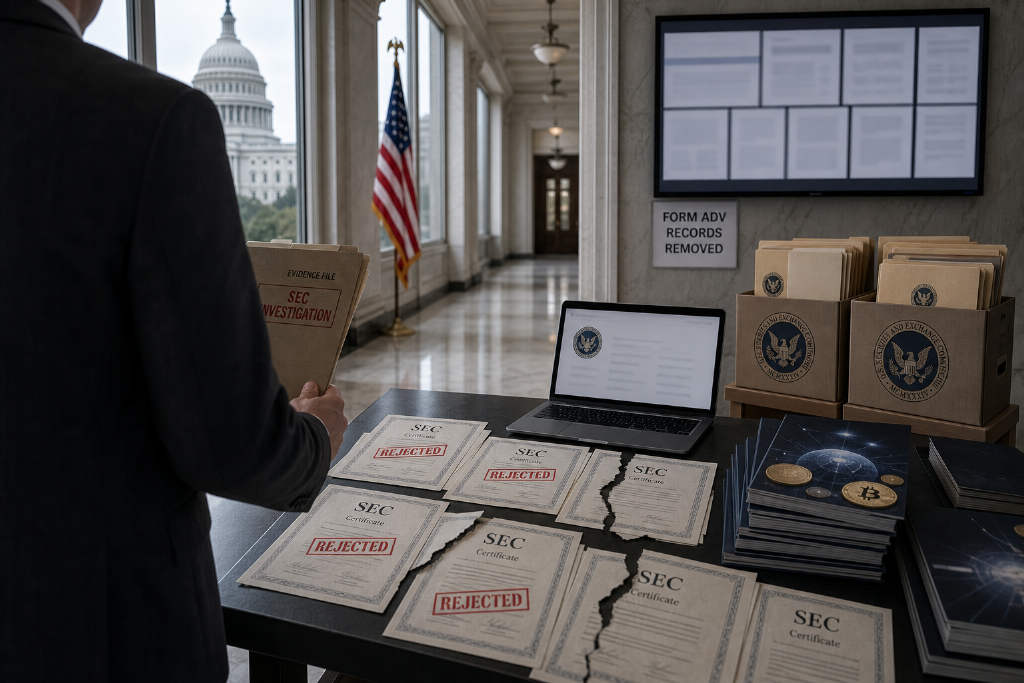
The U.S. Securities and Exchange Commission has asked a federal court to issue injunctions against several investment advisory firms tied to crypto promotions after they displayed fake SEC certificates. The agency named crypto operators including CryptoOrbit, Ftaexchange, Pinnacle, Quantum, and RBH, and said it filed 38 civil complaints over phony filings.
In a public statement posted on August 27, 2026, the SEC said 38 entities had feigned legitimacy as U.S. investment advisers through false filings in order to lure retail investors. The commission is seeking injunctions, civil penalties, and orders barring the defendants from using reporting-exemption privileges in future adviser filings.
SEC says firms claimed adviser status that did not exist
One example cited was Quantum Financial Institute, a crypto-focused operation that allegedly claimed a registered investment adviser status it never had. One of its press releases promoted what it called a "multi-dimensional intelligent investment system" and "courses" where students could learn about "bitcoin giveaways" and "the highest win-rate strategies, helping students understand the deep logic of the market." The SEC allegation says the firm also produced a fake SEC certificate to deceive customers.
Entities named as defendants in U.S. civil lawsuits include RBH Infinity Exchange Inc, Pinnacle Crypto Exchange Inc, THEVGPRO Ltd, Quantum Financial Institute Ltd, Ftaexchange Ltd, and other crypto businesses the agency described as problematic.
Claims center on false Form ADV statements and missing disclosures
The report says third-party promotional write-ups for some of these businesses falsely claimed valid SEC registration, using numbers that matched the enforcement action announced by the agency.
Pinnacle, for instance, marketed crypto swaps and said it was in good standing with U.S. regulators. THEVGPRO promoted a BTC-backed "settlement security fund, enhancing global liquidity and payment efficiency" while using registration numbers the SEC said it never approved.
The SEC accuses the entities of making materially false statements on Form ADV and failing to submit disclosures. Commissioners allege violations of Sections 204(a) and 207 of the Investment Advisers Act. The initial complaints do not quantify investor losses.
FINRA removed non-compliant forms
At the SEC’s direction, the Financial Industry Regulatory Authority, or FINRA, has already removed non-compliant forms for these advisers from adviserinfo.sec.gov.
SEC staff also tried to contact many of the crypto advisers making false claims. According to the report, several phone numbers were disconnected, while others belonged to unrelated businesses. Postal mail sent to listed addresses was returned as undeliverable.
Colorado claims, Hong Kong IP addresses, and access from China
Several unregistered investment advisers said they operated out of Colorado, yet the report says they consistently used Hong Kong IP addresses. Apexium Securities Ltd allegedly used Hong Kong connections while listing a Colorado office where it had no presence.
Web3 University, another unregistered crypto operator, allegedly accessed FINRA’s filing system from the People’s Republic of China. It also used a disconnected phone number and listed a Colorado Springs office that could not receive mail.
Other defendants promoted crypto services with false regulatory credentials
CryptoOrbit, another defendant sued by the SEC, also claimed to hold SEC certificates that had never been issued, according to the report.
A crypto-focused press release from Ftaexchange promoted digital asset trading and custody services while presenting a fake SEC-registered investment adviser status as if the firm were in good standing.
An RBH press release announced three crypto tokens tied to health and intellectual-property themes. The report says those tokens are now worthless. The same release urged readers to "invest in the future — act now."
Pinnacle Crypto Exchange also said it had completed SEC registration when it had not.
Absolutaris also named; consumer complaints cited
Absolutaris Base Limited was another defendant in the SEC action. The report says the Better Business Bureau logged consumer complaints about the service, including worthless stock signals, a fake trading app, and advertisements touting monthly returns of 20% to 60% that were obviously unsustainable.
So far, the SEC’s initial complaints have not put a number on investor losses.