
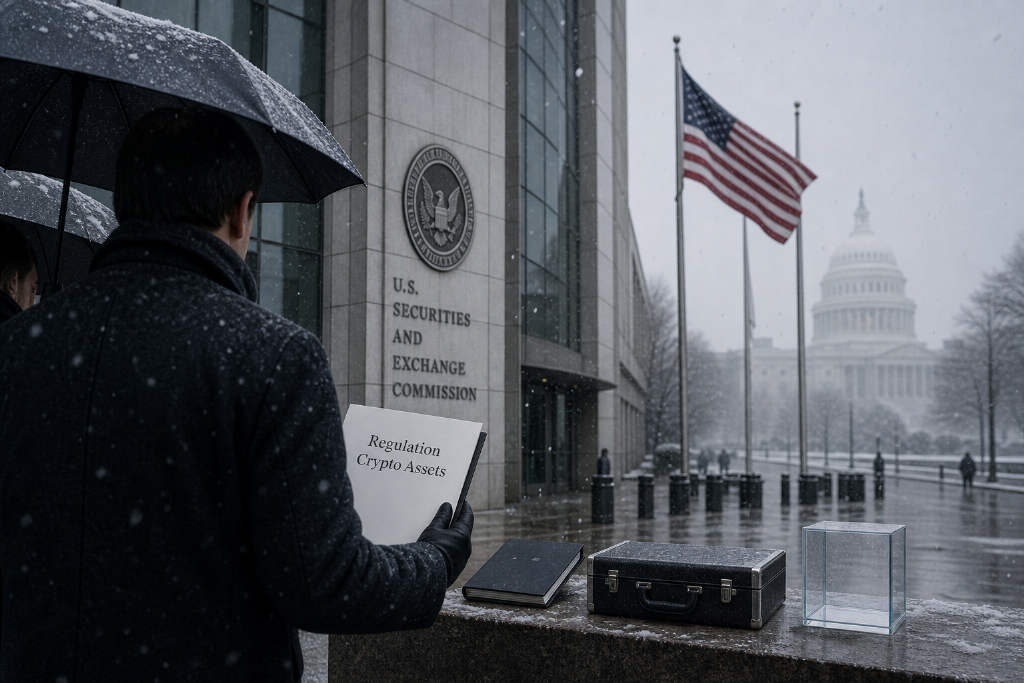
The U.S. Securities and Exchange Commission has published a proposal called Regulation Crypto Assets, setting out a rule-based answer to a basic question for the industry: how a crypto project can raise capital legally from the ground up, grow, and then move beyond securities regulation.
In the article, author Yan Meng says the document is not a broad statement of principles. Based on a review of the SEC datasheet, he describes it as a more concrete framework built around two exemptions and one safe harbor, covering early-stage funding, larger follow-on raises, and the point at which a token is no longer treated as an investment contract.
Two exemptions and a safe harbor form the core of the proposal
The first piece is a startup exemption. As summarized in the article, it would allow a project to raise up to $5 million over a four-year period. The design is meant to give teams a regulatory buffer while they complete the development work promised in their white paper.
The article says the exemption comes with several conditions: a four-year limit, one-time use, a $5 million cap, principle-based narrative disclosure on the project website, and a Form NOR filing with the SEC. It would not require financial statements, would permit public solicitation, would allow sales to retail investors, and would place no resale restrictions on the token. The issuer could be an individual or a team and would not necessarily need to be a registered entity.
The second piece is a fundraising exemption. It borrows from the Regulation A structure but modifies it for crypto offerings. It is split into two tiers: Tier 1 would permit up to $20 million in a 12-month period, while Tier 2 would permit up to $75 million in a 12-month period.
Under this route, the issuer would need to file Form 1-CRYPTO on EDGAR and disclose its financial condition and financial statements. Tier 2 would require an audit. In return, the project could access a larger fundraising ceiling, though it would also take on ongoing reporting obligations. The article notes that the two exemptions are not mutually exclusive. A project could begin with the startup exemption and later use the fundraising exemption to scale.
The third piece is the investment contract safe harbor, which the article describes as the endpoint of the system. Once a project has completed the core managerial efforts promised in its white paper, or has permanently abandoned those commitments and stopped making new ones, it could file Form TR with an accompanying analysis. The SEC would then recognize that the investment contract no longer exists, meaning the token itself would no longer be regulated as a security. At that point, the asset would have moved from a fundraising instrument to a freely circulating commodity.
The article’s argument: the proposal matters because it could reopen the pipeline for new crypto assets
Yan Meng places the proposal in a longer timeline. He writes that after the collapse of FTX in 2022, the crypto sector effectively lost its ability to incubate high-quality new assets. Most of the largest assets by market capitalization today, he says, were created before 2022. At the same time, regulatory uncertainty closed off practical compliant fundraising routes in the United States, leaving new projects to move offshore or give up on compliance.
The article argues that when an asset market stops producing new assets for a long period, older assets lose vitality as well. Liquidity dries up, narratives age, and new capital has fewer fresh destinations. It says the sector spent part of the period after 2023 trying to avoid the challenge of creating new assets by layering new mechanics onto older ones, but adds that the bear market running from late 2025 to the present has, in the author’s view, rejected that approach.
From there, the article makes a broader point: if crypto cannot create native assets that are more compelling and more dynamic than stocks, then older crypto-native assets such as Bitcoin and Ethereum will also gradually weaken. It frames the SEC proposal and the Clarity bill as complementary responses to that problem. One addresses capital formation; the other addresses market structure. Together, in the author’s reading, they point toward reopening a full path for incubating new assets from zero to one.
Industry backdrop: questions over crypto’s ability to create native assets
The article adds what it calls a colder backdrop. It says the industry is moving through a major filter, with market participants widely expecting that more than 95% of projects will ultimately go to zero. At the same time, real-world assets, or RWA, have quietly become a main driver of growth in on-chain trading.
For the author, that trend reflects an uncomfortable reality: the sector is conceding that its ability to create high-quality native assets has dried up, and is instead leaning on traditional assets through tokenized and leveraged extensions. He argues that this should not define crypto’s long-term role, because it does not fully use the technological and economic strengths that crypto and tokenomics are supposed to offer. In that framing, tokenization should not be reduced to putting a blockchain wrapper around real-world assets.
The article says this is the deeper reason the SEC proposal deserves attention. At minimum, it reopens the door at the institutional level. If that route works, the author says, future projects in fields such as AI and robotics could launch through crypto structures, establish themselves under a regulatory framework, complete asset creation, and then expand on platforms such as Coinbase, Binance, and OKX once the assets have reached a sufficient baseline quality. He adds that this could raise the industry’s level of standardization and reduce fraud, though not necessarily speculation.
A hypothetical startup path under the proposed rules
To show how the framework might work in practice, the article walks through a hypothetical startup called Xyz.
At stage zero, the team would first need to post principle-based white paper-style disclosure on its website, and that would have to happen before any token distribution.
If Xyz chose the startup exemption, it would file Form NOR and commit to completing its promised development work within four years, with total fundraising capped at $5 million. The article says airdrops, staking rewards, and testing fees would all count toward that limit. No financial statements would be required. The company could publicly solicit funds, sell to retail participants, and issue tokens with no resale restrictions. But the route could be used only once, and Form TR would need to be filed when the four-year period ends.
If Xyz needed more capital, or wanted to skip the seed-style stage and move directly to a larger raise, it could use the fundraising exemption instead. In that case it would file Form 1-CRYPTO and choose either the $20 million Tier 1 cap or the $75 million Tier 2 cap. Tier 2 would require audited financial statements. Before raising, the project could also test the waters to gauge investor interest.
The article says the routes can be combined in sequence: a project could start with the startup exemption, then move to the fundraising exemption after the product has been proven out.
The end state would be the safe harbor. Once Xyz had completed its promised development work, or had actively and permanently abandoned its commitment to continue, it could file Form TR with an analysis. The SEC could then determine that the investment contract had ceased to exist. At that point, the token would become a standard non-security crypto asset and would no longer need registration or ongoing reporting. The article also says secondary trading would be exempt from state securities registration requirements because of the definition of qualified purchasers.
What happens next may depend in part on the Clarity bill
The article closes with an update on the Clarity bill. It says the bill cleared a procedural vote in early August to move into the legislative process, but the final floor vote was delayed until mid-September, leaving its outcome uncertain.
If Clarity passes, the author says, it would establish a spot-market regulatory framework for mature digital commodities at the Commodity Futures Trading Commission, or CFTC, and would sit alongside the SEC proposal as a division of labor. In that arrangement, the SEC rules would cover a token’s path from launch and fundraising to the end of its securities status, while Clarity would govern how mature tokens trade on regulated venues. The two would work as a relay rather than an overlap.
If the bill remains stalled, the article says projects could still use the SEC proposal to raise capital and eventually enter the safe harbor. But the question of who regulates secondary markets and trading venues would remain in a gray area.
