
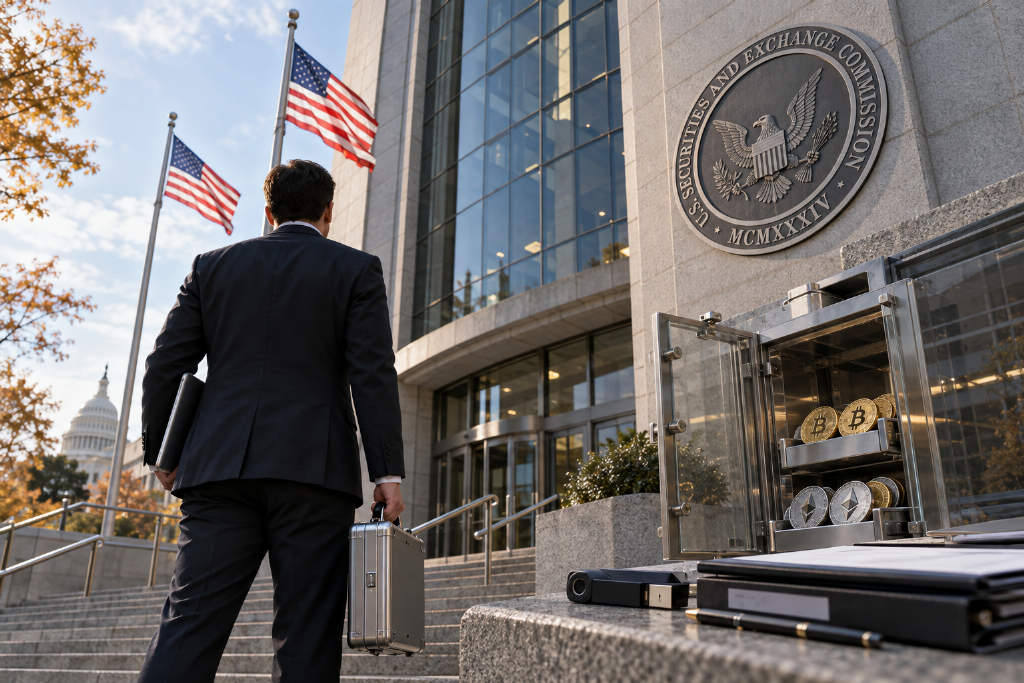
The U.S. Securities and Exchange Commission on Oct. 1 proposed a new crypto asset custody rule that would create a clearer compliance framework for registered investment advisers, regulated funds and business development companies, while allowing self-custody in certain cases.
According to the SEC’s latest figures, regulatory assets under management reported by investment advisers reached about $177 trillion in 2025, up 21% from the previous year. That puts the proposal in front of one of the largest asset-management markets in the world.
A first tailored crypto custody framework for a $177 trillion market
SEC Chair Paul Atkins said that since Bitcoin was created in 2008, the crypto market has grown from a niche asset class into a market worth trillions of dollars, while U.S. custody rules have remained rooted mainly in the structure of traditional securities markets and have not kept up with digital assets.
The proposal is designed to establish a custody regime specifically for crypto assets used by investment advisers, registered investment companies and business development companies, or BDCs. Atkins said the rule would provide advisers and funds with a "compliant pathway" that did not previously exist.
The SEC has only issued a proposed rule. It has not broadly authorized funds to hold Bitcoin on their own, and any self-custody option would be available only under specific conditions. The final rule could still change after public consultation.
Limited self-custody is the proposal’s biggest shift
Under current practice, investment advisers generally must place client assets with a qualified custodian, such as a bank, broker-dealer or another eligible financial institution.
Crypto markets present a separate problem. Some newly issued tokens or on-chain assets may not have a qualified custodian willing or able to hold them. SEC Commissioner Hester Peirce said in explaining the proposal that the current system has left some advisers facing a situation with "no clear rules" and no workable custodian.
The new proposal would allow an adviser or fund to custody the relevant crypto assets itself, subject to conditions, when no appropriate qualified or permitted custodian is available. In practical terms, that means regulated asset managers may not have to abandon certain on-chain investment opportunities solely because the market lacks an eligible custodian.
Still, the SEC’s use of self-custody does not mean a fund manager can simply put client Bitcoin on a Ledger or another cold wallet. The proposal places the legal custody responsibility on the adviser or the fund itself, and institutions would still need to meet added requirements on cybersecurity, internal controls, reporting and asset protection.
Peirce also said advisers would need to determine first that no other suitable permitted custodian is available, and they would have to keep reassessing that conclusion over time. The proposal does not remove custody restrictions across the board. It adds a narrow self-custody route alongside the existing third-party custody structure.
Why Bitcoin is drawing the most attention
Bitcoin remains the largest crypto asset held by institutions, so any SEC change to custody rules is likely to be read by the market as a reduction in the barriers for Wall Street firms to hold BTC directly.
Legally, though, the proposal is focused on how advisers and regulated funds custody crypto assets. Whether a specific asset falls under custody requirements in the Investment Advisers Act or the Investment Company Act still depends on its legal classification and the structure of the fund involved.
Even so, the SEC is moving to lower operational and regulatory barriers for supervised investment institutions that want to hold crypto directly, and Bitcoin is likely to be one of the assets most closely watched by the market.
The proposal also broadens third-party custodian options
Another major change in the proposal is an expanded list of potential third-party custodians for crypto assets. The SEC plans to allow eligible state-chartered trust companies to act as crypto custodians.
That could reduce the market’s dependence on large banks and broker-dealers and open the door to more regulated trust firms that specialize in digital assets.
For large asset managers, that may matter more than the self-custody provision itself. In many cases, the preferred model is not to control every private key internally, but to have a wider selection of regulated crypto custodians with the technical ability to safeguard digital assets.
From spot ETFs to direct holdings, Wall Street faces the next hurdle
In recent years, the clearest breakthrough for institutions entering the Bitcoin market has been the spot Bitcoin ETF. ETFs solved one problem by letting investors gain Bitcoin price exposure through traditional brokerage accounts without managing wallets or private keys themselves.
That does not cover every use case for fund managers and advisers. Some strategies may require direct holdings of Bitcoin, Ethereum, staked assets, on-chain tokens, or participation in decentralized finance, or DeFi, and other native on-chain activity. At that point, the issue is no longer whether institutions can buy crypto, but how they can hold it legally after purchase.
This SEC proposal is aimed at that second-stage problem.
The SEC’s $177 trillion figure covers all assets reported by investment advisers, including stocks, bonds, funds, private assets and other investment products. If that industry gets a clearer and more workable crypto custody regime, even a small allocation to crypto could carry meaningful implications for a market that is still measured in the trillions of dollars.
Investor-protection concerns remain
Self-custody also brings more responsibility. In the traditional model, a fund hands assets to a third-party custodian, keeping custody separate from investment management. If an adviser holds crypto itself, the investment decision-maker also becomes the asset custodian.
That raises risks tied to cybersecurity, private-key management, internal access controls, asset misuse and operations.
Investor-protection group Better Markets criticized the SEC proposal, saying it could weaken the separation between investment management and asset custody and increase the risk that client assets are lost, stolen or misused.
Supporters of the proposal argue that a total ban on self-custody would, in cases where no qualified third-party custodian exists, effectively bar funds from investing in some on-chain assets.